A forecast is one lookup
Every annual animal forecast is generated from one lookup: your birth branch and the year branch, placed side by side. The sign names, the paragraph you read and the advice at the end are all downstream of that pair.
Each branch has exactly one partner in each of the four classical relations, so the pair determines the answer completely. There are twelve birth branches and twelve years, which sounds like 144 combinations; because the relations are fixed pairs, there are really only twelve kinds of answer, and every one of them repeats on a twelve-year cycle.
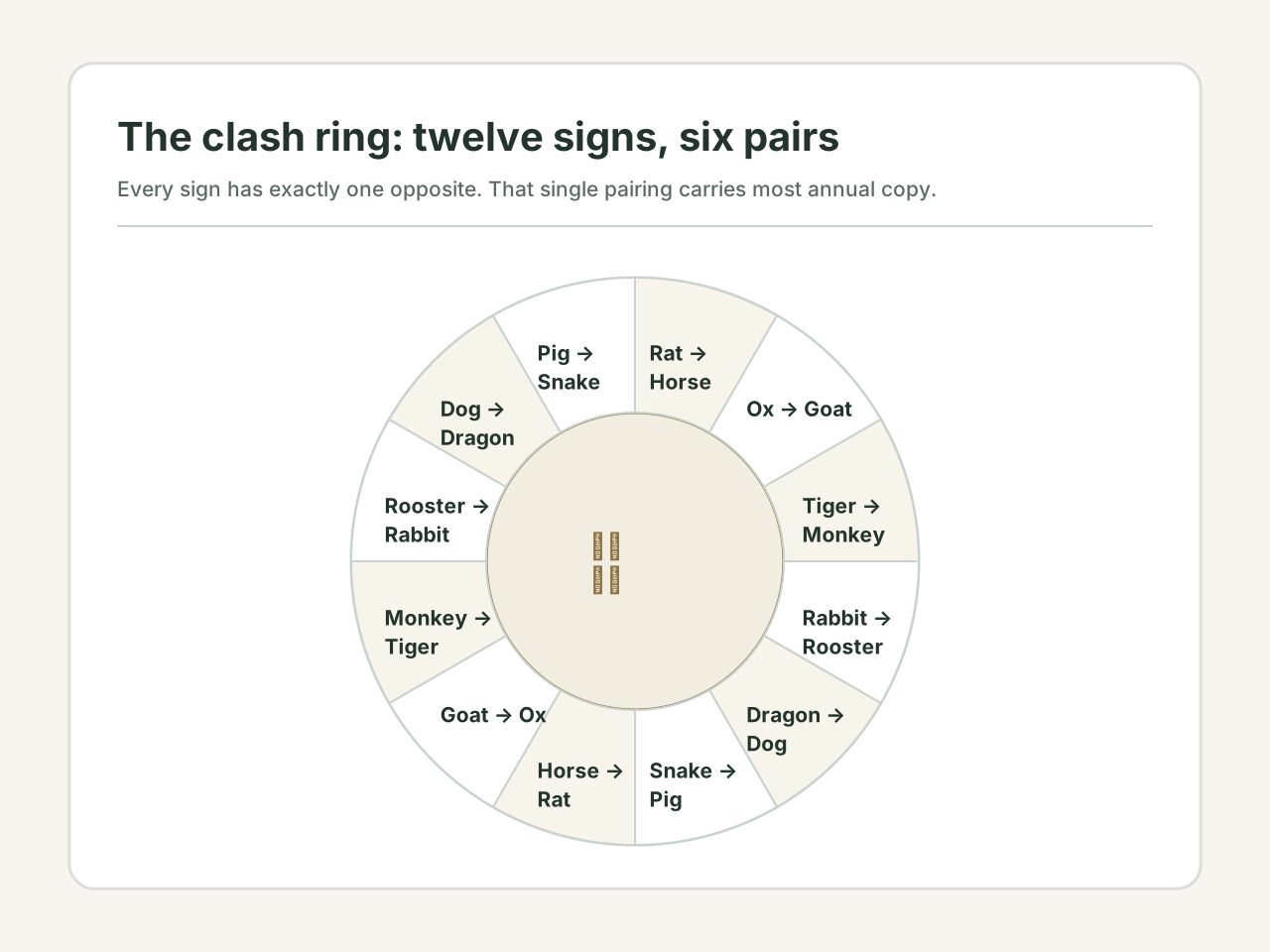
Take 2026, a bing-wu year. If you were born in a zi year, a Rat, the distance to wu is six: the two branches sit directly opposite each other. That single fact is what makes 2026 a clash year for Rats, and a different label for every other sign.
The relations are fixed pairs, not judgements
The twelve branches are connected by four classical relations: chong (clash), liuhe (six-combination), hai (harm) and po (destruction). None of them is a judgement about a person. Each is a fixed pairing in a table, and the table does not change with the year, the person or the century.
Read a row across, find the year branch in it, and the column it sits in is the label for that year. There is no second lookup and no weighting: the pair picks the cell, and the cell supplies the sentence.
| Birth branch | Clash (chong) | Combination (liuhe) | Harm (hai) | Destruction (po) |
|---|---|---|---|---|
| zi (Rat) | wu (Horse) | chou (Ox) | wei (Goat) | you (Rooster) |
| chou (Ox) | wei (Goat) | zi (Rat) | wu (Horse) | chen (Dragon) |
| yin (Tiger) | shen (Monkey) | hai (Pig) | si (Snake) | hai (Pig) |
| mao (Rabbit) | you (Rooster) | xu (Dog) | chen (Dragon) | wu (Horse) |
| chen (Dragon) | xu (Dog) | you (Rooster) | mao (Rabbit) | chou (Ox) |
| si (Snake) | hai (Pig) | shen (Monkey) | yin (Tiger) | shen (Monkey) |
| wu (Horse) | zi (Rat) | wei (Goat) | chou (Ox) | mao (Rabbit) |
| wei (Goat) | chou (Ox) | wu (Horse) | zi (Rat) | xu (Dog) |
| shen (Monkey) | yin (Tiger) | si (Snake) | hai (Pig) | si (Snake) |
| you (Rooster) | mao (Rabbit) | chen (Dragon) | xu (Dog) | zi (Rat) |
| xu (Dog) | chen (Dragon) | mao (Rabbit) | you (Rooster) | wei (Goat) |
| hai (Pig) | si (Snake) | yin (Tiger) | shen (Monkey) | yin (Tiger) |
Two pairs are both at once
Look down the combination and destruction columns together and two rows stand out. Yin and hai are each other’s combination and each other’s destruction; so are si and shen. A Tiger in a Pig year is therefore combined and broken at the same time, and a reading that quotes only one half of that has chosen which half to mention.
This is not a paradox the tradition overlooked. It is a property of the table, and it is the clearest evidence that the four relations were assembled as separate schemes rather than derived from one principle. A system built from a single rule would not produce the same pair in two columns.
For a reader, the practical consequence is narrow but useful: when a year is described as either very good or very bad for a sign, check whether that sign sits in one of these doubled pairs. If it does, the description is a selection.
Punishment does not come in pairs
Xing (punishment) is built differently. It arrives in triads — yin, si and shen; chou, xu and wei — plus the single pair zi and mao, plus four branches that punish themselves: chen, wu, you and hai.
That asymmetry matters when someone counts how many signs a year affects. In 2026 the Horse is both the year’s own branch and a self-punishing branch, so it carries two labels while occupying one place in the table. The count is by sign, not by label, and it changes shape from year to year.
The classical literature treats punishment as friction inside a group: the triad is a set of three that cannot settle. That is a description of a relationship pattern rather than an event, which is why punishment readings tend to be about disputes, procedures and delays.
The same paragraph every twelve years
Work the schedule for a Rat. The wu years fall at ages six, eighteen, thirty and forty-two; the zi years at twelve, twenty-four and thirty-six. The clash reading and the own-sign reading therefore alternate on a twelve-year beat for the whole of a life.
The paragraph attached to a Rat in a Horse year does not change between those years. It cannot: it was generated from the offset, and the offset at six is identical to the offset at forty-two.
This is the structural limit, and it is worth stating plainly. A forecast keyed to one number cannot distinguish 1990 from 2002 from 2014, because nothing about the year enters the calculation except its branch. Whatever else was true of those three years, the animal-sign reading of them is the same sentence.
One in twelve people are reading it with you
About one person in twelve shares your birth branch. In a population of 1.4 billion that is more than a hundred million people reading the same paragraph in the same week, and it will feel accurate to a large share of them.
The American Psychological Association’s entry on the Barnum effect describes why. Descriptions broad enough to fit almost anyone are accepted as accurate self-report when they are framed positively and presented as a personal assessment, and the effect is strongest when the reader has no way to check the claim.
So the sense that the forecast got you is real, and it is not evidence about the year. It is evidence that the sentence was written to fit.
What the other seven characters add
A BaZi chart is eight characters: year, month, day and hour, each with a stem and a branch. The birth-year branch is one of the eight. The month branch, the day stem and the hour carry the rest.
Two people born in the same year can have entirely different day stems, and the day stem is what the ten gods are read from. That is why a full chart can say something specific about a person while an animal-sign forecast cannot.
A practical way to use the annual note without overreading it: look up the year branch, then compare it with your day branch as well as your birth branch. Where the two comparisons disagree, the twelve-sign model has run out — and that is exactly the point at which the rest of the chart would have to be read.
Disclaimer: This content is for informational and cultural reference purposes only. It does not constitute professional medical, legal, financial, or psychological advice. Readers should exercise their own judgment and consult qualified professionals for specific concerns.
Sources and review basis
Traditional references explain historical vocabulary and context. Official practical sources support only the observable safety, comfort, or environmental points noted in the article; they do not validate metaphysical claims.
Traditional reference
Sanming Tonghui (三命通会)Wikisource digital text · Accessed 2026-07-14
A historical compilation used to cross-check traditional BaZi concepts; it is not scientific validation.
Practical source
APA Dictionary of Psychology: Barnum effectAmerican Psychological Association · Accessed 2026-07-14
A psychology reference for why broad, favourable personality descriptions can feel personally accurate. It does not evaluate BaZi calculations themselves.