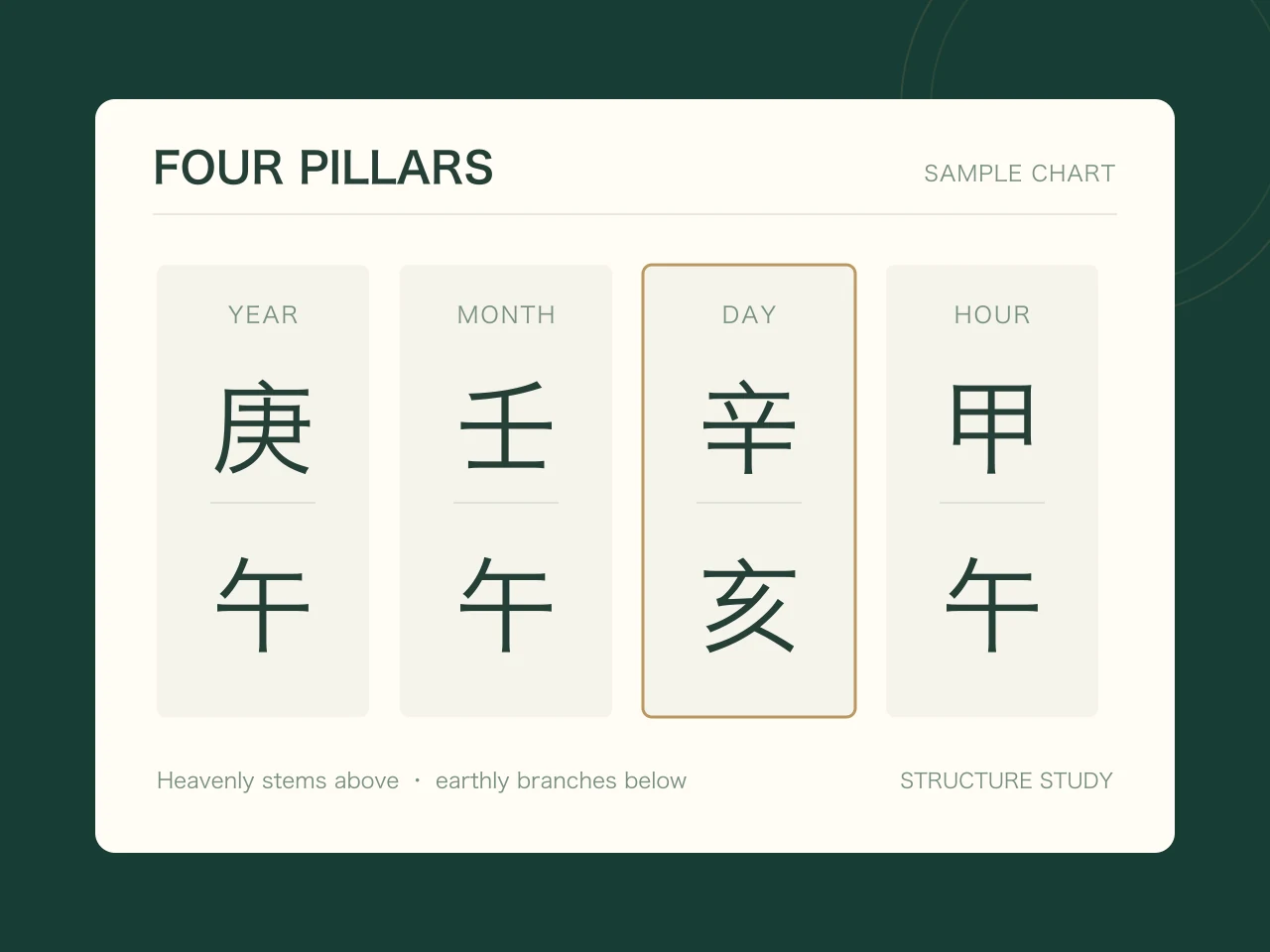
Each branch has exactly one partner in every relation
The branch relations are not a mood. They are fixed pairings on the twelve-branch ring, and every branch has exactly one partner in each: one branch six places away that clashes with it, one it combines with, one it harms. The tables below are the whole set — no seventh clash, no branch without a partner.
The group relations are separate lists. Four 三合 groups each produce one element (申子辰 water, 亥卯未 wood, 寅午戌 fire, 巳酉丑 metal); four 三会 groups follow the compass (寅卯辰 east, 巳午未 south, 申酉戌 west, 亥子丑 north); and 刑 arrives as two three-branch sets (寅巳申, 丑戌未), one pair (子卯) and four self-punishments (辰辰, 午午, 酉酉, 亥亥).
| Branch | Clashes with | Combines with | Harms |
|---|---|---|---|
| 子 | 午 | 丑 | 未 |
| 丑 | 未 | 子 | 午 |
| 寅 | 申 | 亥 | 巳 |
| 卯 | 酉 | 戌 | 辰 |
| 辰 | 戌 | 酉 | 卯 |
| 巳 | 亥 | 申 | 寅 |
Four pillars give six pairs, and only three of them touch
Four branches pair six ways. Three pairs sit next to each other — year with month, month with day, day with hour — and three are separated by at least one pillar: year with day, year with hour, month with hour.
Adjacency is not a matter of taste. The month branch is the season and the day branch is the seat of the day master, so a relation between them links the chart's climate to its owner. The hour is what the chart produces, which puts day-hour next. Year and hour sit at the two ends and touch nothing between them.
The base rate makes the point. Across every day from 1950 to 2049 at all twelve double-hours — 438,300 charts — a year-month clash occurs in 8.33% of them: exactly one in twelve, because the month branch can be any of twelve and only one clashes with it. A year-month clash is a property of the calendar before it is a property of a person.
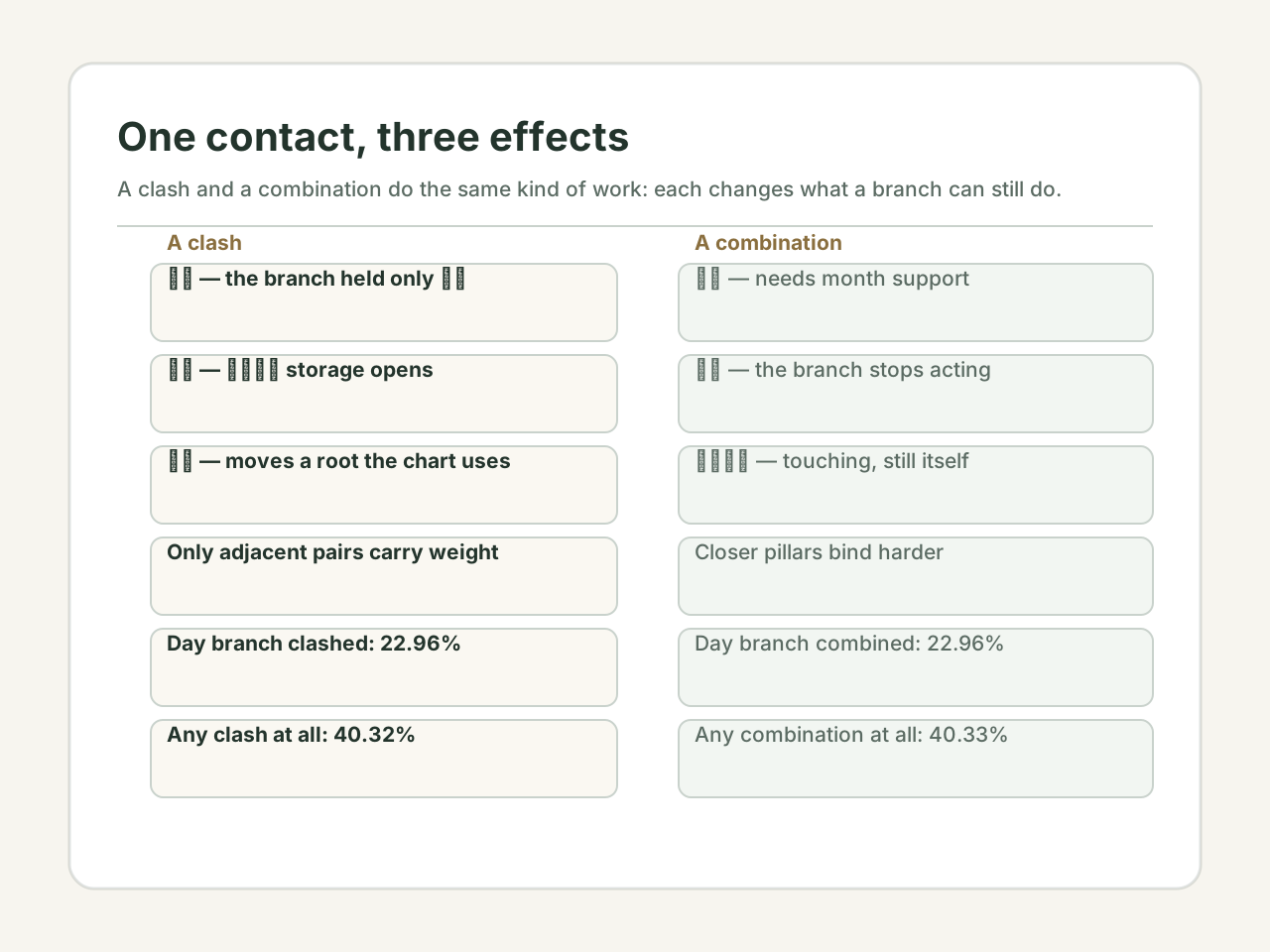
A clash removes something, opens something, or moves something
Once you know which two branches are in contact, the next question is what the contact does to the branch. There are three answers and they are not interchangeable.
It removes. A branch holding only 中气 or 余气, with nothing rooting it, loses a signal that was never load-bearing. The 十神 sitting there loses its platform; there was not much of one.
It opens. 辰, 戌, 丑 and 未 are 墓库, storehouses, and a clash is the standard way to open one. An opened 财库 is a familiar phrase in the classical material, which leaves out that a storehouse holds everything put into it: opening releases the whole contents, including the parts nobody asked for.
It moves. If the branch is where the day master has a root, or holds the element the chart relies on, the clash moves it. Movement is neutral in itself; the question is whether the chart wanted that piece to stay put.
A combination binds far more often than it transforms
合化 — a combination that actually turns both branches into the resulting element — has conditions: the month must support the element produced, neither partner can be clashed at the same time, and the result must be something the chart can use. Charts meeting all three are uncommon, which is why the handbooks dwell on the exceptions.
The ordinary outcome is 合绊: the branch stops acting. It is still there, still holding what it holds, but it no longer participates. Applied to a branch the chart needs, a combination subtracts. That is what gets lost when 合 is filed under good and 冲 under bad — the same 合 that ties up an obstacle also ties up a support.
In between sits 合而不化: attached, still itself. Most combinations in real charts land here, and the accurate description is that two branches are touching and nothing more.
Both on one branch, and how often either happens
The counts below come from the same 438,300 charts. Each row is a share of the total, so they do not add up: one chart can carry several relations.
The first three rows match to two decimal places, and the reason is structural rather than interesting. Every branch has one clash partner, one combination partner and one harm partner, so any pair of positions has the same 1-in-12 chance of carrying any of the three. Four charts in ten therefore contain a clash: not a finding, a default.
Fourteen percent have none of the three. A method that produces a dramatic finding in every chart is producing it in the reader.
| What is present | Share of 438,300 charts |
|---|---|
| At least one clash | 40.32% |
| At least one combination | 40.33% |
| At least one harm | 40.32% |
| A complete 三合 group | 4.85% |
| A complete 三刑 set | 2.44% |
| A self-punishment | 14.67% |
| Day branch clashed by another branch | 22.96% |
| Day branch clashed and combined at once | 3.81% |
| No clash, combination or harm at all | 14.43% |
One day, two hours, two different relation sets
Both charts below are the same date and differ only in the hour. The day master is 癸 water in both.
At 08:30 the day branch 酉 is clashed by the month branch 卯 and combined by the hour branch 辰 — both adjacent, both competing for the same branch. 卯 holds 乙, 食神 for a 癸 day master; 酉 holds 辛, 偏印. The clash is 食神 against 偏印, the shape the manuals call 枭神夺食. The hour's 辰 holds 戊, a 正官, so the combination ties the 偏印 to the officer while the 食神 faces a clash nothing is absorbing.
At 12:30 nothing combines with 酉 and the clash stands alone. The hour stem 戊 does combine with the day stem 癸, so the day master itself is bound by a 正官 instead.
Same date, four hours apart, two relation sets. Nothing about the person changed; the hour did. A reading that announces someone's clash problem without naming the hour has described a condition half of that day does not have.
| 08:30 | 12:30 | |
|---|---|---|
| Year | 庚午 | 庚午 |
| Month | 己卯 | 己卯 |
| Day | 癸酉 | 癸酉 |
| Hour | 丙辰 | 戊午 |
Five checks before calling a clash a problem
The order matters, because the first check removes most of the cases the later ones would only complicate.
- Adjacent or not. Drop year-hour and month-hour relations first. If the only clash in a chart spans the two ends, there is usually nothing to read.
- What each branch holds. Name the hidden stems and the 十神 before naming the relation. 卯酉 is 食神 against 偏印 in one chart and 正财 against 劫财 in another; the word clash describes neither.
- Whether either branch is a 库. A clash between 辰 and 戌 opens two storehouses. That is a different event from 子 against 午.
- Whether the chart needs either branch. If neither is the element the chart is relying on, the clash is between two things it does not use.
- Whether the answer survives a different hour. If the reading changes when the hour changes, the reading was about the hour.
What the relation actually reports
A relation reports contact. Two branches are in a fixed relationship, and the relationship does something to them — removes one, opens one, moves one, ties one down. Which of those depends on what the branches carry, how close they sit, and whether the chart was using them.
Those are three questions with answers you can check by hand, and none of them is answered by the word clash. The word is where the reading starts, not where it ends.
Disclaimer: This content is for informational and cultural reference purposes only. It does not constitute professional medical, legal, financial, or psychological advice. Readers should exercise their own judgment and consult qualified professionals for specific concerns.
Sources and review basis
Traditional references explain historical vocabulary and context. Official practical sources support only the observable safety, comfort, or environmental points noted in the article; they do not validate metaphysical claims.
Traditional reference
Yuanhai Ziping (渊海子平)Wikisource digital text · Accessed 2026-07-14
A classical source for Four Pillars terminology, element relationships, and the Day Master framework.
Traditional reference
Sanming Tonghui (三命通会)Wikisource digital text · Accessed 2026-07-14
A historical compilation used to cross-check traditional BaZi concepts; it is not scientific validation.
Practical source
APA Dictionary of Psychology: Barnum effectAmerican Psychological Association · Accessed 2026-07-14
A psychology reference for why broad, favourable personality descriptions can feel personally accurate. It does not evaluate BaZi calculations themselves.