Ten stems into twelve branches does not divide
The sexagenary cycle pairs ten heavenly stems with twelve earthly branches, sixty pairs in all, and every tenth pair opens with a 甲 stem. Ten into twelve does not divide, so each block of ten uses only ten of the branches and leaves two unused. Those two are the block's void branches — kong wang (空亡), also called xun kong (旬空), the emptiness of the decade.
The six blocks run in a fixed order:
| Decade | Pairs in the block | Void branches |
|---|---|---|
| 甲子旬 | 甲子 to 癸酉 | 戌 亥 |
| 甲戌旬 | 甲戌 to 癸未 | 申 酉 |
| 甲申旬 | 甲申 to 癸巳 | 午 未 |
| 甲午旬 | 甲午 to 癸卯 | 辰 巳 |
| 甲辰旬 | 甲辰 to 癸丑 | 寅 卯 |
| 甲寅旬 | 甲寅 to 癸亥 | 子 丑 |
Which pillar you count from changes the answer
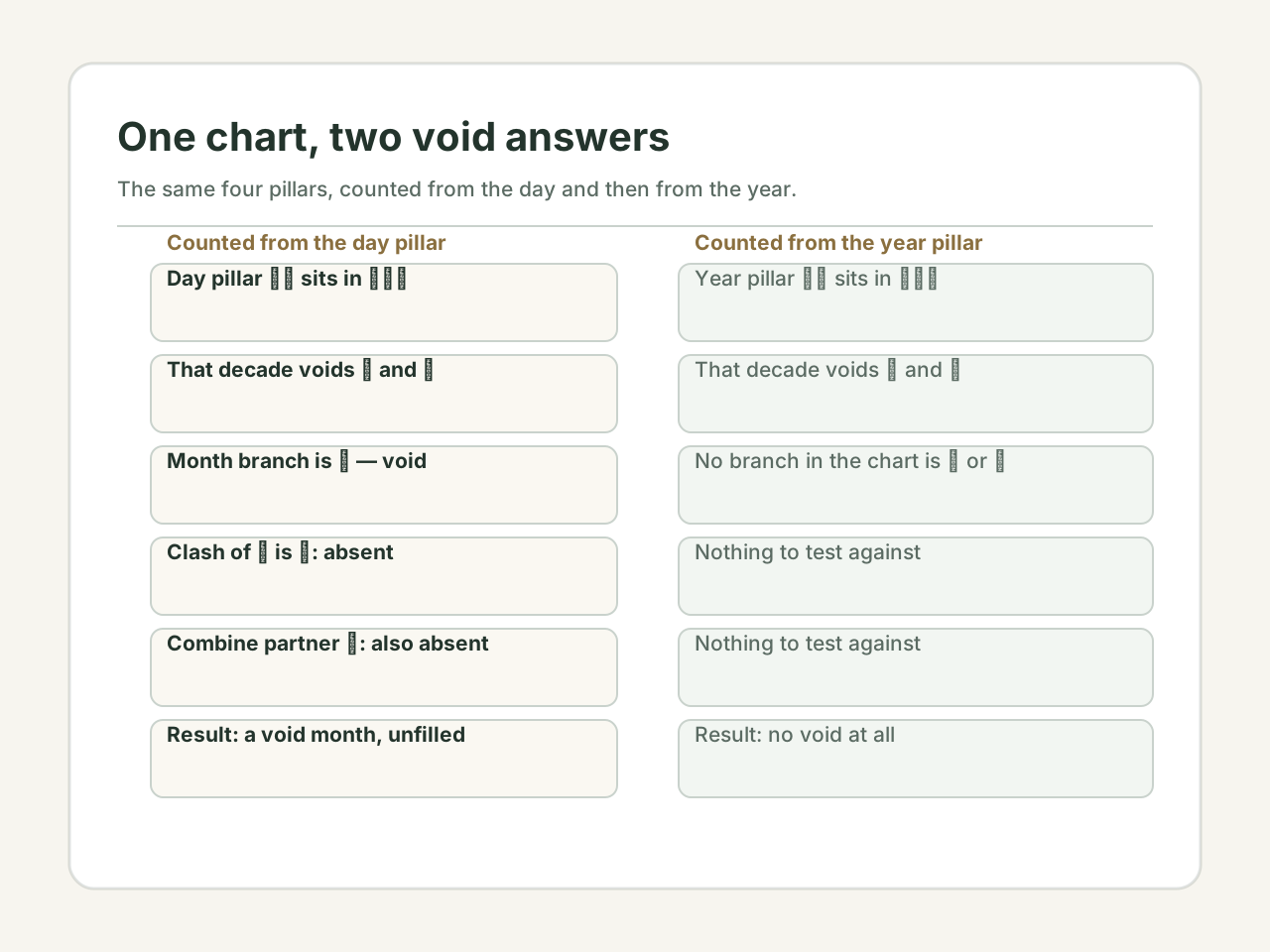
A birth on 14 June 1985 at 09:20 in a UTC+8 city gives four pillars: 乙丑 year, 壬午 month, 甲申 day, 己巳 hour. The day pillar 甲申 belongs to the 甲申 decade, whose void branches are 午 and 未. The month branch is 午. Count from the day pillar and this chart has a void month.
Count from the year instead and the result inverts. 乙丑 belongs to the 甲子 decade, whose void branches are 戌 and 亥, and neither 戌 nor 亥 appears anywhere in the chart. One method reports a void month; the other reports no void at all, from identical birth data.
Neither result is a bug. They answer different questions: what is missing from the day's decade, versus what is missing from the year's. Day-pillar counting is the commoner modern convention; year-pillar counting survives in older material and in software that prints a void column beside every pillar. That is usually why two calculators disagree about your void branches.
Two in five charts carry one
Each chart offers three branches to test — year, month, hour — and each has a 2-in-12 chance of landing on one of the two void branches. Sampling 26,880 charts, every day from 1990 to 2009 at four times of day, 42.4% carried at least one void branch. Per pillar the rate came out between 16.5% and 16.9%, against the 16.7% the arithmetic predicts.
A marker that turns up in two of every five charts is not a diagnosis of a rare condition.
Three readings of one word
Classical texts agree on the arithmetic and disagree about what follows. Three positions are in circulation:
- Reduced — the branch's function is present but thin, so the matter it governs is weaker than the rest of the chart implies.
- Delayed — the function arrives late, once the voiding decade has passed or when a luck pillar brings that branch in.
- Not literal — the branch marks a channel the matter does not travel through, rather than its absence.
The fill rules do most of the practical work
A clash fills the void (冲空), and the branch arriving later in a luck or annual pillar fills it too (填实). Some schools add that a void branch another branch combines is released. The schools do not agree on whether filling removes the label or only suspends it, so a reading that presents one as settled is presenting a preference — but these rules are at least checkable against the chart.
A four-step check
Applied to the 1985 chart, the steps take about a minute:
- Count from the day pillar, and say which pillar you counted from. If a second method gives a different pair, name both rather than picking one silently.
- Name what sits on the void branch. Here 午 hides 丁 (hurting officer) and 己 (direct wealth), so the void falls on the branch carrying those two.
- Check whether anything fills it. Nothing does here: the clash of 午 is 子, absent, and the combine partner 未 is absent too.
- Discount one channel, not the person. A void on the month branch lowers confidence in statements about the month's territory — season, career frame, parents — and leaves the year and hour alone.
What the example actually supports
The chart carries a stronger structural feature than the void. 巳 and 申 combine (六合) and also break (破); 丑 and 午 harm each other (害). A reading that opens with 'your month branch is void' opens with the least informative item on the board.
What holds regardless of kong wang: the month branch is 午, fixed by the solar term and not by any void rule; the day master 甲 is wood in a fire month, out of season; the only water among eight characters is the 壬 on the month stem. Those three judgements are what a reading should rest on, and the void only tells you how loosely to hold the second of them.
Where the label should stop
Kong wang does not predict illness, bankruptcy, childlessness, or a date. It is a statement about pairing inside a sixty-term cycle, and every step from that arithmetic to a life event is interpretation. The defensible version is dull: note which branch is void, note whether anything fills it, lower confidence on that one channel by an amount you can explain.
A reading that uses void to create urgency — a ritual to fill the emptiness, an object to close it — has moved from calculation to sales. The arithmetic is worth knowing because it can be checked. The dread attached to it cannot.
Disclaimer: This content is for informational and cultural reference purposes only. It does not constitute professional medical, legal, financial, or psychological advice. Readers should exercise their own judgment and consult qualified professionals for specific concerns.
Sources and review basis
Traditional references explain historical vocabulary and context. Official practical sources support only the observable safety, comfort, or environmental points noted in the article; they do not validate metaphysical claims.
Traditional reference
Yuanhai Ziping (渊海子平)Wikisource digital text · Accessed 2026-07-14
A classical source for Four Pillars terminology, element relationships, and the Day Master framework.
Traditional reference
Sanming Tonghui (三命通会)Wikisource digital text · Accessed 2026-07-14
A historical compilation used to cross-check traditional BaZi concepts; it is not scientific validation.
Practical source
APA Dictionary of Psychology: Barnum effectAmerican Psychological Association · Accessed 2026-07-14
A psychology reference for why broad, favourable personality descriptions can feel personally accurate. It does not evaluate BaZi calculations themselves.