The useful question is which conclusions survive, not how accurate the reading is
People who do not know their birth hour ask for a number: is the reading still eighty percent right? There is no such number, and anyone quoting one is guessing. The workable version of the question is narrower — sort conclusions into those the birth date fixes and those that hang on the hour, then report the second group as a range instead of picking a value for it.
This is about a missing hour, not a wrong one. A recorded time that needs converting — zone, China’s 1986–1991 summer time, true solar time, the 23:00 boundary — is a different problem.
The example running through the piece: a birth on 8 March 1994 with no recorded hour. Three pillars 甲戌, 丁卯, 癸巳.
Two of eight characters go missing, and with them every relation the hour touches
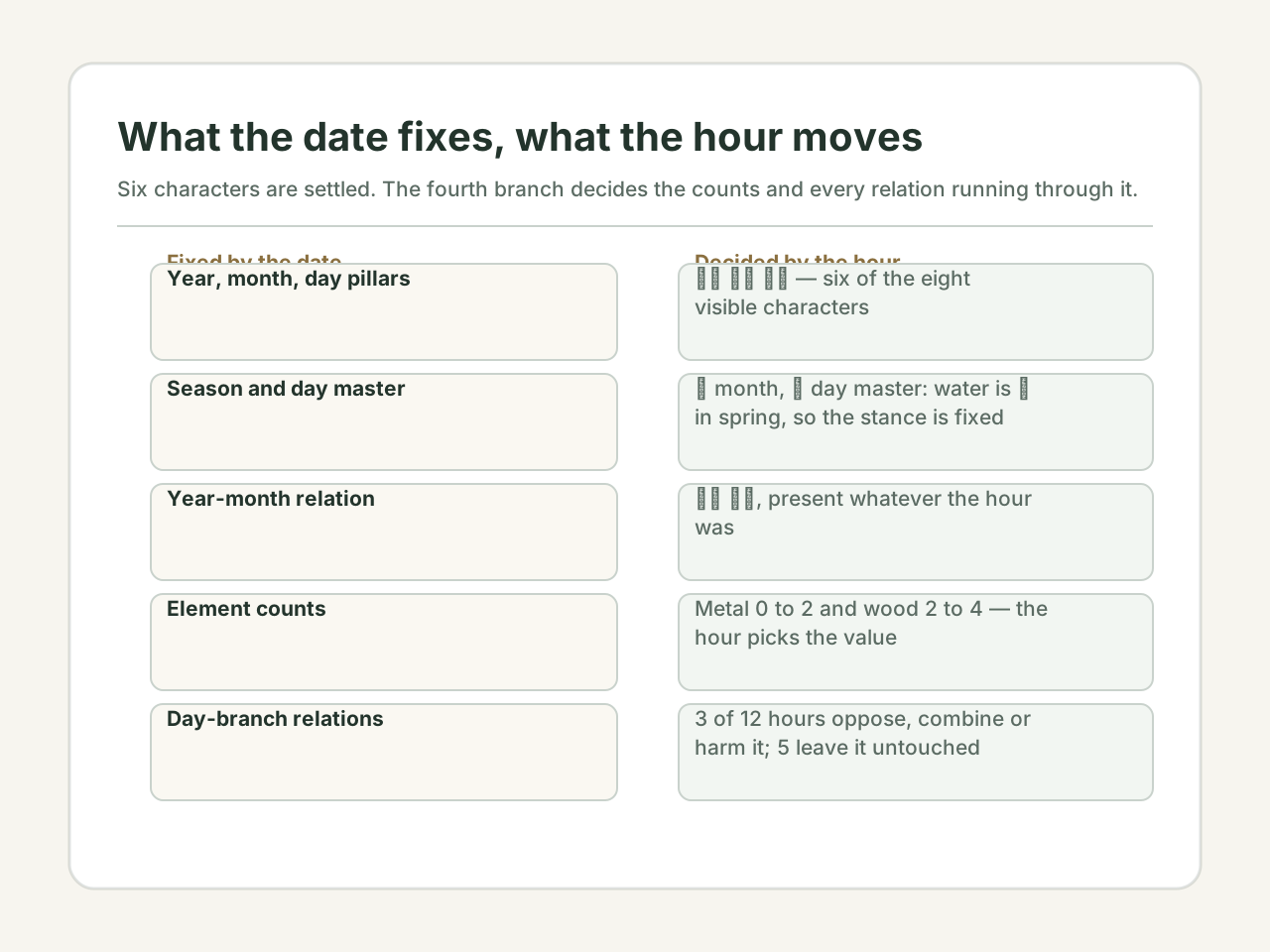
Six of eight visible characters are fixed. That is the figure most people have heard, and it undersells the loss, because much of a chart sits inside the branches rather than on them.
甲戌 丁卯 癸巳 hides seven stems: 戊 辛 丁 in 戌, 乙 in 卯, 丙 庚 戊 in 巳. Thirteen characters do not move. The hour adds two visible and one to three hidden, so the whole chart holds sixteen to eighteen — the hour is roughly a fifth to a quarter of it.
The cost is larger in the relations. The hour branch is one of four, and every combination, clash, harm and punishment needs both of its members present. Remove one branch and every relation through it goes. A three-pillar chart is not a four-pillar chart with a blank filled in.
What the date settles on its own: the season, the day master, and one relation
The month branch is 卯, the second month of spring. Classical phase theory compresses a season into a line: in spring wood is 旺, fire 相, water 休, metal 囚, earth 死. 癸 is yin water, so in a 卯 month it is 休 — drained by the element running the season. No character count changes that, and no missing hour can move it.
The day stem is a stance, not a personality. 癸 is rain, mist, groundwater: it arrives unasked and soaks downward. The useful question in a wood month is not what 癸 says about you but what this 癸 needs — metal to generate it, and something to hold the water rather than let the wood drink it dry.
One relation is already complete without the hour: 卯 and 戌 are a 六合 pair, month against year. That holds whether the birth was at dawn or at midnight. Season, day master, roots and the year-month relation are settled; what is not settled is everything the fourth branch would have touched.
The counts move, and one of them moves a long way
Twelve possible hour branches, twelve charts. Read the columns as ranges: wood two to four, doubling at 寅 and 卯; fire two to four; earth one to three; water one to three; metal zero to two.
Metal is the column that matters in practice. The zero holds for ten of the twelve hours — 庚申 and 辛酉 are the only two that put any metal in the chart. “My chart has no metal” is the question a three-pillar chart most often invites, and here the answer is mostly stable. Stable by luck of the date, though, not by method: on another day the absent element flips with the hour.
A missing element is a statement about a count, not about a person, and it implies no colour to wear. Whether it is a problem at all depends on the season, and the season is fixed — metal is 囚 in spring, so its absence here is not the emergency the question assumes. The twelve charts, visible and hidden stems together:
| Hour | Hour pillar | Wood | Fire | Earth | Metal | Water |
|---|---|---|---|---|---|---|
| 子 00:30 | 壬子 | 2 | 2 | 1 | 0 | 3 |
| 丑 02:30 | 癸丑 | 2 | 2 | 2 | 0 | 2 |
| 寅 04:30 | 甲寅 | 4 | 2 | 1 | 0 | 1 |
| 卯 06:30 | 乙卯 | 4 | 2 | 1 | 0 | 1 |
| 辰 08:30 | 丙辰 | 2 | 3 | 2 | 0 | 1 |
| 巳 10:30 | 丁巳 | 2 | 4 | 1 | 0 | 1 |
| 午 12:30 | 戊午 | 2 | 3 | 2 | 0 | 1 |
| 未 14:30 | 己未 | 2 | 2 | 3 | 0 | 1 |
| 申 16:30 | 庚申 | 2 | 2 | 1 | 2 | 1 |
| 酉 18:30 | 辛酉 | 2 | 2 | 1 | 2 | 1 |
| 戌 20:30 | 壬戌 | 2 | 2 | 2 | 0 | 2 |
| 亥 22:30 | 癸亥 | 2 | 2 | 1 | 0 | 3 |
The relations are where the missing hour costs most
The day branch is 巳. Every relation it enters needs a partner, and the partner is the hour branch. Three of the twelve give it a full relation, four give half of one, five give nothing. Which group you are in decides whether the day branch is opposed, combined, harmed or left alone — the thing most readings spend their opening paragraph on.
By hour branch:
- 亥 22:30 — 巳亥 六冲. The day branch is directly opposed.
- 寅 04:30 — 寅巳 相害, and two thirds of the 寅巳申 三刑.
- 申 16:30 — 巳申 六合 and the same 三刑. The pair the classical lists flag both ways at once.
- 丑 and 酉 — half of the 巳酉丑 metal combination, third member missing.
- 午 and 未 — part of the 巳午未 fire meeting, again incomplete.
- 子, 卯, 辰, 巳, 戌 — no relation at all.
The one window that costs four characters, not two
One case takes more than the hour pillar: 23:00 to 23:59, under the convention that the day turns at the start of 子 hour rather than at midnight.
On this date, 22:30 gives 癸巳 day with 癸亥 hour. At 23:00 the day becomes 甲午 and the hour 甲子. The day master moves from 癸 to 甲 — water to wood — and the season verdict flips with it, because 甲 in a 卯 month is 旺, not 休. Not a refinement of the reading: a different chart.
So when a family says “late at night” or “just before midnight”, the day may be missing too. Ask “before or after midnight” rather than “what time”. If the answer is “around midnight”, treat the day pillar as uncertain and say so.
How to read three pillars without pretending
A workable order for a chart with no hour:
- Write the three pillars, and say in the first sentence that the hour is missing. Do not quietly default to noon.
- Give the season verdict. The month branch fixes it, and it does the heaviest work.
- Give the day master’s stance and what it needs. Also fixed.
- List the relations the three branches already form — here, 卯戌 六合.
- Report hour-dependent conclusions as ranges: “metal 0 to 2”, “the day branch is clashed, combined, or untouched”.
- Decline what needs the hour. Children and late life live in the hour pillar, and so does whether the day branch is under pressure. “That depends on the hour” is a complete answer, not a dodge.
- Stop. A three-pillar reading honest about its edges beats a four-pillar reading built on a guessed hour.
Why rectification is not the fix
The temptation at the last step is birth-time rectification: run all twelve hours, keep the one that fits events the person already knows, then present the fit as confirmation. That cannot fail, which is the problem. Any of twelve charts will fit some remembered events once you are free to choose which to check, and the fit feels like evidence because it was selected to be.
Legitimate narrowing is documentary, not interpretive — a birth certificate, a hospital record, a family memory anchored to something external like a shift change, a radio programme or sunrise. Where none of those exist, keep the range and say what it is.
Disclaimer: This content is for informational and cultural reference purposes only. It does not constitute professional medical, legal, financial, or psychological advice. Readers should exercise their own judgment and consult qualified professionals for specific concerns.
Sources and review basis
Traditional references explain historical vocabulary and context. Official practical sources support only the observable safety, comfort, or environmental points noted in the article; they do not validate metaphysical claims.
Traditional reference
Yuanhai Ziping (渊海子平)Wikisource digital text · Accessed 2026-07-14
A classical source for Four Pillars terminology, element relationships, and the Day Master framework.
Traditional reference
Sanming Tonghui (三命通会)Wikisource digital text · Accessed 2026-07-14
A historical compilation used to cross-check traditional BaZi concepts; it is not scientific validation.
Practical source
APA Dictionary of Psychology: Barnum effectAmerican Psychological Association · Accessed 2026-07-14
A psychology reference for why broad, favourable personality descriptions can feel personally accurate. It does not evaluate BaZi calculations themselves.