The grid on the wall is a table of branch relations
Search for zodiac compatibility and you get a twelve-by-twelve grid of animals, some cells marked as a good match and some as a bad one. The grid is not invented. It encodes a real set of relations between the twelve earthly branches (地支) that Four Pillars uses. What it is not is a verdict on two people, because every cell describes one branch against one branch, and a person is four branches.
The better question is not whether a Rat and a Horse are compatible. It is which of the sixteen branch pairs between these two charts carries the friction, and how much weight that pair deserves. So: the rules the grid is built from, what they flag when you run them over every pair, and where the animal-only answer stops being useful.
Three rules make a pair cooperative
六合 is a fixed list of six pairs: 子丑, 寅亥, 卯戌, 辰酉, 巳申, 午未. Each pair is said to combine into an element — 子丑 into earth, 辰酉 into metal, 巳申 into water — but the list itself is not derived from geometry or arithmetic. It is transmitted, and the schools quote the same six.
三合 is built on spacing instead: four groups of three branches placed four apart, each group naming one season's element at full strength — 申子辰 water, 亥卯未 wood, 寅午戌 fire, 巳酉丑 metal. Four groups of three yield twelve pairs.
三会 is the direction-and-season set: 寅卯辰 east, 巳午未 south, 申酉戌 west, 亥子丑 north. Another twelve pairs. It is the least used of the three in popular writing, which is part of why the popular tables disagree with one another.
Three rules make a pair adversarial
六冲 is the simplest of all: the branch six positions away. 子午, 丑未, 寅申, 卯酉, 辰戌, 巳亥. On the twelve-point circle these sit exactly opposite, and unlike the harmony lists, this rule has a visible mechanism.
六害 is a second list of six: 子未, 丑午, 寅巳, 卯辰, 申亥, 酉戌. Its rationale is later and less consistent between texts, which is worth knowing before you let it settle anything.
相刑 covers 寅巳申, 丑戌未 and 子卯, plus four self-punishments where a branch meets itself: 辰, 午, 酉, 亥. The idea is friction that accumulates rather than a single collision.
The twelve animals and their four partners
This is the information the wall chart carries, written out once so that any pair can be looked up without a grid. The harmony partner is the 六合 pair, the group is the 三合 set, and the last two columns are the clash and harm lists.
| Animal | Branch | Harmony partner | Three-harmony group | Clash | Harm |
|---|---|---|---|---|---|
| Rat | 子 | Ox | Monkey, Dragon | Horse | Goat |
| Ox | 丑 | Rat | Snake, Rooster | Goat | Horse |
| Tiger | 寅 | Pig | Horse, Dog | Monkey | Snake |
| Rabbit | 卯 | Dog | Pig, Goat | Rooster | Dragon |
| Dragon | 辰 | Rooster | Monkey, Rat | Dog | Rabbit |
| Snake | 巳 | Monkey | Rooster, Ox | Pig | Tiger |
| Horse | 午 | Goat | Tiger, Dog | Rat | Ox |
| Goat | 未 | Horse | Pig, Rabbit | Ox | Rat |
| Monkey | 申 | Snake | Rat, Dragon | Tiger | Pig |
| Rooster | 酉 | Dragon | Snake, Ox | Rabbit | Dog |
| Dog | 戌 | Rabbit | Tiger, Horse | Dragon | Rooster |
| Pig | 亥 | Tiger | Rabbit, Goat | Snake | Monkey |
Run the lists over all sixty-six pairs
Twelve branches make sixty-six unordered pairs. Apply the rules above and the result is less dramatic than the grid suggests: twenty-eight pairs are flagged cooperative by at least one rule, twenty-five carry no flag at all, and thirteen carry only an adverse one.
Three pairs are flagged both ways, and they are the interesting ones. 巳申 is a six-harmony pair and a punishment pair. 卯辰 and 酉戌 are directional allies — east and west — and harm pairs. The lists were compiled at different times for different purposes and were never reconciled, so a table that gives one verdict per cell is smoothing over a disagreement that sits inside the tradition.
The distribution is also flat by construction. Each animal has exactly one clash partner among the other eleven, and four or five cooperative ones. That is why the Rat's worst match is always a single animal and never a category, and why the coloured rows of the grid look more informative than they are.
Sixteen pairs, and the animal is one of them
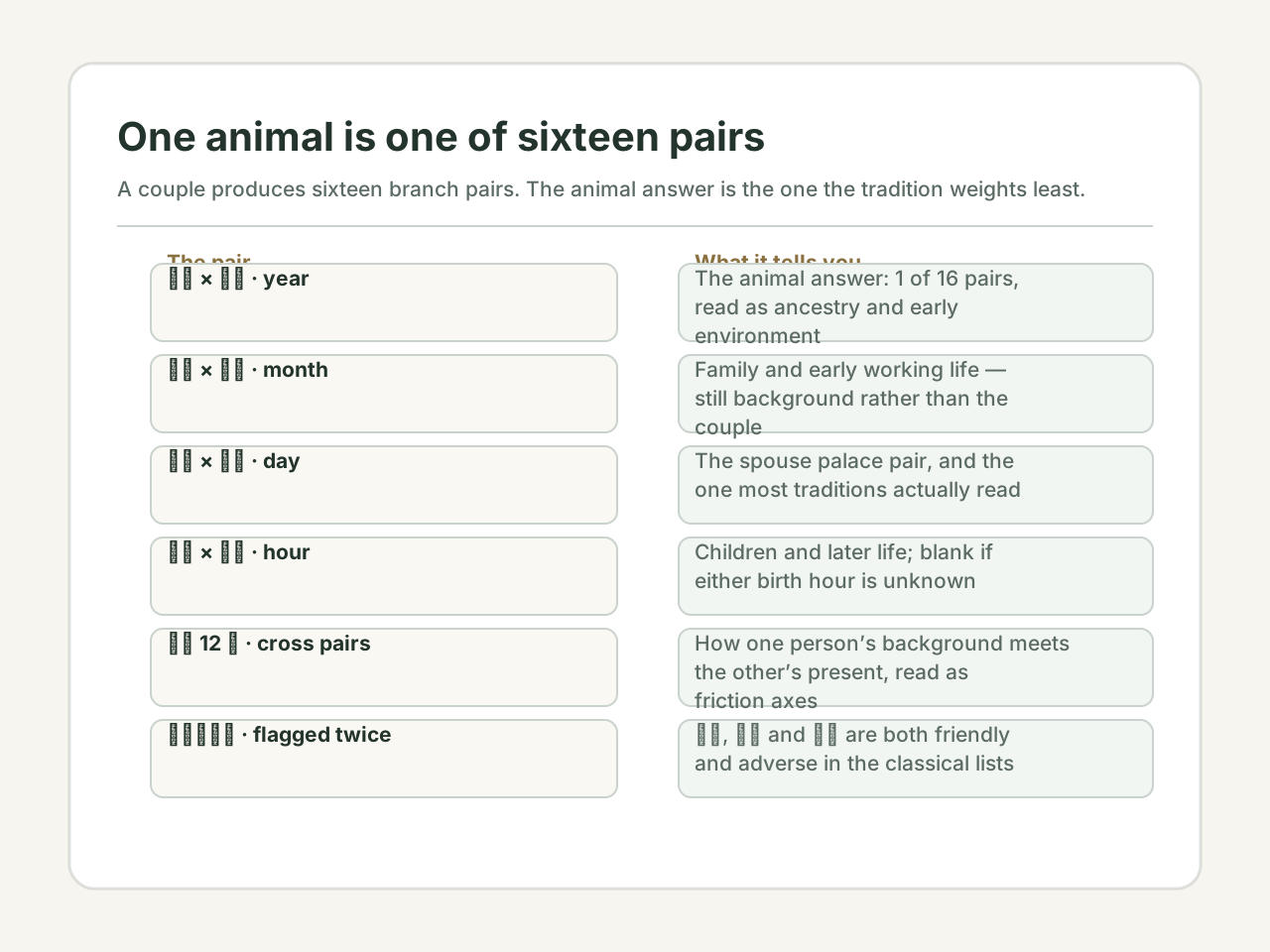
A Four Pillars chart is four branches: year, month, day and hour. Two people produce sixteen cross pairs. The animal is the year branch, so the answer a compatibility grid gives you is one of those sixteen — roughly six per cent of the branch evidence, and specifically the pair the classical reading weights least. The year pillar is read as ancestry and early environment, not as the person.
The pair most traditions actually read for a marriage is the day branch against the day branch, the spouse palace. That is a different cell of the sixteen from the one the grid shows you.
It also explains why two practitioners can give opposite readings for the same two animals: they are looking at different cells, and sometimes at different pillars entirely.
What a clash is actually good for
A clash is normally read as movement rather than damage. A year-branch clash is read as leaving the family home or a change of place; a day-branch clash as a marriage that takes adjustment. Neither is a prediction that a relationship fails.
Used well, a clash names the axis of friction, which is a subject for a conversation and not a verdict. 子午 is water against fire: rest and recovery against activity and social pace. 卯酉 is directness against tact. 辰戌 is storage against exposure — one person puts things away, the other puts them on the table.
If the axis matches an argument you already have every month, the table has told you something true and cheap. If it does not, the table is simply wrong about you, and you can put it down.
Checking a couple in under half an hour
None of this needs a purchase. The order matters more than the steps, because each one narrows what the next is worth.
- Get both charts from a free calculator. You need the date, the clock time and the place; without the hour you still have three branches, and the day branch survives.
- Compare the day branches first. That is the spouse palace, and the pair the tradition weights most.
- Compare the year branches second, and treat the animal answer as background rather than a result.
- Check whether your pair is one of the three flagged both ways. If it is, the table is arguing with itself and the judgement is yours to make.
- Write the friction axis in one sentence — we differ on pace, not on money — then test it against a recurring argument.
- Re-check in a year. The branch pairs never change; the luck pillar each chart is running does.
Disclaimer: This content is for informational and cultural reference purposes only. It does not constitute professional medical, legal, financial, or psychological advice. Readers should exercise their own judgment and consult qualified professionals for specific concerns.
Sources and review basis
Traditional references explain historical vocabulary and context. Official practical sources support only the observable safety, comfort, or environmental points noted in the article; they do not validate metaphysical claims.
Traditional reference
Yuanhai Ziping (渊海子平)Wikisource digital text · Accessed 2026-07-14
A classical source for Four Pillars terminology, element relationships, and the Day Master framework.
Traditional reference
Sanming Tonghui (三命通会)Wikisource digital text · Accessed 2026-07-14
A historical compilation used to cross-check traditional BaZi concepts; it is not scientific validation.