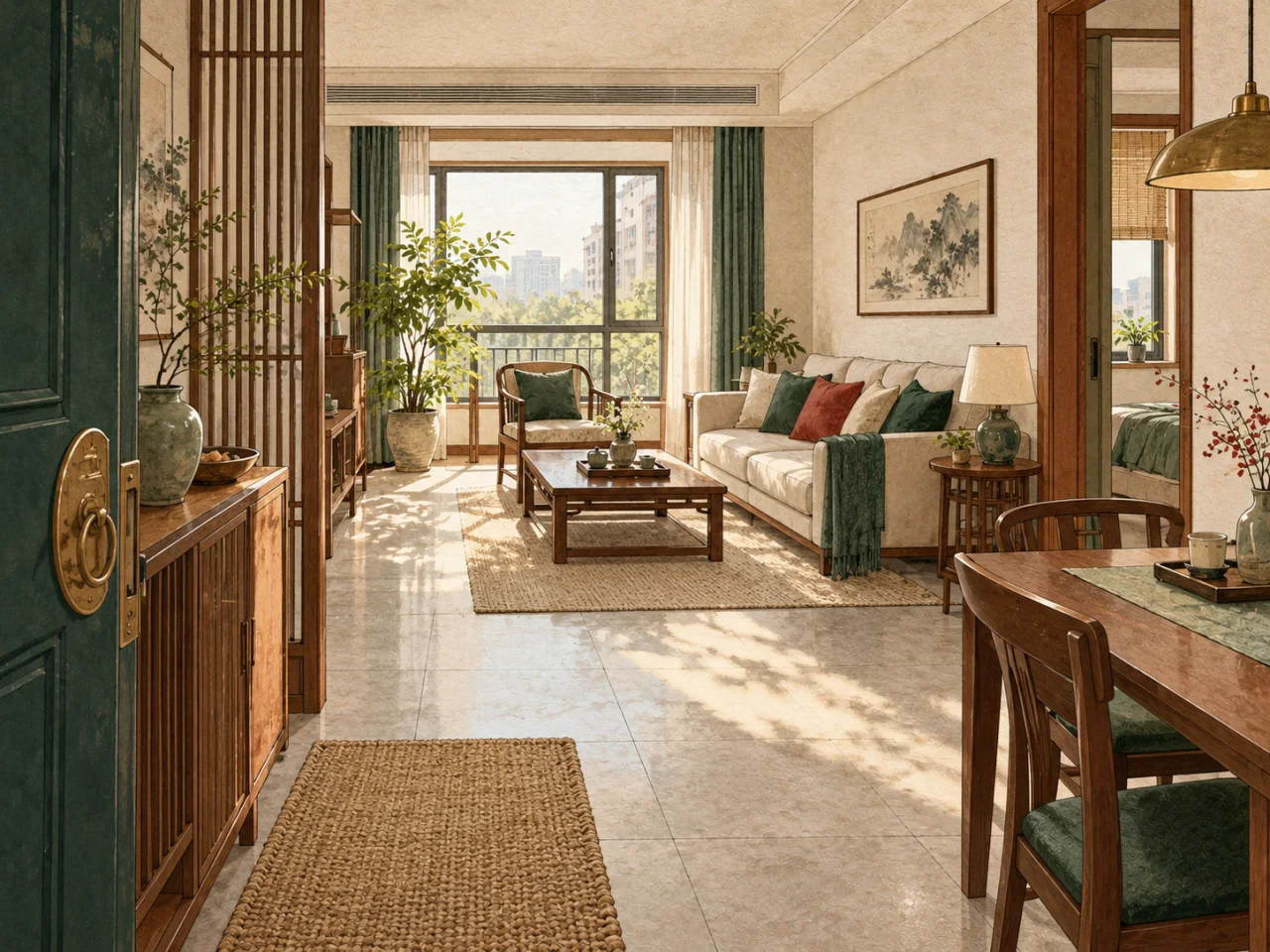
The lease decides more than the compass
A rented flat arrives with a fixed layout, fixed cabinetry, and a landlord who would rather you did not drill. That removes most of what renovation-level feng shui assumes: you cannot move a door, open up a wall, or replace a kitchen. What is left is smaller, cheaper, and — inconveniently for the drama — the part that actually changes how a flat feels: daylight, air, sightlines, storage, and where the two pieces of furniture you own end up.
The traditional vocabulary still works, as long as each term is converted into something you can move in an afternoon. 明堂 is the clear floor just inside the front door. 靠山 is the solid wall behind the bed. 气口 is the window that opens. The parts that need a builder — facing, structure, a new kitchen — belong to the landlord, and a tenant who ignores that spends money improving someone else's flat.
Six checks at the viewing, before anything else
These are ordered by how expensive they are to fix later, which is why they belong at the viewing rather than after the deposit:
- Damp and mould. Look at ceiling corners, the window reveals, and behind the bathroom door. Mould is a ventilation or leak problem; no lamp, salt crystal or coat of paint covers it for long.
- Which way the main rooms face and how much direct sun reaches them. A north-facing bedroom in a humid city is a different room from a south-facing one, and the lease fixes that for the whole tenancy.
- Noise at the wall where the bed would go. Visit on a weekday evening, not a Sunday morning.
- What the front door opens onto. A toilet door, a blank corridor, or a straight run to a balcony window is the sightline you will be managing for as long as you live there.
- Kitchen extraction. Does the hood vent outside or recirculate through a filter? A recirculating hood moves far less moisture and odour out of the room.
- Where the boiler or water heater sits. A combi boiler in a bedroom wall is a noise source at six in the morning and a service access point you cannot relocate.
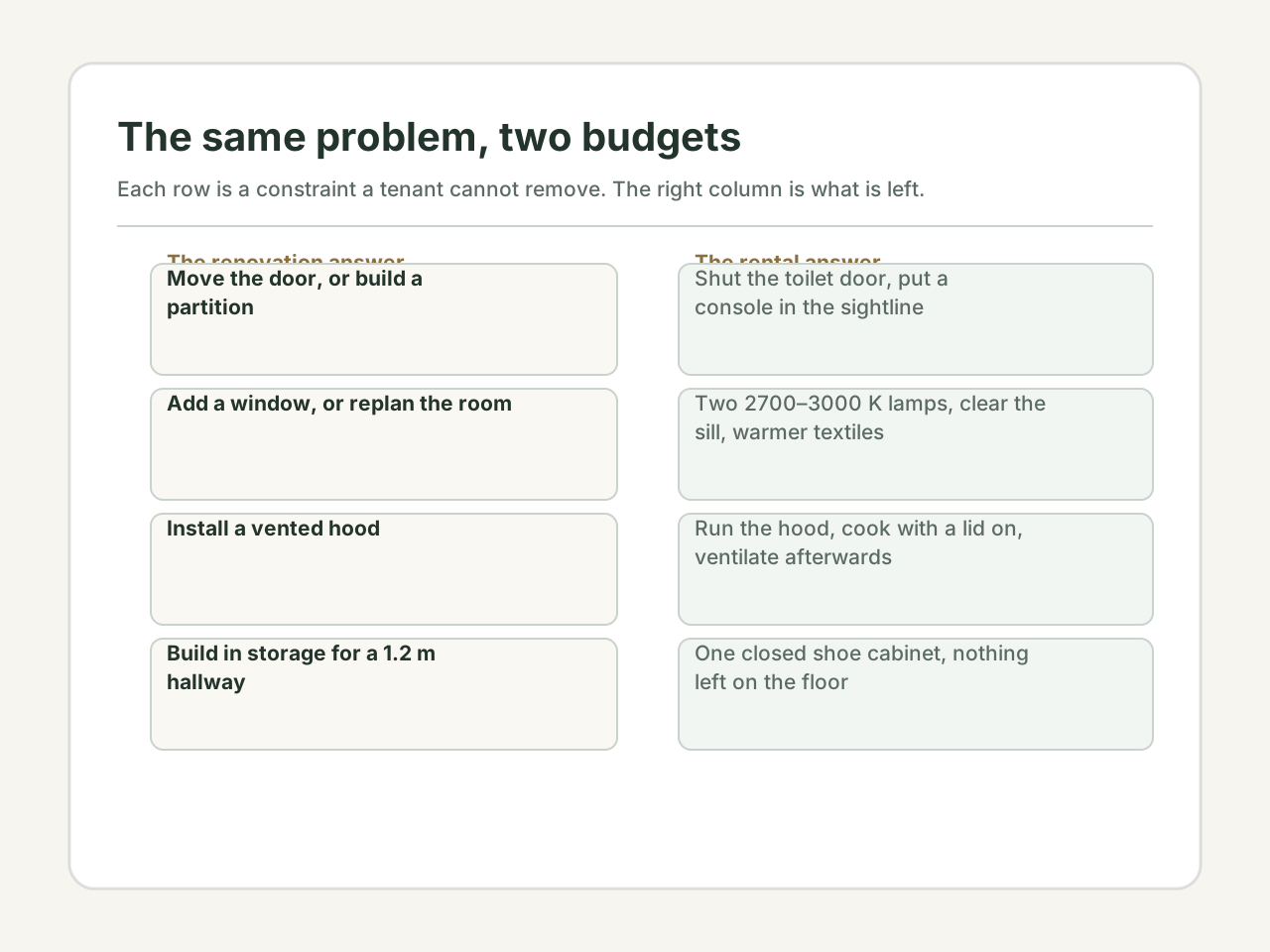
| The constraint | What a renovation would do | What a tenant can do |
|---|---|---|
| Front door opens onto the toilet | Move the door or build a partition | Keep the toilet door shut; put a console or a runner in the sightline |
| Bedroom faces north and is dim | Add a window or replan the room | Two 2700–3000 K lamps, clear the windowsill, warm textiles |
| Kitchen hood only recirculates | Install a vented hood | Run the hood, cook with a lid on, ventilate afterwards |
| Hallway is 1.2 m wide and cluttered | Build in storage | One closed shoe cabinet, one hook rail, nothing left on the floor |
| Bed has to sit under a window | Move the wall | Heavy curtain, draught excluder, headboard if there is room |
Command position in a room that cannot be rearranged
The command position — seeing the door without sitting in the traffic path, with something solid behind you — is the one traditional rule that survives translation intact, because it describes two things anyone can check: whether you are startled when someone walks in, and whether you are sitting in a walkway.
In a rental the room is what it is, so the rule has to be applied to the walls you actually have:
Keep the door swing, the radiator and the only opening window clear. Those appear on every traditional list, and they are also fire, heat and ventilation requirements.
- Bed: headboard against the longest solid wall, with a diagonal view of the door. If the only workable position is under a window, take it — draughts and early light are the real problems, and a heavy curtain plus a draught excluder solves both.
- Desk: facing the door is often impossible. Turning the chair 20–30° so the door sits in peripheral vision gets most of the benefit, and it costs nothing.
- Sofa: if it has to back onto a walkway, a narrow console behind it or a high back restores the same cue.
- Nothing in front of the only opening window. In a small flat the window is the ventilation, and a sofa or a drying rack in front of it undoes the one thing the room does well.
Light does more than paint, and it leaves with you
Most rentals have one ceiling light per room, usually cool white and usually centred on nothing in particular. Two lamps at 2700–3000 K will change a room more than any wall colour, and they move to the next flat with you.
Keep the windowsill clear and the curtains pulled back during the day; in a dim flat the largest single gain is usually just not blocking the window. If the fitting is fixed, a plug-in dimmer or a smart bulb is reversible at the end of the tenancy. A strip light under the kitchen cabinets does more for how that room reads than a new splashback, at a fraction of the price.
An entrance you cannot rebuild
If the door opens onto a blank wall or a long corridor, the traditional answer is a screen. The rental answer is anything that gives the eye somewhere to land a step inside: a slim console, a runner, a lamp, a tall plant. None of it needs a drill.
If it opens onto the bathroom door, closing that door is the single most effective step, and a console or runner breaks the line. Shoes go into one closed cabinet rather than a rack, because in a 1.2 m hallway the real problem is floor space rather than symbolism.
There is one popular cure worth refusing: a bagua mirror hung outside, facing a neighbour's door. It is the only item on the list with a genuine downside — a visible provocation in a shared corridor, and in a block of flats, a complaint with your name on it.
What to skip because it costs money and changes nothing
Four things absorb a tenant's budget without touching the room's air, light or layout:
- Repainting without written permission, then repainting it back before the inspection.
- Large red or black feature walls. They are the two finishes that show every mark, and in a small kitchen either one makes the room read smaller.
- Aquariums and water features. Weight on a floor you do not own, a pump running at night, and a leak you are liable for.
- Crystals, salt lamps and cure purchases. A decorative object does not change ventilation, daylight or the layout. If it makes the space feel better to you, that is a real reason to own it, and it is the only one that holds up.
A first-weekend sequence, cheapest first
The order matters more than the individual steps, because each one changes what the next one needs:
- Clean and ventilate. Open every window, run the extractor, and treat black mould on the bathroom ceiling with a proper mould remover instead of paint.
- Fix the door and the window that stick. An hour and a few pounds, and it removes a daily irritation.
- Move the bed and the desk to the best available wall. Free, and the change with the largest effect on how the room feels.
- Add two warm lamps. Reversible, and they travel with you.
- Clear the entrance down to one pair of shoes.
- Only then think about colour, and only with the landlord's agreement: one wall in a washable matte finish, not the whole room.
Give it two weeks before blaming the flat
Most rented rooms feel wrong in the first week because they are unfurnished, badly lit and full of boxes, and they feel fine by the third week once those three things change. If a room still feels wrong after a fortnight of living in it, the cause is almost always light or storage. Neither is fixed by the element of the wall, and both are fixed by things a tenant is allowed to do.
Disclaimer: This content is for informational and cultural reference purposes only. It does not constitute professional medical, legal, financial, or psychological advice. Readers should exercise their own judgment and consult qualified professionals for specific concerns.
Sources and review basis
Traditional references explain historical vocabulary and context. Official practical sources support only the observable safety, comfort, or environmental points noted in the article; they do not validate metaphysical claims.
Practical source
US EPA: Indoor Air QualityUnited States Environmental Protection Agency · Accessed 2026-07-14
Practical background for ventilation, pollutants, combustion sources, and indoor air concerns.
Practical source
US EPA: MoldUnited States Environmental Protection Agency · Accessed 2026-07-14
Practical guidance for moisture control and mold prevention in bathrooms, homes, and renovation work.
Traditional reference
Huangdi Zhaijing (黄帝宅经)Wikisource digital text · Accessed 2026-07-14
Historical context for traditional residential orientation and spatial vocabulary. Modern recommendations are judged against real conditions.