Two systems, both called hand shape, that do not convert
Search for hand shape in palmistry and you will get two incompatible answers. One divides hands into five types named after the Chinese elements — 金, 木, 水, 火, 土. The other divides them into four named after the Western elements — earth, air, fire, water. Both are real traditions. Neither is a translation of the other, and the tables that map one onto the other are a modern convenience rather than a historical correspondence.
Which system you are looking at matters, because the two classify different things. The Western scheme measures two ratios. The Chinese scheme also reads colour, flesh and knuckles, and it partitions the space five ways rather than four.
The Chinese five are read from proportion, flesh and knuckles
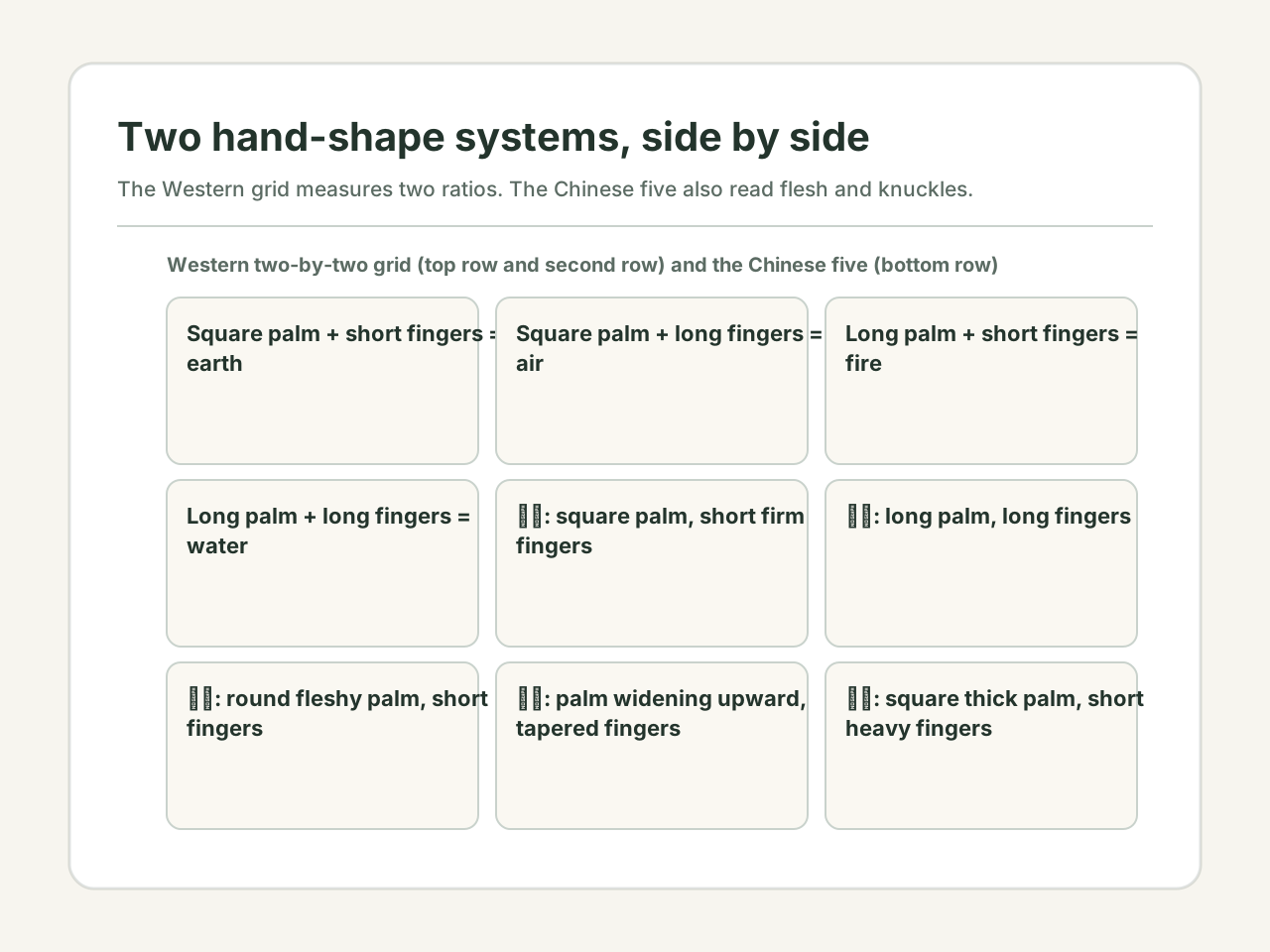
The 五行 hand types are a five-way classification. 金型 is a square palm with short, firm fingers and hard flesh. 木型 is a long palm with long fingers and visible knuckles. 水型 is a rounded, fleshy palm with short, soft fingers. 火型 is a palm that widens toward the fingers with long, tapering fingers. 土型 is a square, thick palm with short, heavy fingers.
Notice how much those descriptions lean on qualities that are not purely geometric: firm, soft, hard, thick, visible knuckles. That is the point of the system. It is a holistic impression of a hand, and two people with the same palm length can land in different types because their flesh and knuckles differ.
The traditional reading treats the type as a baseline rather than a verdict. It sets the register in which the creases and pads are then read, which is why the same crease can be described differently on two hands of the same length.
In practice the classification is done by eye, and the eye has to be trained on something. The usual anchors are the wrist crease for the bottom of the palm, the base of the middle finger for the top, and the tip of the middle finger for finger length. Comparing palm length with middle-finger length is the quickest version of the check, and it is also where most disagreements between two readers come from — the anchors are not marked on the hand, so two people can measure slightly different spans and land in different types.
The Western four are a two-by-two grid
The English-language scheme is simpler and, in a narrow sense, more rigorous: it crosses palm length with finger length. A square palm with short fingers is earth. A square palm with long fingers is air. A long palm with short fingers is fire. A long palm with long fingers is water.
The names are not arbitrary. They come from the four temperaments of Greek medicine — sanguine, choleric, melancholic and phlegmatic — each of which was tied to an element and a bodily humour. Palmistry borrowed the vocabulary because it needed a personality typology with four slots, and the humoral system was the one Europe had. That history explains something the modern tables rarely say: the elements were never observations about hands. They were a personality scheme looking for physical markers.
That is the whole method, and its virtue is consistency. Two readers looking at the same hand should reach the same type, because both are judging the same two ratios. The weakness is that the ratios are crude: long and short are judged against the palm rather than against a measurement, and most hands sit somewhere in the middle.
The grid, with the Chinese type that is usually mapped onto it
The mapping column is where the two systems are usually stitched together. Look at what happens to the finger length.
| Palm | Fingers | Western type | Often mapped to | The mapping's status |
|---|---|---|---|---|
| Square | Short | Earth | 土型 (earth) | Close: both describe a compact, solid hand |
| Square | Long | Air | 金型 (metal) | Loose: metal hands have short fingers in the Chinese scheme |
| Long | Short | Fire | 火型 (fire) | Coincidental: the names match, the criteria do not |
| Long | Long | Water | 木型 (wood) | Partial: wood and water are both read as long hands |
Why metal-equals-air is a modern artefact
The problem with the mapping is arithmetic. In the Western grid, air is a square palm with long fingers. In the Chinese scheme, 金型 is a square palm with short fingers. The two descriptions contradict each other on finger length, which is one of the two things the Western grid actually measures.
The mapping survives because it is convenient for English-language articles that want to present both traditions at once. It is worth knowing that it is a modern bridge rather than a correspondence found in either tradition's own texts. If you use both systems, use them separately, and notice when they disagree about the same hand.
What a shape label is good for, and what it is not
A hand-shape label is a piece of vocabulary. It gives two people a shared word for a set of proportions, and it gives a reading a starting register. That is a real, if modest, use.
It is not a personality diagnosis. There is no evidence that palm proportions predict temperament, and the categories are coarse enough that most people recognise themselves in several of them at once — which is the Barnum effect doing the work, not the hand. If a description fits you, the useful question is what specifically you recognise in it, not which element you are.
The practical rule: use the label to start a description, never to end one. A hand shape tells you how a reading should be pitched. It does not tell you who the person is.
Disclaimer: This content is for informational and cultural reference purposes only. It does not constitute professional medical, legal, financial, or psychological advice. Readers should exercise their own judgment and consult qualified professionals for specific concerns.
Sources and review basis
Traditional references explain historical vocabulary and context. Official practical sources support only the observable safety, comfort, or environmental points noted in the article; they do not validate metaphysical claims.
Practical source
MedlinePlus: Single palmar creaseUS National Library of Medicine · Accessed 2026-10-18
The source for the timing and frequency used across the palm-reading articles: palmar creases develop in the womb, most often by the twelfth week of gestation, and a single palmar crease appears in about one person in thirty. It describes anatomy and association only; it makes no claim that a crease predicts anything.
Practical source
APA Dictionary of Psychology: Barnum effectAmerican Psychological Association · Accessed 2026-07-14
A psychology reference for why broad, favourable personality descriptions can feel personally accurate. It does not evaluate BaZi calculations themselves.