One bearing, and the wall you decide is the front
Every direction-based method needs the same input before it can say anything: the bearing the building faces. Sitting (坐) and facing (向) are 180 degrees apart, so this is one measurement, not two. Eight Mansions reads the house from its sitting direction; a flying-star chart needs the facing bearing and the year of construction. Get the bearing wrong and every number downstream is wrong in a way no amount of interpretation repairs.
What counts as the front is a convention rather than a fact. A flat offers at least three candidates: the wall with the largest window, the door you actually enter by, and the elevation the building is addressed from. The classical texts assume a free-standing house with one obvious facade, and a tower block has four. Pick the side with the largest opening to the outside on the addressed elevation, write down which wall you used, and use the same wall for every later reading. Switching walls midway is the most common way a household ends up with two contradictory charts of one home.
The method's tolerance decides the instrument
Both systems quantise direction, so both have a tolerance you can state in degrees. The eight-sector table used by Eight Mansions gives each sector 45 degrees, which means a reading can be wrong by up to 22.5 degrees and still land in the same sector. The twenty-four mountain ring on a luopan gives each mountain 15 degrees, so the tolerance there is 7.5 degrees.
That difference decides which instrument is adequate. A phone that is five degrees off is comfortable for the eight-sector table and marginal for the ring. The question is not which compass is better in general, but which table you are going to read afterwards.
| Sector | Degrees covered | Width |
|---|---|---|
| North | 337.5 - 22.5 | 45 |
| Northeast | 22.5 - 67.5 | 45 |
| East | 67.5 - 112.5 | 45 |
| Southeast | 112.5 - 157.5 | 45 |
| South | 157.5 - 202.5 | 45 |
| Southwest | 202.5 - 247.5 | 45 |
| West | 247.5 - 292.5 | 45 |
| Northwest | 292.5 - 337.5 | 45 |
Why a phone compass struggles in a flat
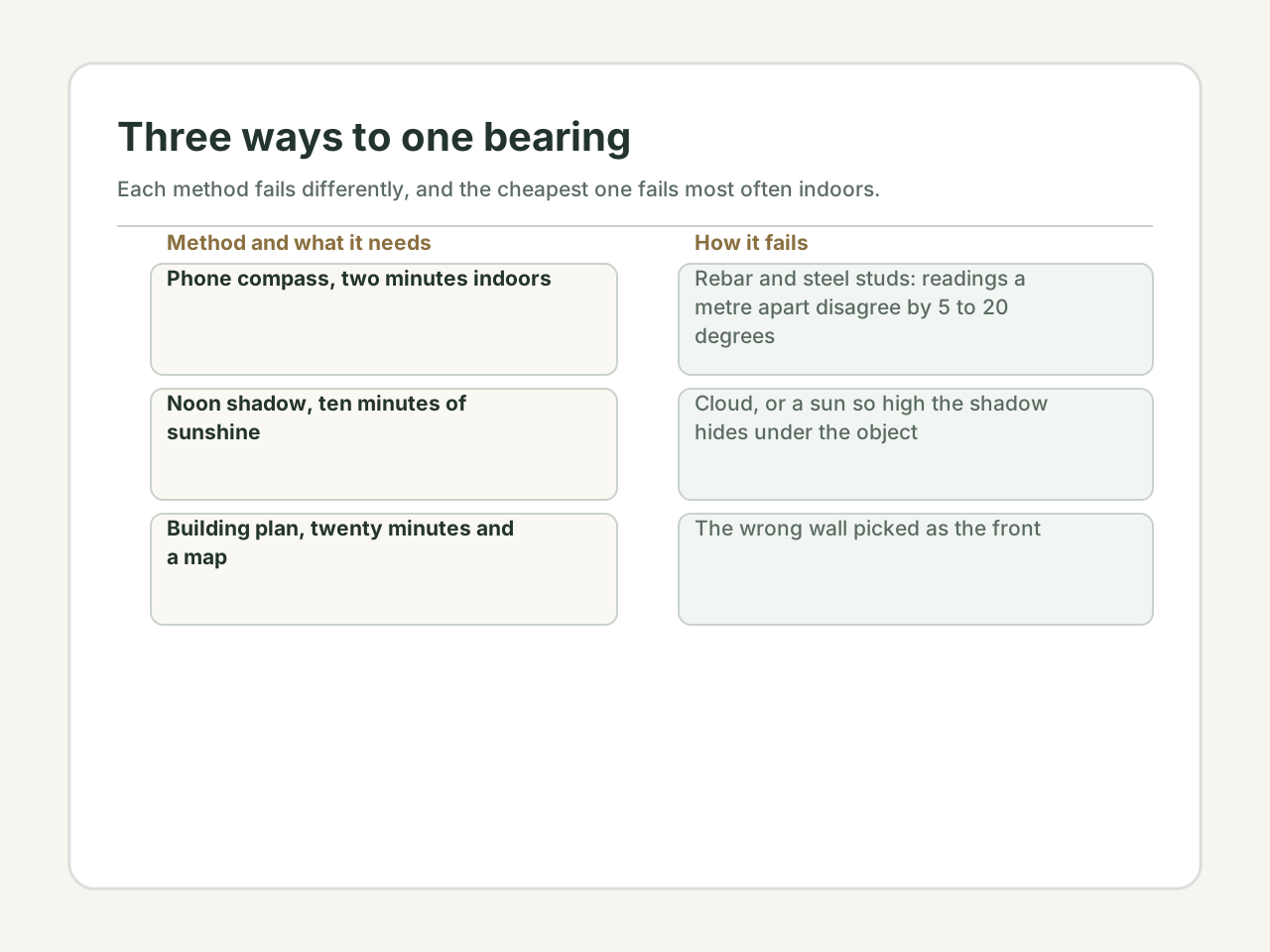
A phone compass reads a magnetometer, and a magnetometer reads whatever magnetic field is present locally. Indoors, that field is mostly the building. Reinforcing bar in a floor slab is typically laid at 150 to 200 millimetre centres and sits directly under your feet; steel studs, metal door frames, radiators, speaker magnets and a magnetic phone case all add their own contribution.
The error is not a fixed offset that can be subtracted. It changes from one spot to the next, which is why two readings a metre apart can disagree by more than the width of a mountain. The practical test is four readings at least a metre apart, at chest height, with the phone flat and its top edge pointed the same way each time. If all four agree within five degrees, average them and keep the number. If they spread further than that, the readings are contaminated: step outside, onto a balcony, or into the doorway, where the slab is thinner or absent, and take the reading again.
Magnetic north, true north, and which one the table expects
A compass points at magnetic north; maps and satellite images are drawn to true north. The gap between them is declination, which in mainland China runs from roughly ten degrees west in the northeast to a few degrees east in Xinjiang, close to zero through parts of Sichuan and Yunnan, and drifts by about a tenth of a degree a year. For a bearing in Beijing, six or seven degrees is the order of magnitude.
Here is the part that surprises people: correcting to true north is not automatically the more correct choice. The luopan is a magnetic instrument and the classical tables were built on magnetic bearings, so a modern true-north correction can move a reading away from the convention the table assumes. What matters is consistency. State which north you used, and use the same one when you re-measure. If the bearing is more than ten degrees from a sector boundary, the distinction cannot change the answer; if it is closer than that, say so instead of silently picking one.
The noon shadow, which needs no instrument at all
At local solar noon the sun crosses the meridian due south anywhere north of the Tropic of Cancer, so the shadow of any upright object points true north. A stick, a sunny ten minutes and a mark on the ground give a true-north line that no steel can distort.
The one thing to get right is the time. Solar noon is not clock noon. China keeps UTC+8, the meridian of 120 degrees east, so every place west of that line has a later noon, and the equation of time adds or subtracts up to about sixteen minutes on top. In late October the correction is near its maximum, which is why the table below spreads over two and a half hours.
| City | Solar noon, 29 October | Shadow per metre of height |
|---|---|---|
| Harbin | 11:18 | 1.65 m |
| Beijing | 11:58 | 1.32 m |
| Shanghai | 11:38 | 0.98 m |
| Guangzhou | 12:11 | 0.73 m |
| Urumqi | 13:53 | 1.53 m |
How accurate the shadow actually is
Near noon the shadow turns slowly, which is what makes the method usable with an ordinary clock. At the latitude of Beijing in late October the shadow swings about 0.3 degrees per minute of clock error: five minutes off is 1.5 degrees, ten minutes is 3 degrees. A phone clock is accurate to the second, so the practical error is set by how well you mark the tip, not by the timing.
The method fails in three situations, and each is visible before you start. Overcast weather removes the shadow entirely. A sun too high to cast a usable shadow does the same: in Guangzhou on 21 June the noon sun stands at 90.3 degrees and the shadow disappears under the object. And a surface that is not level tilts the line you draw, so use a hard, flat surface rather than grass.
The plan method, which ignores magnetism
For a flat, the most reliable reading is often taken from a drawing rather than from the air. Open a satellite view of the building, note which way north is on the image, mark the wall you decided is the front, and measure the angle between that wall's outward normal and north. The result is a true-north bearing with no magnetic component at all, and rebar cannot touch it.
Its failure mode is different: the answer is only as good as the wall you picked and the accuracy of the footprint. Use it as a cross-check rather than a replacement. If the phone and the plan disagree by more than ten degrees, one of them is wrong, and it is usually the phone. If they agree within five degrees, you have the number and you can stop measuring.
Where thirteen degrees changes the answer
Take a flat whose living-room window faces 118 degrees while the building's main elevation faces 105 degrees. To the eye both are east-southeast. On the eight-sector table, 105 degrees falls in East, which ends at 112.5, and 118 degrees falls in Southeast. Under Eight Mansions those two sectors carry different stars, so the whole reading flips on thirteen degrees of measurement. On the twenty-four mountain ring the same gap crosses from 乙 to 辰.
This is the argument for writing the number down instead of the word. East is not an input any table can use, and a bearing recorded without its method cannot be reproduced by the next person who measures the same home.
What the bearing does not decide
The bearing is one input among several, and it is not a verdict on the home. It does not outrank daylight, damp, noise, a door that will not open fully, or a room nobody wants to sit in. Where a traditional preference and a measurable condition disagree, the condition comes first, and the bearing can wait.
It also does not settle disagreements between systems. If Eight Mansions calls a room favourable and the flying-star chart calls it hostile, no rule inside either system resolves the conflict; they are different tables applied to the same wall. Record the bearing, the method used to get it, and the date. A number without its method is a claim, not a measurement.
Disclaimer: This content is for informational and cultural reference purposes only. It does not constitute professional medical, legal, financial, or psychological advice. Readers should exercise their own judgment and consult qualified professionals for specific concerns.
Sources and review basis
Traditional references explain historical vocabulary and context. Official practical sources support only the observable safety, comfort, or environmental points noted in the article; they do not validate metaphysical claims.
Traditional reference
Huangdi Zhaijing (黄帝宅经)Wikisource digital text · Accessed 2026-07-14
Historical context for traditional residential orientation and spatial vocabulary. Modern recommendations are judged against real conditions.
Practical source
NOAA Solar CalculatorNOAA Global Monitoring Laboratory · Accessed 2026-10-16
Used to check local solar noon and the equation of time, which is the part the true-solar-time correction adds to or subtracts from clock time.
Practical source
IANA Time Zone Database (tzdata)Internet Assigned Numbers Authority · Accessed 2026-10-16
The reference dataset for historical UTC offsets and daylight-saving transitions. Its Asia/Shanghai rules are the source for the 1986–1991 China summer-time dates used above.