Read symbol by symbol and the chart contradicts itself
Most first readings work like a dictionary. Look up 丁 (yin fire), look up 亥 (water, first month of winter), look up 丑 (earth), then assemble a paragraph out of the definitions. The paragraph comes out fluent and it contradicts itself, because each of those symbols means something different depending on what sits beside it.
A chart is a hierarchy, not eight labels. The season constrains what the day master can do, the roots decide whether it can do it, and the ten gods only describe relationships that already exist. Read out of order and a later layer overrules an earlier one, which is why two people can quote the same chart and reach opposite conclusions. Read in order and each layer narrows the next one.
Six steps below, worked on one real chart: 8 November 1990, 14:40, no daylight saving. The pillars are 庚午 丁亥 丁丑 丁未 — year, month, day, hour.
Step 1 — settle the hour before reading anything else
The hour pillar is the least reliable input and the most consequential. Four clock times on that same day produce four different charts:
- The fire count swings between three and five out of eight characters without a single change of date.
- The 丑未 clash exists only at 14:40. It is the day branch against the hour branch — the spouse palace against children and late life — and at 12:40 it is replaced by a self-punishment on 午.
- The 子丑 combination at 00:30 and the 亥子丑 seasonal meeting exist nowhere else in the day.
- Before the hour is a chart question it is a clock question: the time on a birth record is civil time in a named zone, and if that zone's daylight-saving rules changed between the birth and now, the recorded hour can be wrong by sixty minutes.
| Birth time | Four pillars | Fire count | Branch relations |
|---|---|---|---|
| 00:30 | 庚午 丁亥 丁丑 庚子 | 3 of 8 | 子丑 六合, 子午 六冲, 亥子丑 三会 |
| 12:40 | 庚午 丁亥 丁丑 丙午 | 5 of 8 | 午 自刑, 丑午 六害 |
| 14:40 | 庚午 丁亥 丁丑 丁未 | 4 of 8 | 午未 六合, 丑未 六冲, 丑午 六害 |
| 16:40 | 庚午 丁亥 丁丑 戊申 | 3 of 8 | 丑午 六害, 申亥 六害 |
Step 2 — the month branch is the season, and the season judges the day master
亥 is the first month of winter. Classical phase theory reduces a season to one line: in winter, water is 旺 (prospering), wood 相 (supported), metal 休 (resting), earth 囚 (confined), fire 死 (spent). 丁 is fire, so in a 亥 month it sits at the weakest of the five phases no matter how many fire characters appear elsewhere in the chart.
That line outranks every count, and it is the step most beginner readings skip. A chart can hold four fire characters and still have a day master out of season; that is not a contradiction, it is the ordinary case for anyone born in the wrong half of the year. The season is fixed by the birth date, cannot be argued with, and therefore has to be settled before the symbols are interpreted rather than after.
Step 3 — the day stem is a stance, not a personality
丁 is yin fire: a candle, a lamp, a forge ember. 丙 is the sun. The image is only useful as a stance, because a candle's problem is not self-expression — it is fuel and draught. The productive question is not what 丁 means about you in general, but what this 丁 needs in this month.
In a 亥 month the answer is close to forced: wood to burn, and shelter from the water that is in command. That is a claim about the chart, not about the person, and it is checkable against the rest of the chart — which is what the next three steps do.
Step 4 — count roots, not symbols
A root is a branch that carries the day master's own element in its main or secondary stem. 丁's 禄 is 午, so the year branch is a real root. 未 holds 丁 as a secondary stem — a second, weaker root. 丑 carries no fire, and 亥 carries none. Two roots out of four branches, one of them strong.
Compare the 12:40 version, where 丙午 in the hour puts a second 午 in the chart. A fire day master with two 午 roots is a different object from one with a 禄 plus a storage branch, and the difference came entirely from the hour. Root counting is downstream of step one, which is why step one goes first.
Step 5 — count the elements twice, and trust neither count
Visible characters only, the eight on the page: wood 0, fire 4, earth 2, metal 1, water 1. Fire looks dominant and wood looks absent.
Now open the four branches and include what they hide: 午 hides 丁 and 己, 亥 hides 壬 and 甲, 丑 hides 己, 癸 and 辛, 未 hides 己, 丁 and 乙. Wood is not absent at all — 甲 sits inside 亥 and 乙 inside 未. Over all fifteen stems the distribution is fire 6, earth 5, water 3, wood 2, metal 1.
Three statements, three different impressions, and none of them is wrong. The count answers how much of each element is on the page. The season answers which element is in charge this month. The roots answer whether the day master can reach what is on the page. A reading that quotes only the first is the one that goes wrong, and it is also the reading behind most of the anxiety about a chart being missing an element.
Step 6 — read the branch relations between the four palaces
The relations are fixed lists rather than calculations: 六合, 六冲 (the branch six places away), 六害, and the punishments. In this chart three of them fire at once. 午未 六合 joins the year and hour branches. 丑未 六冲 puts the day branch against the hour branch. 丑午 六害 links the day branch to the year.
Read them as axes, not scores. 丑未 is storage against exposure — one person files things away, the other leaves them on the table. 丑午 is damp earth against dry fire. Each names a recurring kind of disagreement rather than predicting that one will happen.
Notice what the hour did here as well. At 12:40 the 丑未 clash disappears and 午 punishes itself instead. Any relation reported with confidence is a relation that depends on a birth time that should have been confirmed in step one.
What this order settles, and what it leaves open
It does not settle strength. This chart has six of fifteen fire, a 禄 root, and a day master out of season; schools weight those three facts differently and will disagree about whether it is weak, balanced, or strong but unsupported. The order does not remove that disagreement. It makes it visible, and it names which fact each reader is weighting.
It also does not predict events. What comes out is a description of tensions with a stated basis: this element is out of season, this root exists, this pair clashes. Two readers can check the basis and argue about the weight, which is a better conversation than quoting different dictionary entries at each other.
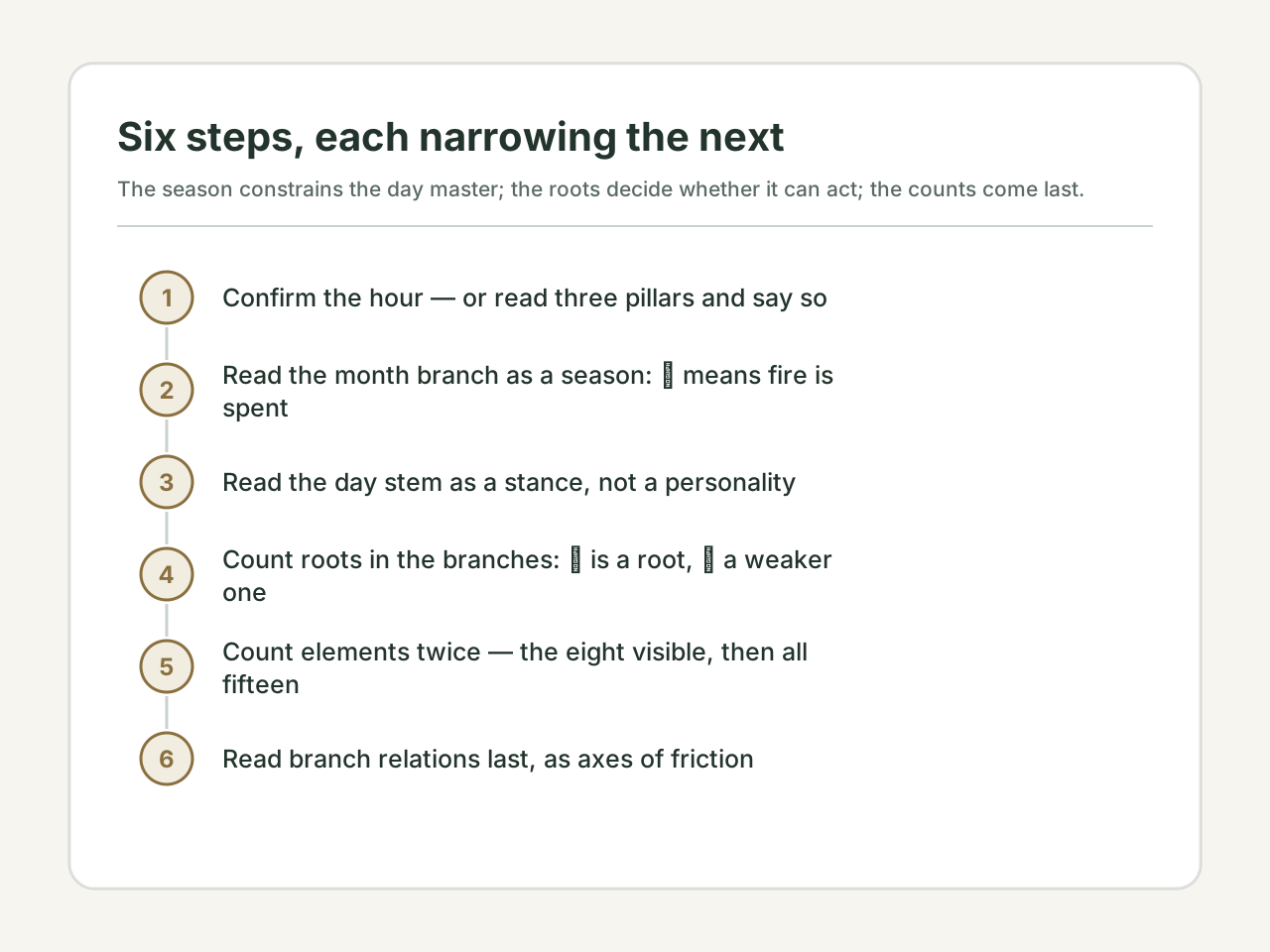
- Confirm the hour, or drop to three pillars and say so.
- Read the month branch before any element count.
- Find the roots next — a root is a branch, not a label.
- Count visible and hidden stems separately, then compare.
- Read branch relations last, as axes of friction.
- Say which fact your conclusion depends on, so it can be checked.
Disclaimer: This content is for informational and cultural reference purposes only. It does not constitute professional medical, legal, financial, or psychological advice. Readers should exercise their own judgment and consult qualified professionals for specific concerns.
Sources and review basis
Traditional references explain historical vocabulary and context. Official practical sources support only the observable safety, comfort, or environmental points noted in the article; they do not validate metaphysical claims.
Traditional reference
Yuanhai Ziping (渊海子平)Wikisource digital text · Accessed 2026-07-14
A classical source for Four Pillars terminology, element relationships, and the Day Master framework.
Traditional reference
Sanming Tonghui (三命通会)Wikisource digital text · Accessed 2026-07-14
A historical compilation used to cross-check traditional BaZi concepts; it is not scientific validation.
Practical source
IANA Time Zone Database (tzdata)Internet Assigned Numbers Authority · Accessed 2026-10-16
The reference dataset for historical UTC offsets and daylight-saving transitions. Its Asia/Shanghai rules are the source for the 1986–1991 China summer-time dates used above.