The lunar month name is not the input
Every few years someone born in a 閏 month asks which month pillar they carry, and the answer usually comes back as a judgement about the lunar month number: count 閏六月 as the sixth month, or count it as the seventh. Both are guesses at a value the chart never reads.
The month pillar is fixed by the twelve 節 — 立春, 驚蟄, 清明, 立夏, 芒種, 小暑, 立秋, 白露, 寒露, 立冬, 大雪, 小寒 — and by nothing else. Each one opens a solar month and closes the previous one. On the sun's longitude they sit thirty degrees apart, with 立春 at 315°, so a boundary is an astronomical instant rather than a printed date.
A lunar month is a different kind of object: twenty-nine or thirty whole days, beginning on the day that contains the new moon, averaging 29.53. The two clocks run at different rates, and leap months exist because of the gap between them. A birth is one instant, and only one of the two clocks is consulted when the month pillar is assigned.
Why a leap month must contain a 節
The leap month is defined as the month holding no 中氣. How that happens is set out on the calendar page; what matters here is a consequence that is easy to miss.
節 and 中氣 alternate around the year. Between any two consecutive 節 there is exactly one 中氣, so a stretch of days containing no 中氣 cannot contain two 節 — two 節 would have a 中氣 sitting between them.
Nor can it contain none. Consecutive terms arrive fourteen to sixteen days apart across 1900 to 2100, and a lunar month runs twenty-nine or thirty days, so every lunar month contains at least one term. If the term it contains is not a 中氣, it is a 節.
That leaves one possibility: a leap month always contains exactly one 節. Not usually, not on average — by the structure of the rule it cannot contain zero or two. And since the 節 is where the month pillar turns, the pillar turns inside every leap month.
Seventy-four leap months, seventy-four splits
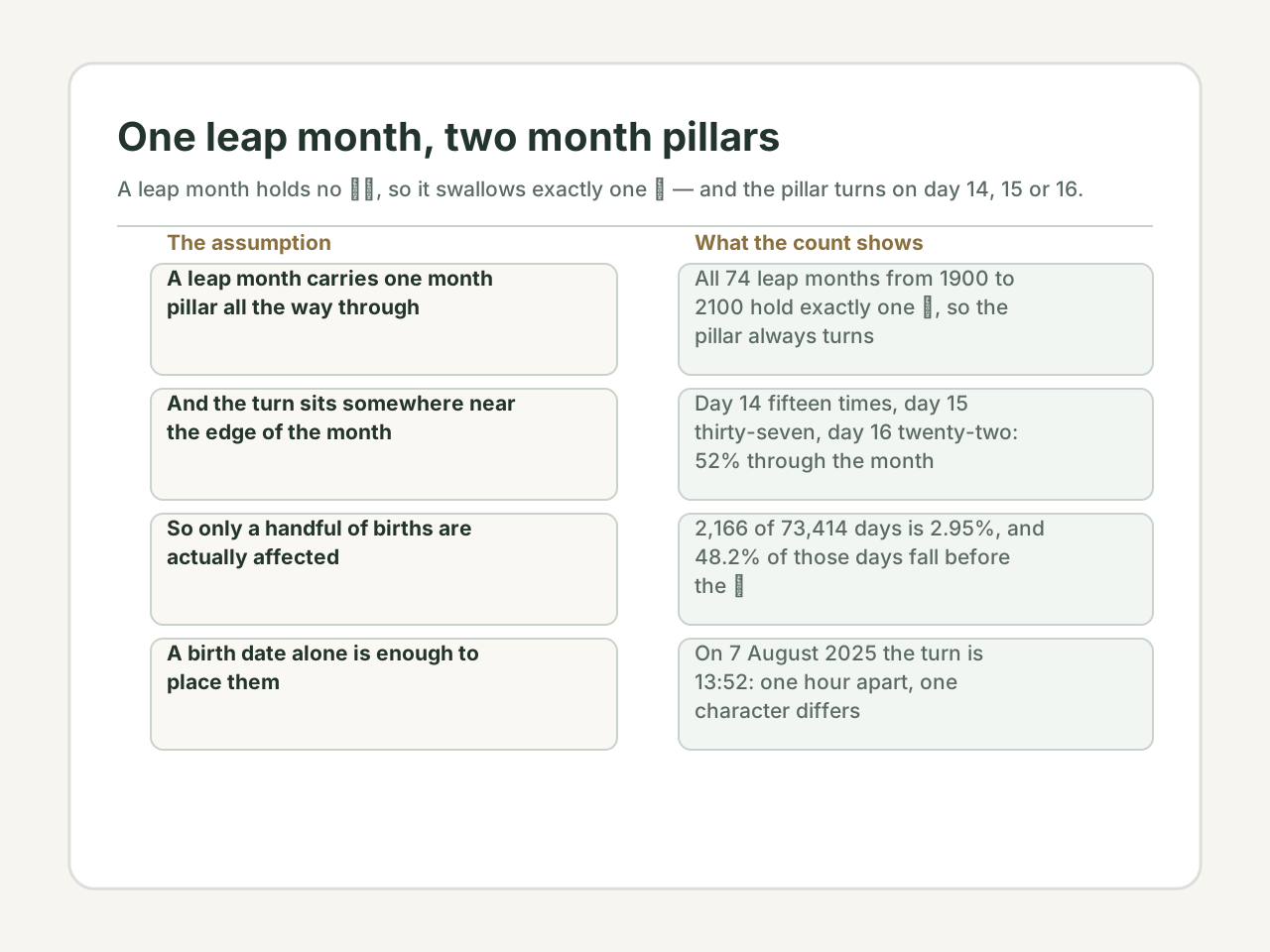
Enumerating every leap month from 1900 to 2100 gives 74 of them across 201 years — one every 2.70 years, arriving two years after the previous one twenty times and three years after it fifty-three times. Their 2,166 days are 2.95 per cent of the 73,414 days in the span, so roughly three births in a hundred land in one.
Every one of the 74 holds exactly one 節 and zero 中氣. Seventy-four out of seventy-four, with no case where the pillar stands still from the first day to the last.
The leap month is not spread evenly through the year either. 閏四月 and 閏五月 account for fourteen each, 閏六月 twelve, 閏二月, 閏三月 and 閏七月 eight each, 閏八月 seven, and 閏九月, 閏十月 and 閏十一月 one each. Neither 閏正月 nor 閏十二月 occurs anywhere in the span.
Where inside the month the split lands
Counting the 節's position in each leap month puts it on day 14 in fifteen cases, day 15 in thirty-seven, and day 16 in twenty-two. The average is day 15.1 of a 29.27-day month, which is 52 per cent of the way through — close enough to the middle that neither half can be dismissed as an edge case.
Weighted by days rather than by months, 1,043 of the 2,166 leap-month days fall before the 節 and 1,123 after it: 48.2 per cent against 51.8. A table that hands one month pillar to an entire leap month is therefore wrong for slightly more than half the people born in one.
Which 節 does the splitting depends on the year: 小暑 fourteen times, 芒種 fourteen, 立秋 twelve, 清明 eight, 白露 eight, 立夏 eight, 寒露 seven, and 立冬, 大雪 and 小寒 once each.
One hour apart, one character different
2025 carries a leap sixth month. It runs from 25 July to 22 August, twenty-nine days, and the 節 inside it is 立秋 on 7 August at 13:52 Beijing time.
Two births on that day, an hour apart:
- 13:00 — 乙巳 癸未 戊申 己未
- 14:00 — 乙巳 甲申 戊申 己未
Same date, same lunar day, one pillar apart
Both births above share the date, the lunar day (the fourteenth of 閏六月), the day pillar and the hour pillar. Only the month character moves. That is what a month boundary looks like when it lands in the middle of a lunar month, and it is why a birth date on its own cannot settle the question on the switch day — the hour decides, and 13:52 is the line.
The same thing happens at a coarser scale across the month. Two births three weeks apart, both in 閏六月:
- The month pillar differs, and so does everything downstream of it. The 大運 sequence is generated by stepping from the month pillar, forwards or backwards, so these two charts do not merely carry a different label — they run different decades.
- That is the real cost of the lunar-month shortcut. It is not a one-character slip in a reading; it moves the whole luck sequence by one position, which changes which decade a reader is told they are in.
| Birth | Lunar date | Four pillars |
|---|---|---|
| 30 July 2025, 12:00 | 閏六月初六 | 乙巳 癸未 庚子 壬午 |
| 12 August 2025, 12:00 | 閏六月十九 | 乙巳 甲申 癸丑 戊午 |
Checking a chart in four steps
The check does not need software. It needs the 節 dates, which any almanac prints.
- Find the 節 immediately before the birth. 立春 opens the first month, 驚蟄 the second, 清明 the third, and so on around the twelve. The month pillar begins at that instant, not at the start of the lunar month.
- If the lunar month is a leap month, find the 節 inside it and compare the birth date to it. Half of leap-month births fall on each side.
- If the birth falls on the day of the 節, the hour decides, and the printed date is not enough. This is the one case where a chart cannot be drawn from a date alone.
- If a calculator returns the same month pillar for the whole leap month, it is reading the lunar month number rather than the terms. The answer it gives is right for part of the month and wrong for the rest.
What the leap month does not change
It does not create a thirteenth month pillar. There are twelve, and a leap month borrows one of them rather than adding a slot.
It does not move the year boundary, which stays at 立春, or the day pillar, which is unaffected by any month question. It does not make the chart unusual: about three births in a hundred fall in a leap month, which is a large group, not a curiosity.
It also says nothing about whether a birth was early or late, or about the person's temperament. What it changes is narrow and specific — the month pillar, for roughly half the people born in one, and the luck sequence that starts there.
Disclaimer: This content is for informational and cultural reference purposes only. It does not constitute professional medical, legal, financial, or psychological advice. Readers should exercise their own judgment and consult qualified professionals for specific concerns.
Sources and review basis
Traditional references explain historical vocabulary and context. Official practical sources support only the observable safety, comfort, or environmental points noted in the article; they do not validate metaphysical claims.
Traditional reference
Yuanhai Ziping (渊海子平)Wikisource digital text · Accessed 2026-07-14
A classical source for Four Pillars terminology, element relationships, and the Day Master framework.
Practical source
NOAA Solar CalculatorNOAA Global Monitoring Laboratory · Accessed 2026-10-16
Used to check local solar noon and the equation of time, which is the part the true-solar-time correction adds to or subtracts from clock time.
Practical source
NASA Science: Moon PhasesNASA Science · Accessed 2026-10-17
Used for the definition of a phase as the moon's position relative to the sun and Earth, and for the 29.5-day synodic month. It describes the astronomy; it says nothing about calendars or fortune.