Four lines get named, but only three are always there
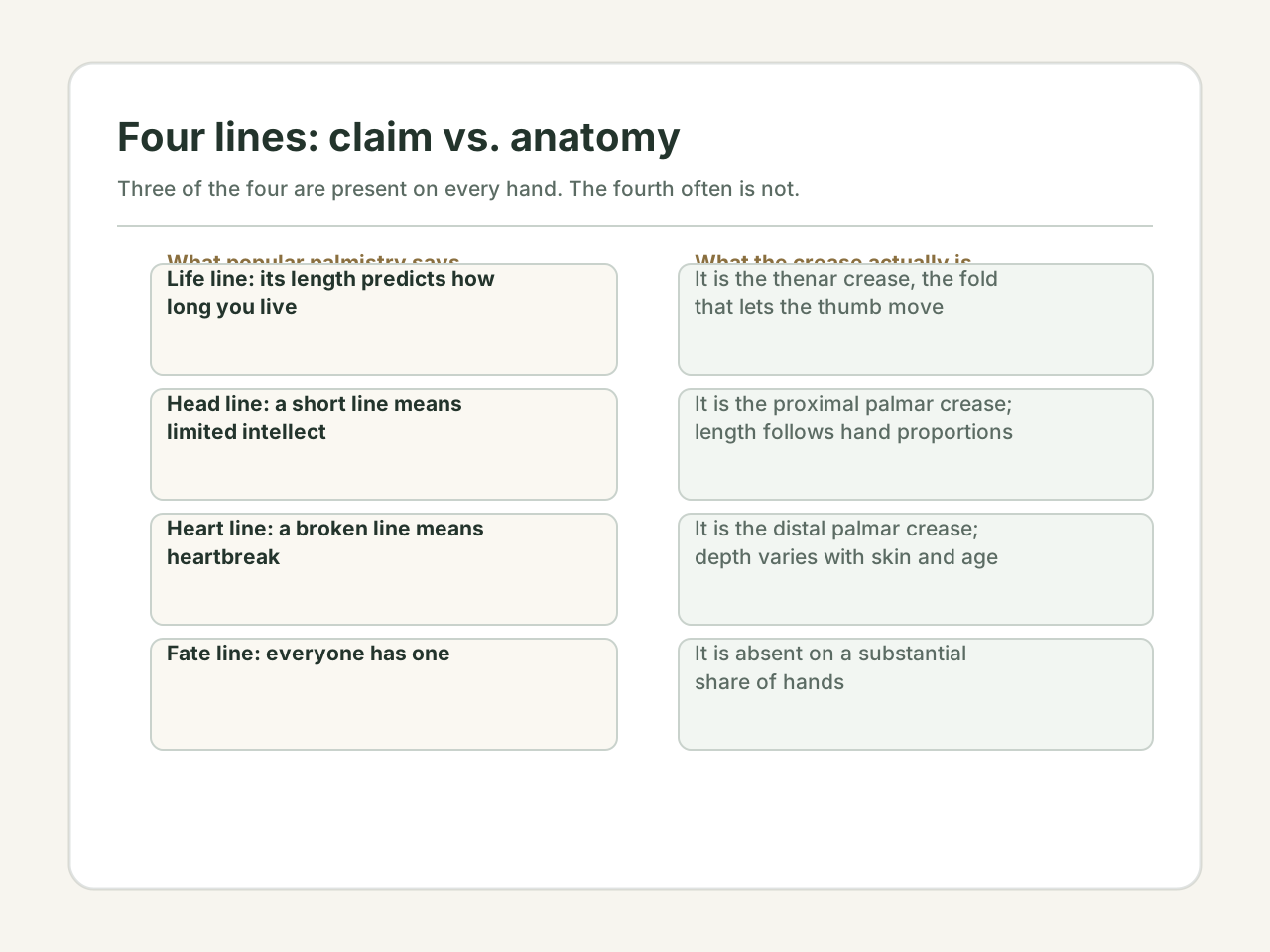
Ask someone to point at the lines on their palm and they will usually trace four: the life line, the head line, the heart line, and the fate line. The first three are present on essentially every hand, because they are the creases the hand needs in order to close. The fourth is not. The fate line, the vertical crease running up the middle of the palm, is missing on a substantial share of hands, and on many others it starts and stops instead of running continuously.
That asymmetry is the most useful thing to know before reading anything into the four lines. Three of them are structural. One of them is an occasional feature. Treating all four as equally fixed pieces of a map is where most popular palm reading goes wrong.
The life line is the crease that lets the thumb move
The life line curves around the base of the thumb, and in anatomy it is the thenar crease — the fold that forms where the thumb's muscle mass meets the rest of the palm. It sits in the same place on every hand because it is doing mechanical work: it is one of the folds that let the hand cup and the thumb oppose the fingers.
Its length follows the proportions of the hand, not the length of a life. A broad, fleshy palm with a large thenar eminence produces a long curve; a narrow hand produces a shorter one. Nothing in the anatomy of the crease carries information about how many years a person will live, and no study has found a relationship between the two.
What does vary visibly is depth and continuity. A deep, unbroken line and a faint, chained one are genuinely different observations, and a reader is entitled to describe the difference. The error is in the next step — turning 'faint' into 'fragile health' rather than 'this crease is less pronounced on this hand'.
The head and heart lines are the two horizontal creases
Across the upper palm run two roughly horizontal creases. The lower is the head line and the upper is the heart line; in anatomy they are the proximal and distal palmar creases, and together with the thenar crease they make the three folds described in clinical literature.
These are the two creases most often fused. When the proximal and distal creases merge into one line running across the whole palm, the result is a single palmar crease. MedlinePlus gives the frequency as about one person in thirty, notes that men are about twice as likely as women to have it, and describes it as usually a normal variant — though it also appears more often in certain chromosomal and developmental conditions. That last point has to be stated carefully: the association runs one way. A single crease does not indicate a condition; some conditions are more likely to include one.
For palm reading the practical consequence is that a fused line is not a dramatic sign. It is a common anatomical variant, and reading it as a warning is a good example of what happens when a tradition is applied without the anatomy underneath it.
The fate line is the one that often is not there
The fate line runs vertically up the centre of the palm toward the middle finger. English-language palmistry calls it the Saturn line. It is the least constant of the four, and its variability is the point: it can begin at the wrist, at the head line, or nowhere at all, and it can be a single stroke or a series of segments.
A reader who treats its absence as a deficiency is reading a common hand as a damaged one. In the classical Chinese material the vertical centre line is not one of the three creases that carry the basic reading at all; the career dimension is read through the pads and the overall hand type rather than through a single vertical crease. Naming it as one of four 'major lines' is a Western convention that arrived later.
Line, anatomical name, and how constant it actually is
The four names most readers use do not map onto four equally reliable structures.
| Line | Anatomical name | Where it runs | What the tradition reads | How constant it is |
|---|---|---|---|---|
| Life line | Thenar crease | Curves around the base of the thumb | Vitality and life course | Present on essentially all hands |
| Head line | Proximal palmar crease | Lower horizontal crease | Thinking style and decision habits | Present on essentially all hands; may fuse with the heart line |
| Heart line | Distal palmar crease | Upper horizontal crease | Emotional style and relationships | Present on essentially all hands; may fuse with the head line |
| Fate line | No standard anatomical name | Vertical, centre of the palm | Career and direction | Absent on a substantial share of hands |
Reading the four together, and the honest limit
The lines are read together because depth, length and branching are all relative. A head line that looks short on a wide palm may be average on a narrow one. A heart line that curves toward the index finger is not better than one that runs straight; it is a different shape, and the tradition assigns it a different reading.
What none of it does is predict. The creases form before birth, they do not encode events, and the traits the tradition assigns to them have not been shown to track anything measurable. A reading is a description in a traditional vocabulary, and its value lies in the conversation it starts about how a person works rather than in a forecast.
The practical test is simple. If a reading tells you something you could have noticed about yourself in a week of paying attention, it is doing its job. If it tells you what will happen, it has left the hand behind.
Disclaimer: This content is for informational and cultural reference purposes only. It does not constitute professional medical, legal, financial, or psychological advice. Readers should exercise their own judgment and consult qualified professionals for specific concerns.
Sources and review basis
Traditional references explain historical vocabulary and context. Official practical sources support only the observable safety, comfort, or environmental points noted in the article; they do not validate metaphysical claims.
Practical source
MedlinePlus: Single palmar creaseUS National Library of Medicine · Accessed 2026-10-18
The source for the timing and frequency used across the palm-reading articles: palmar creases develop in the womb, most often by the twelfth week of gestation, and a single palmar crease appears in about one person in thirty. It describes anatomy and association only; it makes no claim that a crease predicts anything.
Practical source
APA Dictionary of Psychology: Barnum effectAmerican Psychological Association · Accessed 2026-07-14
A psychology reference for why broad, favourable personality descriptions can feel personally accurate. It does not evaluate BaZi calculations themselves.