A month in this system is a solar term
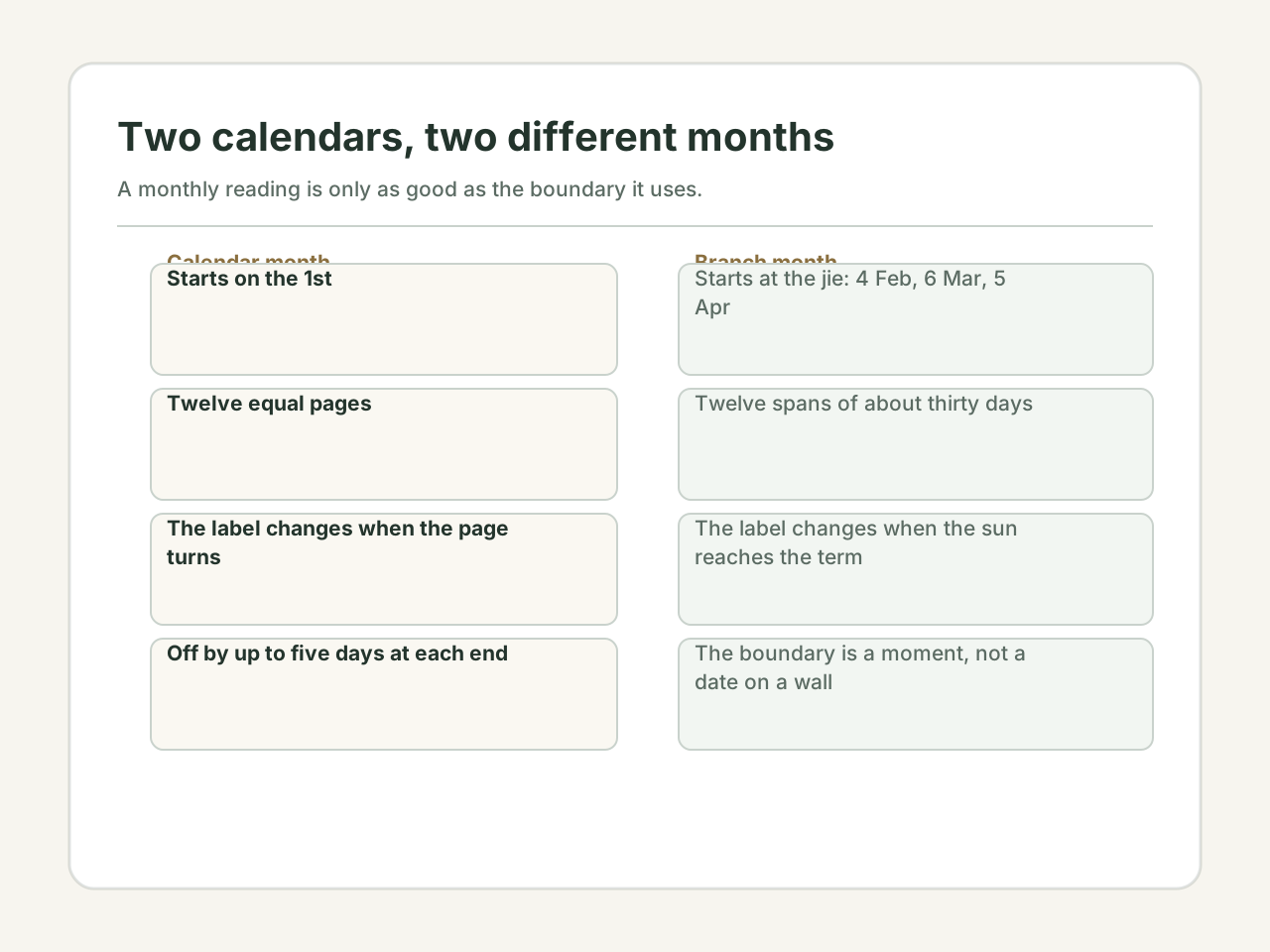
The twelve month branches do not begin on the first of a calendar month, and they do not begin at Chinese New Year. Each one begins at a jie — one of the twelve solar terms that mark the turn of a season.
The twenty-four terms alternate between jie and qi. A jie opens a month; the qi that follows sits near its middle. That is why the dates below are all jie dates and not, for example, the spring equinox or the summer solstice.
That single rule is the difference between a monthly reading that lines up with the tradition and one that does not.
| Month branch | Starts at | 2027 date |
|---|---|---|
| yin | Start of Spring | 4 February |
| mao | Awakening of Insects | 6 March |
| chen | Clear and Bright | 5 April |
| si | Start of Summer | 6 May |
| wu | Grain in Ear | 6 June |
| wei | Minor Heat | 7 July |
| shen | Start of Autumn | 8 August |
| you | White Dew | 8 September |
| xu | Cold Dew | 8 October |
| hai | Start of Winter | 7 November |
| zi | Major Snow | 7 December |
| chou | Minor Cold | 5 January |
The first days of a month belong to the one before
In 2027 the mao month begins on 6 March. So 1–5 March is still the yin month — the Tiger, not the Rabbit — even though every wall calendar has turned the page.
The error is not decorative. The branch changes only at the term, so a forecast printed by calendar month is wrong at both ends of every month, by up to five days. Anyone who has followed a monthly forecast into the last week of a month has met the same problem from the other side: the reading has already moved on to a period that has not started.
It also means the month being described is not a fixed thirty days. A branch month runs from one jie to the next, which is about thirty days and varies by a day or two with the solar year. Any table that assigns a fixed number of days to a branch month has already stopped describing the calendar it claims to use.
The offsets never change
Your birth branch is fixed for life. The twelve month branches are fixed in the calendar. So the relation between them is fixed too.
A zi person is in a clash every wu month — roughly June — and in a combination every chou month, in January. That is true this year, next year and in forty years.
Which means a monthly forecast by animal sign is a static twelve-cell table. It does not change from year to year, because nothing in the calculation changes. Two sites publishing such a table for the same sign are not competing readings; they are the same reading, and either can be checked against the other in a minute.
Why the table still feels like information
It reads as a calendar of attention: June is the month you are told to expect friction, January the month you are told to expect support. Because it repeats, it works as a habit cue rather than as news.
The Barnum effect does the rest. A statement that fits a twelfth of the population will fit almost anyone on some day of the month it describes, and the reader supplies the confirming example.
None of that makes the table useless. It makes it a schedule, which is a different thing from a prediction.
What actually varies is the stem
The month branch is fixed; the month stem is not. It is derived from the year stem by a fixed rule — the wu hu dun sequence, which starts the first month at a stem determined by the year stem and then counts on — so the same branch carries a different stem in different years.
That matters because a BaZi month reading is built from the stem-branch pair, and the ten gods are read from the stem’s relation to the day master. The animal sign supplies half of the pair, and never the half that changes.
So the year-specific content of a monthly reading comes from the stem, not the animal. A forecast that mentions only the animal has discarded the one variable it had.
There is one more distinction worth separating. In a chart, the month branch is not primarily a time period at all: it is the season a person was born into, and it is the heaviest single factor in judging whether the day master is strong or weak. The month as a forecast period and the month as yue ling, the seasonal command, are two different uses of the same character. A monthly forecast borrows the second and quietly drops the first.
Put the term dates in the calendar
The useful part of this system is the boundary, and the boundary can be written down once a year.
- Enter the twelve jie dates for the coming year. They are stable to within a day and do not need to be recalculated monthly.
- If you plan around a month, plan around the term date. Anything scheduled in the first week of a Gregorian month is probably still in the previous branch month.
- Then keep the calendar and drop the forecast. Knowing when a period turns is the part that survives; the label attached to it is the part that repeats.
Disclaimer: This content is for informational and cultural reference purposes only. It does not constitute professional medical, legal, financial, or psychological advice. Readers should exercise their own judgment and consult qualified professionals for specific concerns.
Sources and review basis
Traditional references explain historical vocabulary and context. Official practical sources support only the observable safety, comfort, or environmental points noted in the article; they do not validate metaphysical claims.
Traditional reference
Sanming Tonghui (三命通会)Wikisource digital text · Accessed 2026-07-14
A historical compilation used to cross-check traditional BaZi concepts; it is not scientific validation.
Traditional reference
Seasonal Customs of Jing-Chu (荆楚歲時記)Wikisource digital text · Accessed 2026-10-14
A sixth-century record of regional seasonal customs. Cited for the earliest written description of the ninth-day outing and the use of 茱萸; it is a historical text, not evidence for any effect of the date.