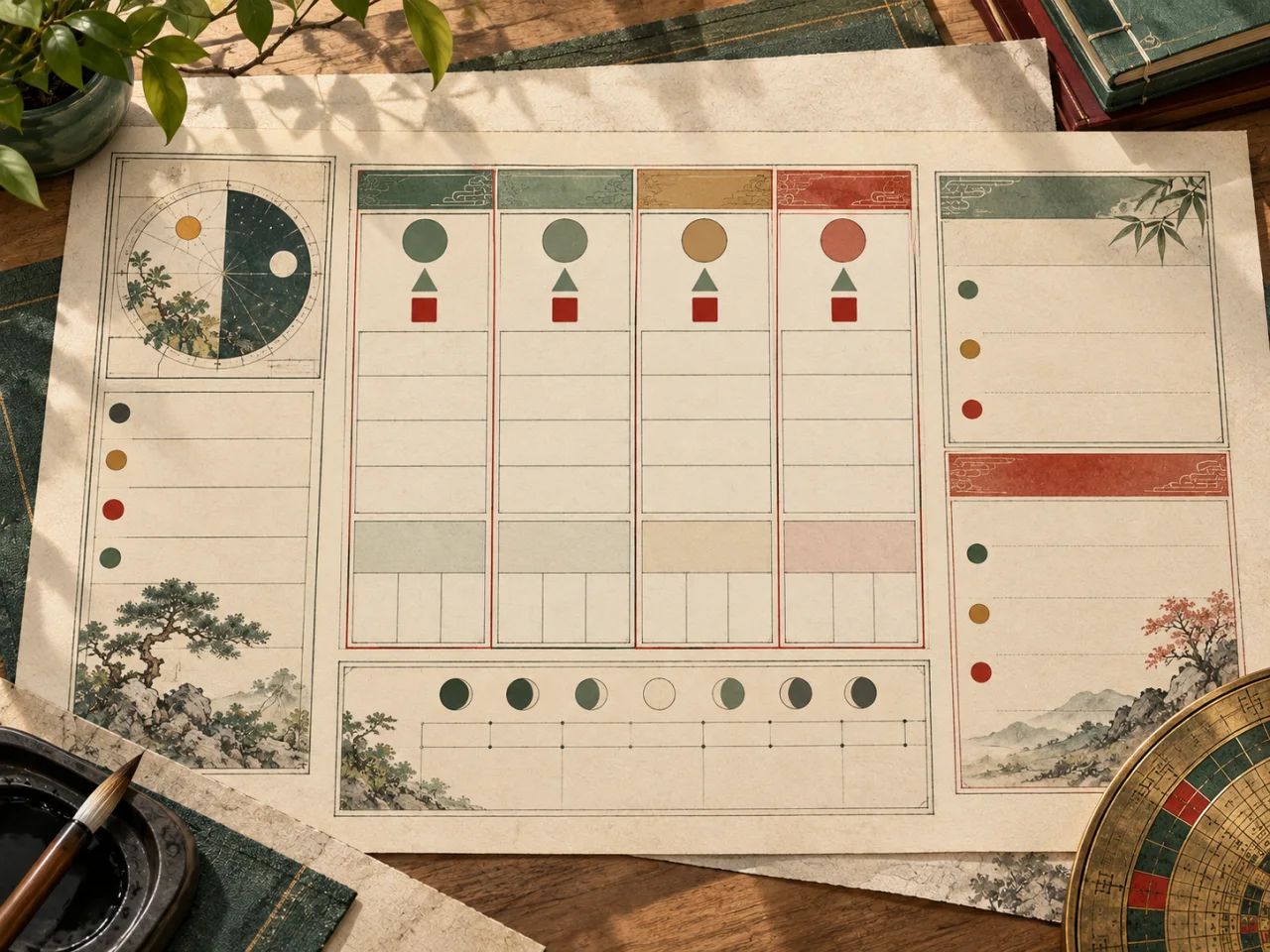
Two maps of the same palm, from two different traditions
Look up palm mounts and you will find a palm divided into pads named after planets: Venus at the thumb, Moon on the opposite edge, Jupiter under the index finger, Saturn under the middle, Apollo under the ring finger, Mercury under the little finger, and Mars in two places. The scheme is coherent and old — in the European tradition.
Chinese palmistry maps the same palm differently. It divides the hand into 八卦宫位, eight positions named after trigrams, and reads them as areas of life rather than as planetary influences. The two maps cover the same territory and do not line up. Much of the English-language material on Chinese palm mounts is a blend of both.
The Western mounts are planets, and the naming is the system
The planetary names are not decoration; they are the logic. Each pad is assigned to a planet and inherits that planet's associations: Venus for warmth and appetite, Mars for courage and conflict, Jupiter for authority, Saturn for discipline and limit, Apollo for display and recognition, Mercury for exchange and speech, the Moon for imagination.
The scheme follows a pattern older than palmistry itself. Medieval astrology assigned parts of the body to signs and planets — Aries to the head, Taurus to the throat, and so on — and palmistry applied the same logic to the hand, giving each region a planet and letting the planet supply the meaning. The list is also visibly historical: it is built from the planets known to the medieval West, which is why the pads carry Jupiter and Saturn but not Uranus or Neptune. The Neptune mount is a later addition to an older set, and a reader using it is extending the system rather than reporting an observation.
That is an astrological scheme applied to the hand. It is worth saying plainly: the pads are not named after planets because of anything observed about them. They are named because the system needed a set of symbols, and the planets were the set available.
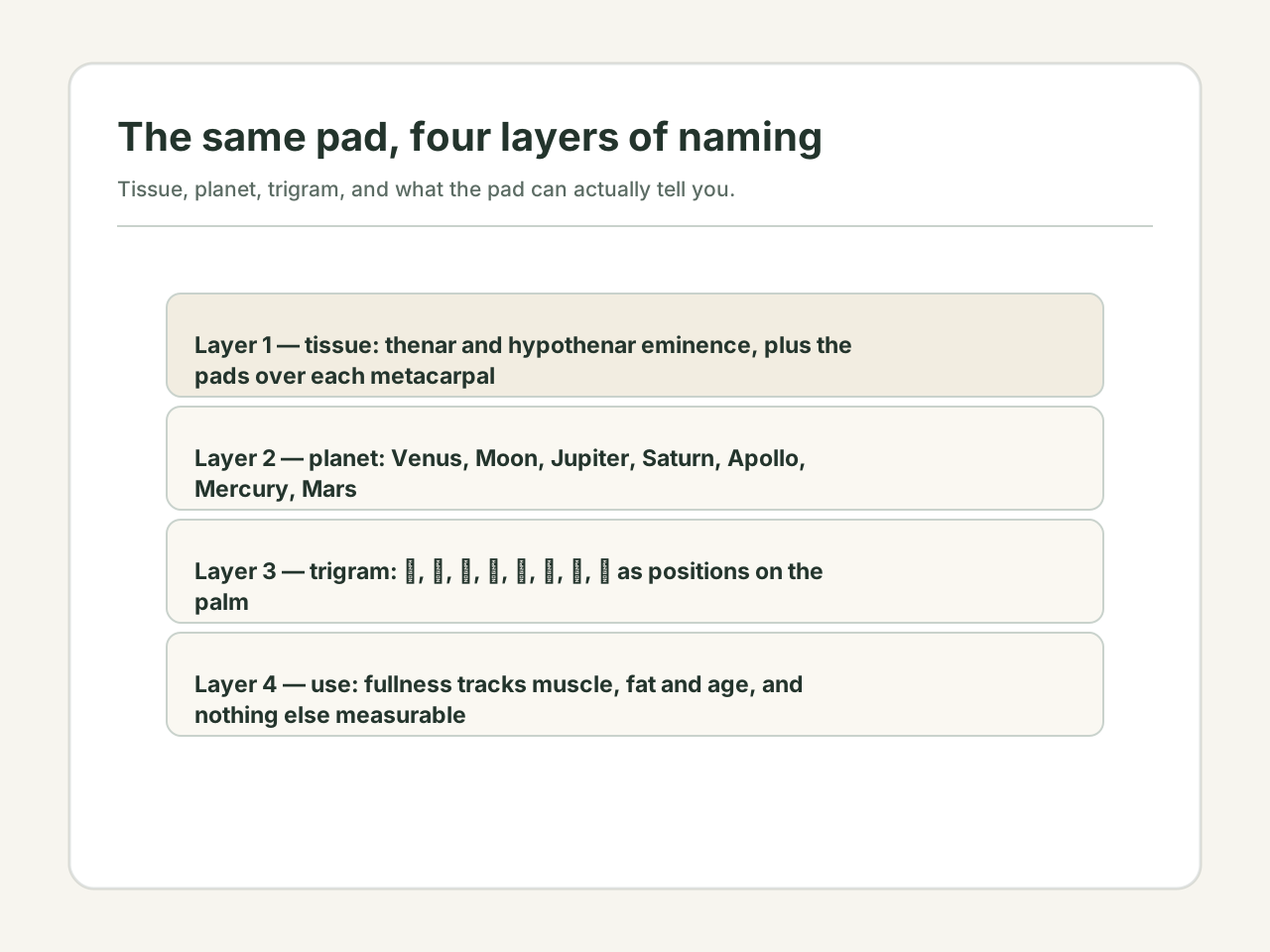
The Chinese palm divides into trigrams instead
In the Chinese scheme the palm is divided into 乾, 坎, 艮, 震, 巽, 离, 坤 and 兑 — eight positions arranged around the hand, each associated with a domain such as wealth, career, marriage or children depending on the text. The 掌丘 of classical writing is a looser term for the fleshy regions and does not carry planetary identities.
The practical difference is structural. A trigram position is a location, and its reading depends on what sits there: a pad, a crease, a mark. A planetary mount is a region with a personality already built into its name. Reading one as though it were the other produces statements that neither tradition would make.
The pads themselves are muscle and fat
Anatomically, the prominent pads are the thenar eminence at the base of the thumb and the hypothenar eminence on the little-finger side, plus the softer tissue over the metacarpals beneath each finger. Their fullness tracks three things: muscle use, body fat and age.
This is why mount reading contains a grain of truth. Someone who works with their hands, plays an instrument or does a physically demanding job will develop the pads they use. A reader who says the Venus mount is well developed is, in plain terms, describing a hand that grips and lifts. The observation is real. The inference — that this indicates warmth and sensuality — is the interpretive layer placed on top.
There is a second, less obvious source of variation: fat distribution changes with age and with overall body composition, and it does so unevenly. A hand that was bony at twenty can look padded at fifty without any change in what it does. A reader comparing two hands of different ages is partly comparing two metabolisms, which is another reason to treat pad reading as description rather than diagnosis.
Mount, planet, Chinese counterpart, and what the pad actually is
Four names for the same piece of tissue. Only the last column is measurable.
| Mount | Planet | Chinese counterpart | What the pad actually is |
|---|---|---|---|
| Base of the thumb | Venus | 艮宫 region | Thenar eminence, the muscle mass that moves the thumb |
| Outer edge, opposite the thumb | Moon | 乾宫 and 兑宫 regions | Hypothenar eminence |
| Under the index finger | Jupiter | 巽宫 region | Tissue over the second metacarpal |
| Under the middle finger | Saturn | 离宫 region | Tissue over the third metacarpal |
| Under the ring finger | Apollo | 坤宫 region | Tissue over the fourth metacarpal |
| Under the little finger | Mercury | 坤宫 and 兑宫 regions | Tissue over the fifth metacarpal |
| Between thumb and index, and the outer edge | Mars | 震宫 region | The muscular areas on either side of the palm |
What the pads can and cannot tell you
The pads can tell you, roughly, what a hand does for a living and how much flesh is on it. That is a genuine observation, and it is available to anyone who looks.
They cannot tell you that one area of your life holds more energy than another. That claim comes from the planetary layer rather than from the tissue, and it has no independent support. When a reading says the Jupiter mount shows ambition, the ambition is in the symbol, not in the pad.
Used honestly, the mounts are the least mystical part of palmistry: they are a reminder that a hand is a working instrument and that its shape records use. That is worth more than a horoscope of the palm.
Disclaimer: This content is for informational and cultural reference purposes only. It does not constitute professional medical, legal, financial, or psychological advice. Readers should exercise their own judgment and consult qualified professionals for specific concerns.
Sources and review basis
Traditional references explain historical vocabulary and context. Official practical sources support only the observable safety, comfort, or environmental points noted in the article; they do not validate metaphysical claims.
Practical source
MedlinePlus: Single palmar creaseUS National Library of Medicine · Accessed 2026-10-18
The source for the timing and frequency used across the palm-reading articles: palmar creases develop in the womb, most often by the twelfth week of gestation, and a single palmar crease appears in about one person in thirty. It describes anatomy and association only; it makes no claim that a crease predicts anything.
Practical source
APA Dictionary of Psychology: Barnum effectAmerican Psychological Association · Accessed 2026-07-14
A psychology reference for why broad, favourable personality descriptions can feel personally accurate. It does not evaluate BaZi calculations themselves.