A palm has three creases, four pads, and one overall shape
A hand is not a page. Before any tradition is applied to it, a palm carries a small, fixed inventory of features: the proportions of palm and fingers, three long creases that let the hand fold, a set of fleshy pads over the metacarpals, and the skin itself — its thickness, its smaller folds, its colour.
Chinese palmistry (手相) reads that inventory in a set order: 掌型 first, then 掌纹, then 掌丘, then 掌色. The order matters because each layer constrains the next. A deep line on a narrow hand is read differently from the same line on a broad one, and a reader who starts with the line has already skipped the two observations that would have made the line mean anything.
Hold on to one fact while reading any of the four articles in this topic: only one of those layers is stable. The pads change with muscle and fat. Colour changes with circulation, temperature and light. The three main creases are formed before birth and do not move.
The creases are built before birth, and that settles several arguments
Palmar creases develop while the hand is folding in the womb, most often by the twelfth week of gestation, according to MedlinePlus, the consumer health service of the US National Library of Medicine. In most palms there are three: two roughly horizontal creases and one that curves around the base of the thumb. In about one person in thirty, two of the horizontal creases fuse into a single line, and the trait is roughly twice as common in men.
This is the most useful single fact for anyone learning palm reading, because it quietly rules out a great deal of what gets written about hands. The creases are not a record of your choices. They are not deepened by hard work or lengthened by good fortune. They are folds that appear on every human hand, in the same places, at the same stage of development, because a hand has to fold to be a hand.
What the creases do vary in is depth, clarity, branching, and the exact angle at which they meet. Those variations are real, visible, and stable enough to describe. Whether they mean anything about a life is a separate question, and not one that anatomy answers.
What the tradition reads, and where its vocabulary comes from
The classical Chinese literature on hands is usually traced to 麻衣神相 (Ma Yi Shen Xiang), a text attributed to a figure called the Hemp-Robed Daoist and compiled in the Song era. Its method is not a list of lucky and unlucky lines. It is a layered reading: the hand's element type sets the baseline, the three main creases describe the broad pattern, the smaller creases add detail, and the pads give the reading its emphasis.
Two conventions in that tradition are worth knowing because they are often presented as rules. The first is 男左女右 — men read the left hand, women the right. This is a later folk convention rather than a universal principle, and many practitioners instead read the dominant hand as the present and the other hand as the inherited baseline. The second is that classical texts map the palm through 八卦宫位, eight trigram positions, rather than through the planetary mounts that English-language palmistry uses. The two maps cover the same hand and are not translations of each other.
What is on the palm, what the tradition reads into it, and what it physically is
The same feature can be described three ways. Keeping the three descriptions apart is the whole discipline of reading a hand without overclaiming.
| Feature | What palmistry reads | What it physically is | Does it change? |
|---|---|---|---|
| Overall shape | An element type (金木水火土) that sets the register for everything else | Proportions of palm length, palm width, finger length and flesh | No — bone and proportion are fixed in adulthood |
| The three main creases | Vitality, thinking style, emotional style | Flexion creases formed by about the twelfth week of gestation | No — position is fixed; depth can look different with age and skin |
| Smaller creases | Detail on health, travel, relationships | Secondary skin folds, partly produced by repeated movement | Somewhat — they can soften or deepen |
| The pads | Emphasis across different areas of life | Muscle and fat over the metacarpals | Yes — with muscle use, body fat and age |
| Colour and texture | Constitution and current condition | Circulation, hydration, skin thickness, callus | Yes — day to day |
The order a reading actually goes in
Beginners almost always start with a line, usually the life line, and work outward from it. That is backwards, for a practical reason: every feature is read relative to the hand it sits on. A short life line on a wide, fleshy palm and the same line on a narrow, bony one are two different observations, and neither one is a statement about lifespan.
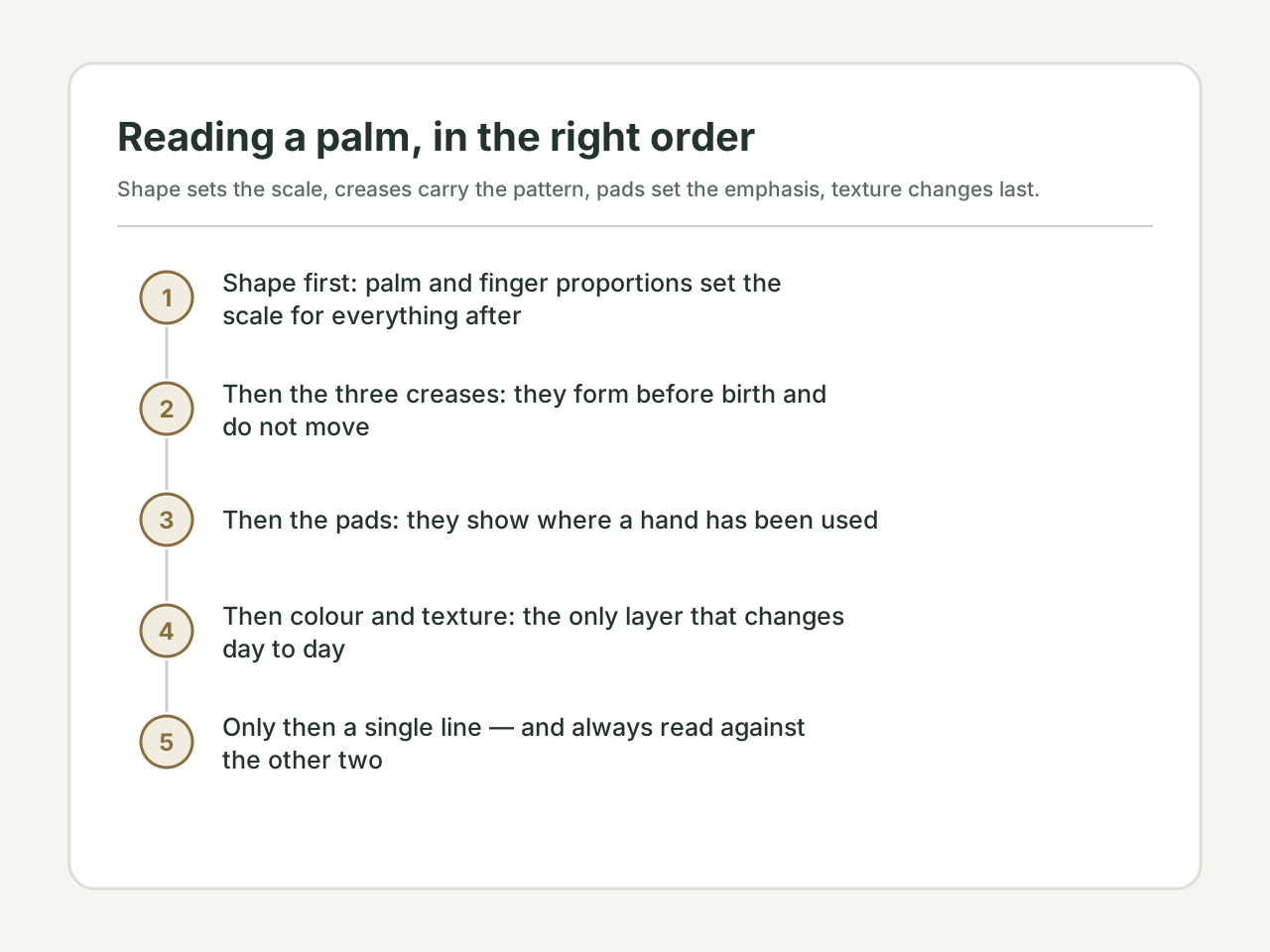
The workable order is shape first, because it sets the scale; creases second, because they are the most stable and most legible layer; pads third, because they tell you where the reading should be weighted; texture last, because it changes. Only then does a single line get read on its own, and even then it is read against the other two.
This is also the order that keeps a reading honest. When someone asks what a particular line means, the accurate answer always begins 'on this hand, with these other features, it reads as…'. There is no context-free meaning for any single crease.
Where a beginner's reading stops
The limit is not that palmistry is old. The limit is that no study has shown the creases predict anything about a person's life, and there is a well-documented reason readings feel accurate anyway: the Barnum effect, in which people accept vague, flattering descriptions as personally precise. The American Psychological Association's dictionary entry on the effect is worth reading before reading anyone's hand, including your own.
That leaves two honest uses. The first is vocabulary: a shared way of talking about temperament, energy and habit, which is what most people actually want from a reading. The second is a prompt for self-observation — noticing that you hold tension in your hands, that your dominant hand is more marked than the other, that your work has callused a particular pad.
What a palm reading cannot do is tell you how long you will live, whom you will marry, or which year will be difficult. Nothing on the hand carries that information. Read the hand for what it is: a small, legible piece of anatomy with a long interpretive tradition laid over it.
Disclaimer: This content is for informational and cultural reference purposes only. It does not constitute professional medical, legal, financial, or psychological advice. Readers should exercise their own judgment and consult qualified professionals for specific concerns.
Sources and review basis
Traditional references explain historical vocabulary and context. Official practical sources support only the observable safety, comfort, or environmental points noted in the article; they do not validate metaphysical claims.
Practical source
MedlinePlus: Single palmar creaseUS National Library of Medicine · Accessed 2026-10-18
The source for the timing and frequency used across the palm-reading articles: palmar creases develop in the womb, most often by the twelfth week of gestation, and a single palmar crease appears in about one person in thirty. It describes anatomy and association only; it makes no claim that a crease predicts anything.
Practical source
APA Dictionary of Psychology: Barnum effectAmerican Psychological Association · Accessed 2026-07-14
A psychology reference for why broad, favourable personality descriptions can feel personally accurate. It does not evaluate BaZi calculations themselves.