太歲 is a position before it is a figure
The usual translation, year god, invites a picture of a deity who takes offence and has to be appeased. In the text where the term is fixed, it is a station on a circuit. 咸池為太歲,二月建卯,月從右行四仲,終而復始。太歲迎者辱,背者強,左者衰,右者昌。 The rule is directional — facing it is worse than turning your back on it — and it is stated about a point in the sky, not about anyone's character.
The same chapter supplies the clash. 歲星之所居,五榖豐昌,其對爲衝,歲乃有殃。 The point opposite the year star is called 衝. So 沖太歲 is not a later folk addition; it is in the Han text, and what it names is the station opposite the year's station.
The position is fictitious on purpose, because Jupiter does not take twelve years
Jupiter's sidereal period is 11.862 years, not 12. Divide a circle by it and the planet advances 30.35° a year, so after twelve years it has travelled 364.2° — four degrees short of where the twelve-year count says it should be.
That shortfall is small and it accumulates. At 0.35° a year it takes about 86 years to add up to one whole station, and the historical 岁星 reckoning dealt with the surplus by inserting an extra station, a 超辰, every few generations. The fix that replaced it was to stop using the planet at all: define a point that moves exactly 30° a year, in the direction opposite to Jupiter, and name the years after that. That point is 太歲. It is a bookkeeping device, invented to keep a twelve-part cycle divisible by twelve.
This matters for how the term is read. 太歲 is not an object that can be observed, so nothing about it can be measured; but it is defined with complete precision, so everything about its position can be calculated. Those two properties together are what a calendar convention looks like.
Five relations bundled under one phrase
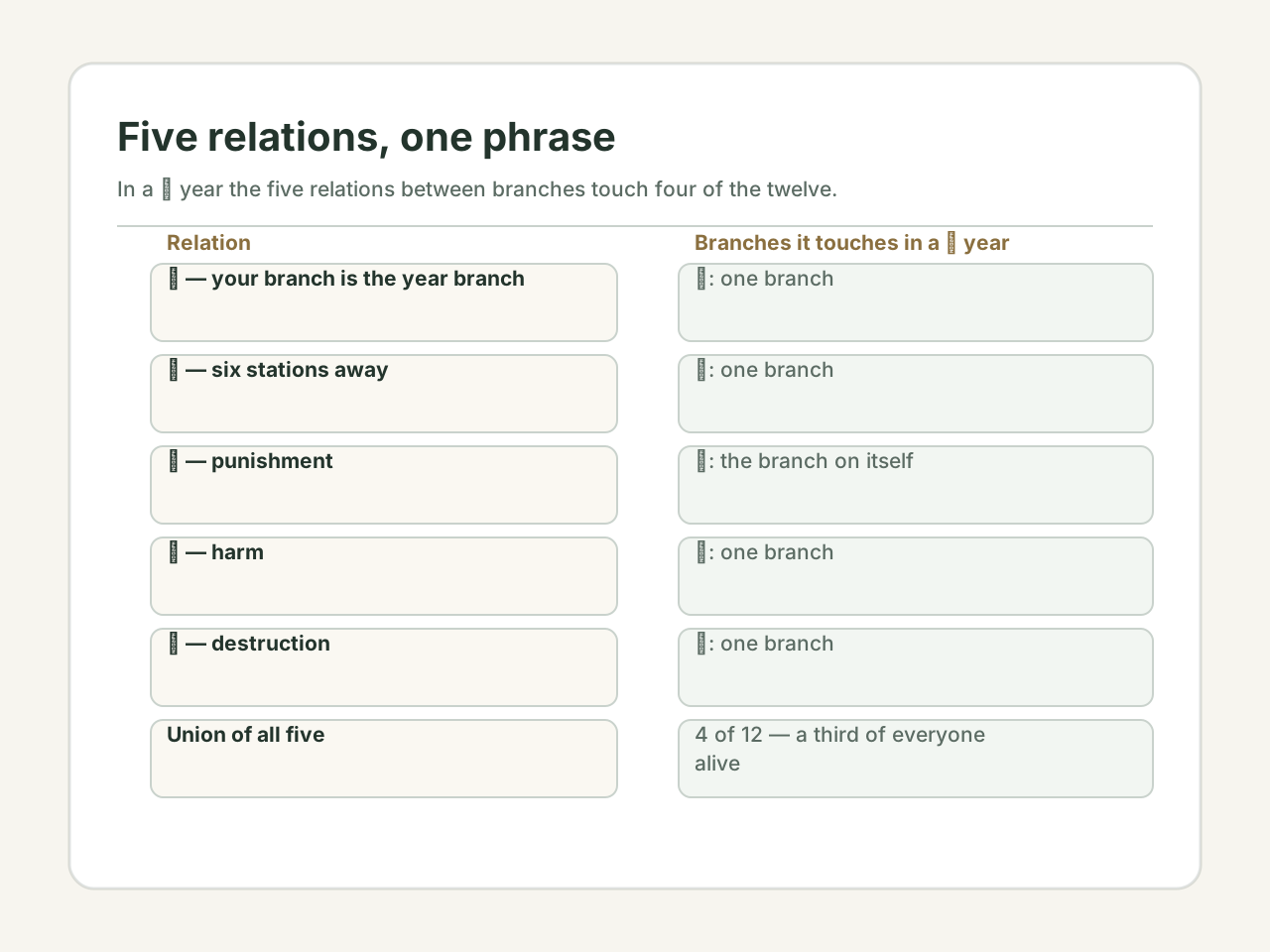
What people are told at each new year is that they 犯太歲 — offend the year. The phrase bundles five branch relations, each with its own rule. Taking 2026, a 丙午 year, as the example:
| Relation | Rule | Branches it touches in a 午 year |
|---|---|---|
| 值 (on duty) | your branch is the year branch | 午 |
| 沖 (clash) | six stations away | 子 |
| 刑 (punishment) | 子卯; the 寅巳申 triad; the 丑戌未 triad; or a branch on itself | 午 (on itself) |
| 害 (harm) | 子未, 丑午, 寅巳, 卯辰, 申亥, 酉戌 | 丑 |
| 破 (destruction) | 子酉, 丑辰, 寅亥, 卯午, 巳申, 未戌 | 卯 |
The full count, for all twelve years
Union the five relations for each possible year branch and the set is never smaller than four branches and never larger than five. Four years in twelve implicate five branches; the other eight implicate four. The total across a full cycle is 52 branch-years, which is an average of 4.33 out of twelve — 36% of everyone alive in an average year.
The table is the whole argument, and it can be checked by hand in ten minutes:
| Year branch | Branches implicated | Count |
|---|---|---|
| 子 | 子 午 卯 未 酉 | 5 |
| 丑 | 丑 未 午 辰 戌 | 5 |
| 寅 | 寅 申 巳 亥 | 4 |
| 卯 | 卯 酉 辰 午 子 | 5 |
| 辰 | 辰 戌 卯 丑 | 4 |
| 巳 | 巳 亥 寅 申 | 4 |
| 午 | 午 子 丑 卯 | 4 |
| 未 | 未 丑 子 戌 | 4 |
| 申 | 申 寅 亥 巳 | 4 |
| 酉 | 酉 卯 戌 子 | 4 |
| 戌 | 戌 辰 酉 未 丑 | 5 |
| 亥 | 亥 巳 申 寅 | 4 |
Where "one in three" comes from: how many relations you bother to count
The figure is not a fact about the year. It is a function of how many of the five relations a practitioner includes, and the range is wide enough to explain most of the disagreement between one almanac and the next.
Counting only 值 and 沖, the two everybody knows, gives two branches out of twelve — 17%. Add 害 and it is three, 25%. Add 破 and it is four, 33%. Add 刑 and it settles at four or five, 36% on average. Every one of those numbers is defensible from the same list of relations; the only thing that changes is where the list stops.
| Relations counted | Branches per year | Share of people |
|---|---|---|
| 值 + 沖 | 2 | 17% |
| + 害 | 3 | 25% |
| + 破 | 4 | 33% |
| + 刑 | 4 or 5, average 4.33 | 36% |
Over twelve years it reaches everyone, without exception
A single year's set covers a third of the population, which already makes the label weak as a warning. The twelve-year view makes it weaker still. Every branch is the 值 branch of exactly one year in twelve, and the 沖 branch of exactly one other, six years later. So every person alive is 犯太歲 at least twice in any twelve-year window, whatever their birth year, and on the full five-relation count the average is 4.33 times.
That is the part worth holding on to. A warning that reaches a third of the population every year, and all of it within twelve, is not distinguishing between people. It is describing the calendar.
What is prescribed, and which parts can be checked
Four practices attach to the label, and they differ sharply in whether anything about them can be verified:
- 安太歲, a rite performed at a temple for the year, usually with the name and birth date written on a slip. It is a ceremony; whether it did anything is not observable, and it is not sold as though it were.
- 穿紅, wearing red for the year. A convention with no mechanism offered, and the cheapest of the four.
- 躲春, avoiding conflict during the hour that contains the 立春 moment — staying indoors, not arguing, not travelling. This one is checkable in the narrow sense: the moment is computed from the sun's apparent longitude reaching 315°, published to the minute, and in 2027 it falls on 4 February. The window is exactly one 時辰 wide, and you can verify that you stayed inside it.
- 太歲方, the direction of the year branch, and 歲破, the direction opposite. In a 午 year that is due south and due north, and the traditional warning is against digging or building in the 太歲 sector. This is the only one of the four that can be checked against the physical world, because a compass settles it and a renovation either is or is not in that sector.
What the label can and cannot carry
The calendar half is exact. Which branch the year carries, which branches that implicates, when 立春 falls, which compass sector the year occupies — all of it is defined, computable, and the same for everyone who does the arithmetic correctly. If the question is what the year is called, there is a right answer.
The consequence half is not. Nothing about a branch relation can be tested against how a year goes, and the arithmetic above explains why the attempt fails: the relation is satisfied by a third of the population in any given year, so it cannot separate the people whose year went badly from the people whose year went well.
The usable position follows from that split. Treat 犯太歲 as a fact about the calendar and a convention about conduct — the hour to stay in, the sector not to dig up, the red thing to wear if it pleases you — and not as a forecast. The label is precise. It is just not about you.
Disclaimer: This content is for informational and cultural reference purposes only. It does not constitute professional medical, legal, financial, or psychological advice. Readers should exercise their own judgment and consult qualified professionals for specific concerns.
Sources and review basis
Traditional references explain historical vocabulary and context. Official practical sources support only the observable safety, comfort, or environmental points noted in the article; they do not validate metaphysical claims.
Traditional reference
Huainanzi, “Treatise on Celestial Patterns” (淮南子·天文訓)Wikisource digital text · Accessed 2026-10-26
The Han text that states the twelve-year count as an observation of Jupiter: 太陰在四仲,則歲星行三宿;太陰在四鉤,則歲星行二宿。二八十六,三四十二,故十二歲而行二十八宿。 It then fixes the schematic counter that replaces the planet — 天維建元,常以寅始起,右徙一歲而移,十二歲而大周天 — and names the clash as the opposite point: 歲星之所居,五榖豐昌,其對爲衝。 Cited for the period and the vocabulary only; nothing in it predicts anything about a person.
Practical source
APA Dictionary of Psychology: Confirmation biasAmerican Psychological Association · Accessed 2026-10-26
A psychology reference for why evidence that fits an existing expectation is kept and evidence that does not is not retrieved. Used to explain what a dated dream record changes; it does not evaluate dream interpretation itself.