The twelve-step count is older than the animals
The sequence — rat, ox, tiger, rabbit, dragon, snake, horse, goat, monkey, rooster, dog, pig — is the part everyone knows and the least informative part. What the cycle actually is, is a twelve-step count of years. The steps are named after animals because twelve arbitrary numbers are hard to hold in the head and twelve animals are not. The animal is a mnemonic attached to a number, and the number came first.
So the real question is not what each animal means. It is why the count has twelve steps and not ten or fourteen. The Huainanzi answers it in one sentence, and the sentence is a division problem.
The Huainanzi sentence is a division problem
The passage reads: 太陰在四仲,則歲星行三宿;太陰在四鉤,則歲星行二宿。二八十六,三四十二,故十二歲而行二十八宿。 Jupiter — 歲星, the year star — travels through the twenty-eight lunar mansions, three mansions in some years and two in others, and closes the circuit in twelve years.
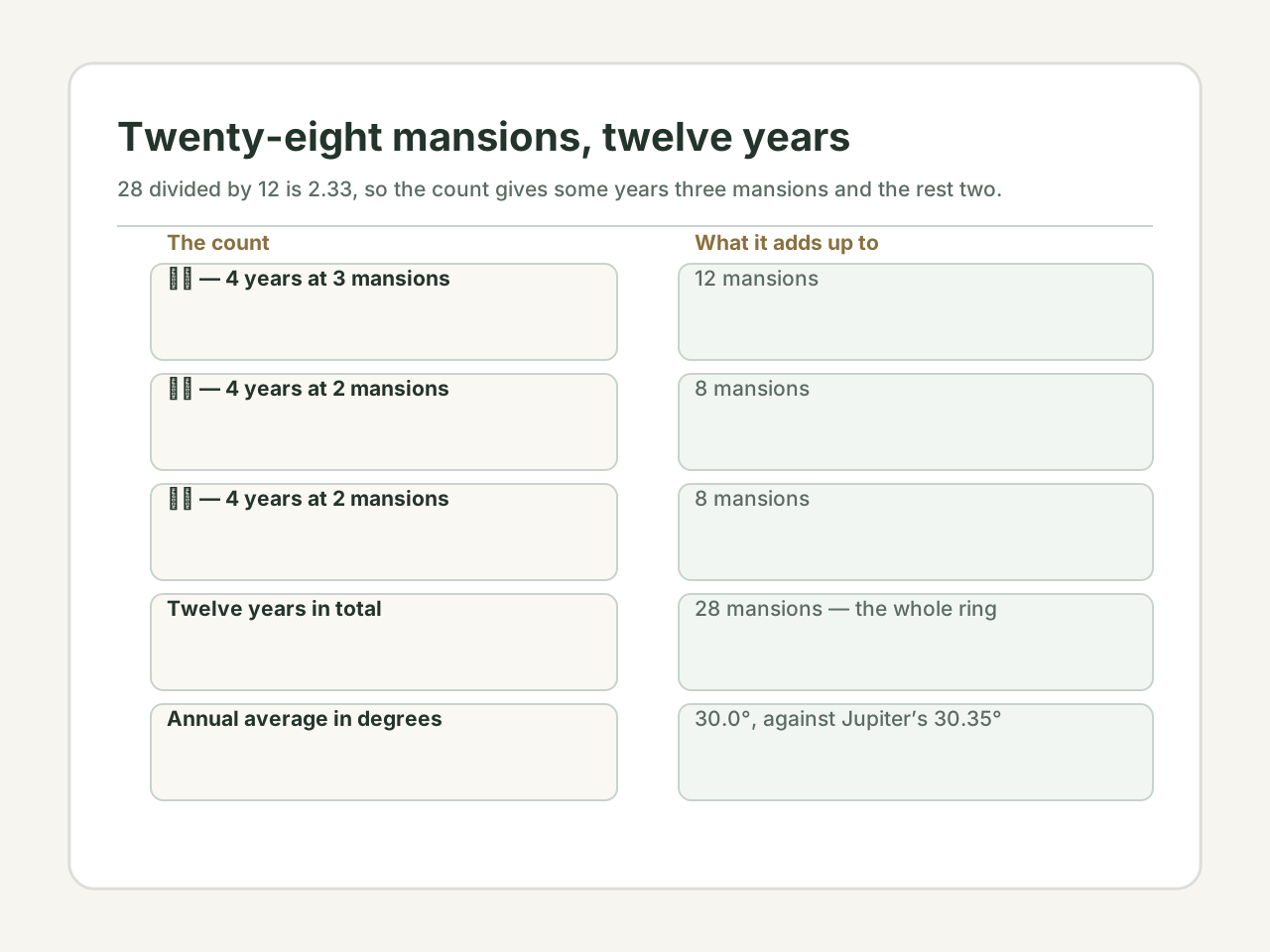
The arithmetic in the middle is the part usually skipped. 二八十六 is eight positions at two mansions each; 三四十二 is four positions at three each. Twelve positions, twenty-eight mansions, twelve years. Laid out:
| Group | Positions | Mansions a year | Subtotal |
|---|---|---|---|
| 四仲 — 子 午 卯 酉 | 4 | 3 | 12 |
| 四鉤 — 寅 申 巳 亥 | 4 | 2 | 8 |
| 四維 — 辰 戌 丑 未 | 4 | 2 | 8 |
| Total | 12 years | — | 28 mansions |
The division does not come out even, which is why the split exists
Twenty-eight mansions spread over twelve years is 2.33 mansions a year, and 2.33 is not a whole number. A planet cannot spend two thirds of a year in one mansion and move on, because the mansion is a label for a region, not a duration. The only way to keep the count integral is to give some years three and the rest two — which is exactly what the passage does, and why it needs two separate clauses to say it.
The cost of that repair shows up the moment the units are converted. If the twenty-eight mansions are treated as an even division of the circle, each is 360 ÷ 28 = 12.86°. Two and a third of those is 30.0° a year. NASA puts Jupiter's sidereal period at 11.86 years, which is 30.35° a year. The count and the planet part company by 0.35° a year:
| Quantity | Value |
|---|---|
| 28 mansions ÷ 12 years | 2.33 mansions a year |
| One mansion, if the circle is split evenly (360° ÷ 28) | 12.86° |
| 2.33 × 12.86° | 30.0° a year |
| Jupiter's actual advance (NASA, 11.86-year orbit) | 30.35° a year |
| Difference | 0.35° a year |
Counted in mansions instead of degrees, the gap is a third of a mansion
The same shortfall can be stated without degrees at all, which is closer to how the original count was kept. Twelve years of Jupiter at 30.35° a year is 364.2°, and 364.2° ÷ 12.86° is 28.3 mansions. The count says twenty-eight. The planet delivers twenty-eight and a third.
So the residue is not only a number of degrees. It is a fraction of a mansion per cycle, which is precisely the quantity the passage had to round away in order to keep the year count integral. The rounding and the drift are the same fact described twice.
Dividing the circle evenly removes the ambiguity
The alternative needs no allocation at all. Split 360° into twelve equal parts and every part is 30°, every year, with nothing left over and nothing to distribute. There is no year that has to absorb a fraction, and no dependence on which mansion happens to be where.
That is the whole advantage, and it is a bookkeeping advantage rather than an astronomical one. A cycle built from equal parts can be computed forward from any starting point without consulting the sky. A cycle built from mansion counts cannot, because the mansions are landmarks of unequal width and the count is only defined relative to them.
The trade is real in both directions. An even division buys arithmetic that always closes, and gives up any claim to describe where the planet actually is. A mansion count keeps a visible link to the sky, and cannot be added up without a rounding rule.
Why an approximate count was good enough to keep
A year count has two possible jobs. One is to say where Jupiter is; the other is to give each year a label that never repeats ambiguously. The first job needs the planet. The second needs only internal consistency.
Once the count was doing the second job, the 0.35° stopped mattering. Nobody numbering a year needs the number to be a position; they need last year's number to differ from this year's by exactly one. The twelve-step ring delivers that, and delivers it without an observation, which is why it outlasted the observation it was built from.
The residue only becomes a problem when someone tries to run the count backwards — to take a year label and infer a sky position from it. That inference is where the accumulated error turns into a visible mismatch, and it is the reason the label system was eventually separated from the planet altogether.
Once separated, the twelve-step ring became reusable. The same twelve labels were hung on the months, with the 寅 month beginning at 立春; on the double-hours; and on the years. The animal names arrived later and were attached to the branches, and the branches were never Jupiter.
Twelve branches under ten stems
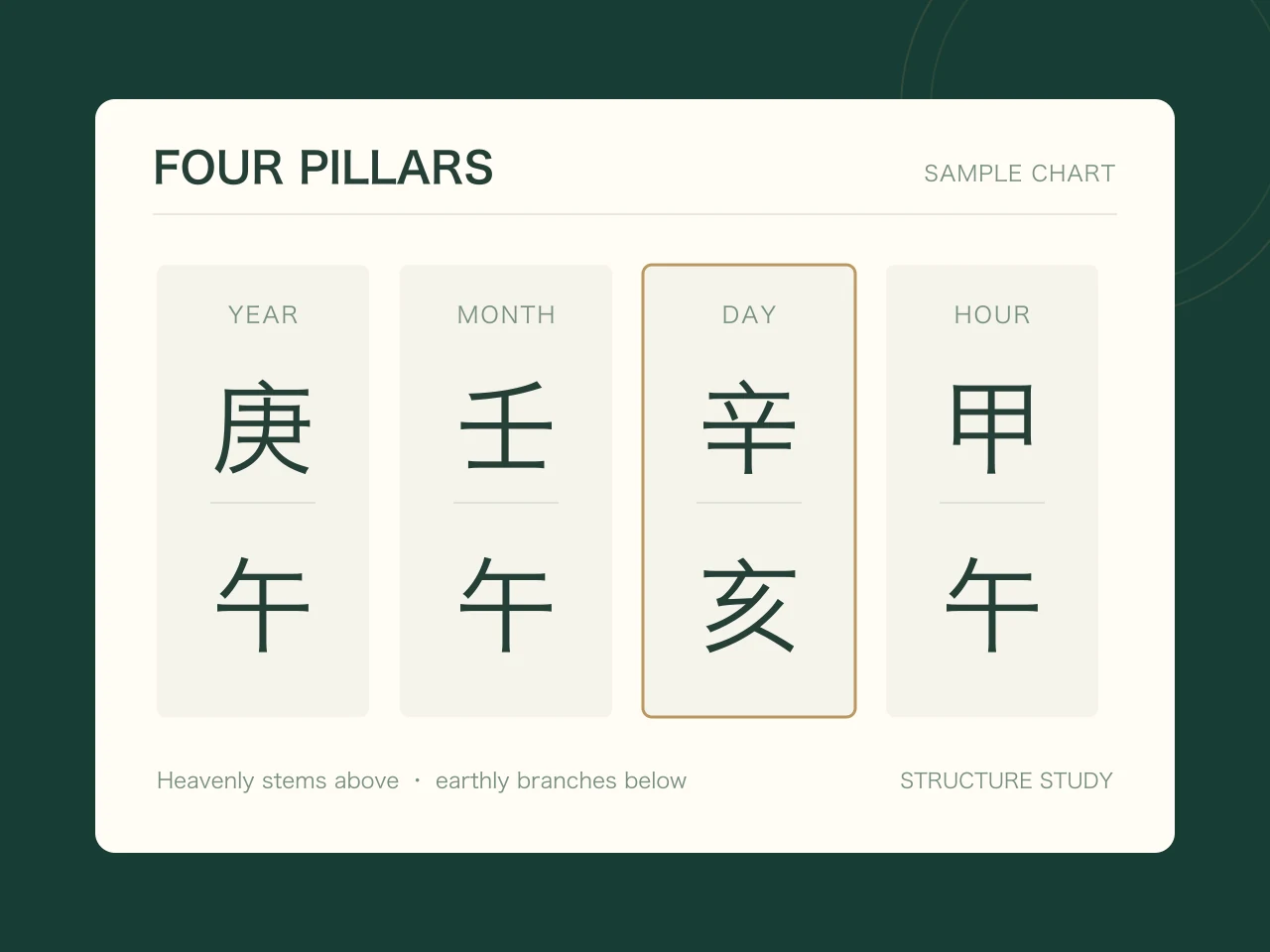
A bare twelve-year animal cycle repeats every twelve years, which is too short to date anything. The count that is actually used pairs the twelve branches with ten stems, and the pair repeats every sixty years, because sixty is the least common multiple of ten and twelve. The animal repeats; the full label does not.
Three rat years, twelve years apart, share the branch and nothing else. The stem is what separates them, and the stem is the half a chart reads.
| Year | Year pillar | Animal |
|---|---|---|
| 2020 | 庚子 | rat |
| 2032 | 壬子 | rat |
| 2044 | 甲子 | rat |
What the animal therefore does and does not tell you
Five consequences follow from the construction:
- It gives a position in a twelve-count. Two people born twelve years apart share it, and so does roughly one in twelve of everyone alive.
- It dates nothing on its own. The stem is missing, and the stem is the half that distinguishes one rat year from another.
- It does not describe a temperament. The animal names a station in a count built to track a planet; no step in that construction measures a person.
- It is a rounded number. Twelve years is where the count lands, not where Jupiter lands, and the gap is 0.35° a year rather than zero.
- It is not even one count. The year it belongs to starts at 立春 for chart work and at the lunar new year for folk reckoning, and those dates sit up to a fortnight apart.
Disclaimer: This content is for informational and cultural reference purposes only. It does not constitute professional medical, legal, financial, or psychological advice. Readers should exercise their own judgment and consult qualified professionals for specific concerns.
Sources and review basis
Traditional references explain historical vocabulary and context. Official practical sources support only the observable safety, comfort, or environmental points noted in the article; they do not validate metaphysical claims.
Traditional reference
Huainanzi, “Treatise on Celestial Patterns” (淮南子·天文訓)Wikisource digital text · Accessed 2026-10-26
The Han text that states the twelve-year count as an observation of Jupiter: 太陰在四仲,則歲星行三宿;太陰在四鉤,則歲星行二宿。二八十六,三四十二,故十二歲而行二十八宿。 It then fixes the schematic counter that replaces the planet — 天維建元,常以寅始起,右徙一歲而移,十二歲而大周天 — and names the clash as the opposite point: 歲星之所居,五榖豐昌,其對爲衝。 Cited for the period and the vocabulary only; nothing in it predicts anything about a person.
Practical source
NASA Science: Jupiter FactsNASA Science · Accessed 2026-10-19
The orbital figure behind the tai sui explanation: NASA gives Jupiter one orbit in about 4,333 Earth days, which is 11.86 years rather than the twelve the schematic cycle assumes. Cited for the period only; nothing in the source supports a claim about fortune.