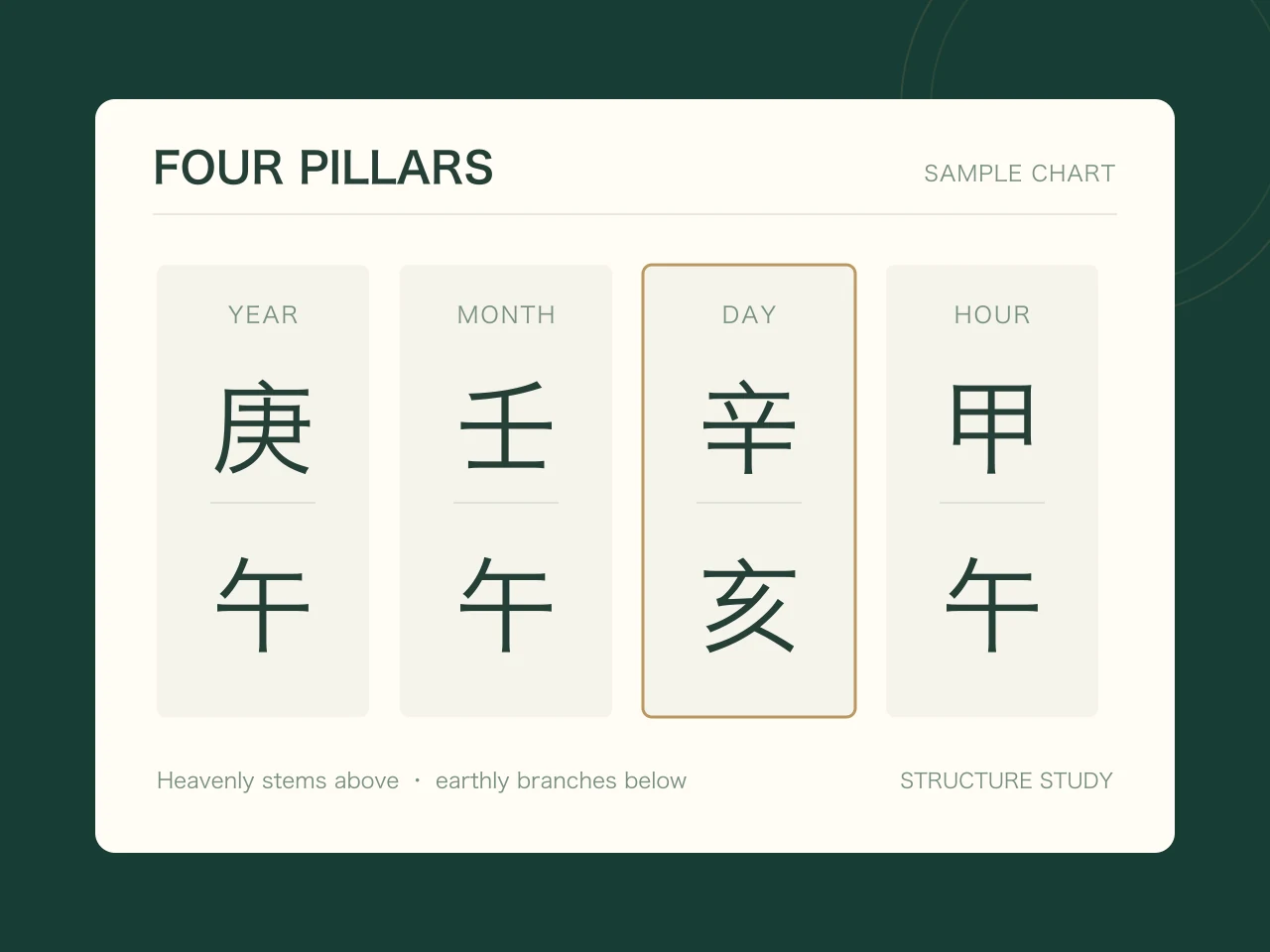
Two people, one set of four characters
A twin pair is the cleanest test a birth chart can be given, because the input is duplicated and the outcome is not. Identical twins share a genome, a household, a school and a birth date, and they still end up with different tempers, different illnesses and different lives. Anyone who has watched that happen wants to know what the chart was doing while it happened.
The answer that holds up starts with the instrument rather than the pair. Four characters are computed from a date and a two-hour window. They are not computed from a person. Everything a chart describes is therefore something that stays constant across that window — and twins born minutes apart almost always sit inside it.
The rest of this page is checkable: how often a twin pair really receives two different charts, which four boundaries can split one, and what the shared part still says. What it will not do is decide which twin a chart belongs to. There is no procedure in the method for that, and inventing one would be the dishonest move.
Two hours is the finest unit the method has
A day is divided into twelve 时辰 of two hours each, beginning with 子時 at 23:00. Each 时辰 carries one hour pillar, so the hour pillar takes twelve values and changes at 01:00, 03:00, 05:00 and so on. The day pillar changes once a day, at 23:00 in the convention used here; an alternative convention puts the change at midnight, and the difference matters here because a pair born either side of 23:00 receives a different day master.
Two consequences follow, and both are easy to underestimate. First, every moment inside a 120-minute block produces the identical four characters. Second, the total supply of charts is small. Enumerating all 525,600 minutes of 2026 returns 4,393 distinct four-pillar combinations — about twelve charts per day for the whole year. Of those, 4,380 are simply 365 days times twelve 时辰; the extra thirteen appear where a 节 cuts a day into two different months.
A chart is therefore not a fingerprint. It is closer to a weather report: everyone born inside the same two hours received the same one, in the way that everyone standing in the same city on the same afternoon met the same weather.
How often a twin pair really splits
This can be answered by enumeration instead of intuition. Take every minute of 2026, compute the four pillars, then compare the chart at each minute with the chart at that minute plus a gap. Two births separated by that gap share a chart unless the gap crosses a boundary.
The arithmetic behind the first column below is the length of the gap divided by 120 minutes, because a 时辰 boundary falls inside the gap once per cycle. Ten minutes gives 8.3%. The day column uses the same idea with a period of 1,440 minutes, since there is only one 23:00 in a day. The month column is small because only twelve of the twenty-four solar terms change the month pillar, and the year column is a single instant in the whole year.
| Gap between births | Two different charts | Day pillar differs | Month pillar differs | Year pillar differs |
|---|---|---|---|---|
| 2 minutes | 1.67% | 0.14% | 0.005% | 0.0004% |
| 5 minutes | 4.18% | 0.35% | 0.011% | 0.001% |
| 10 minutes | 8.36% | 0.69% | 0.023% | 0.002% |
| 15 minutes | 12.53% | 1.04% | 0.034% | 0.003% |
| 20 minutes | 16.71% | 1.39% | 0.046% | 0.004% |
| 30 minutes | 25.06% | 2.08% | 0.069% | 0.006% |
Four boundaries, and the minute each one falls on
The columns of that table correspond to four different boundaries. Each has a real timestamp, and each changes a different number of characters.
- 时辰 boundary — 01:00, 03:00, 05:00 and every second hour after. Changes the hour pillar only. On 14 September 1993, 08:58 lands in 辰 and 09:02 lands in 巳.
- 23:00 — changes the day pillar, and with it the day master. On 28 October 2026, 22:59 gives 丙午 戊戌 乙亥 丁亥; one minute later it is 丙午 戊戌 丙子 戊子. The day master moves from 乙 to 丙.
- 节 boundary — twelve a year, roughly every thirty days. Changes the month pillar. In 2026 立冬 arrives at 17:52 on 7 November, so 17:52 still gives 戊戌 and 17:53 already gives 己亥.
- 立春 — once a year, changes the year pillar and the month pillar together. 立春 2026 falls at 04:02 on 4 February: 04:02 gives 乙巳 己丑, 04:03 gives 丙午 庚寅.
A four-minute gap, chart by chart
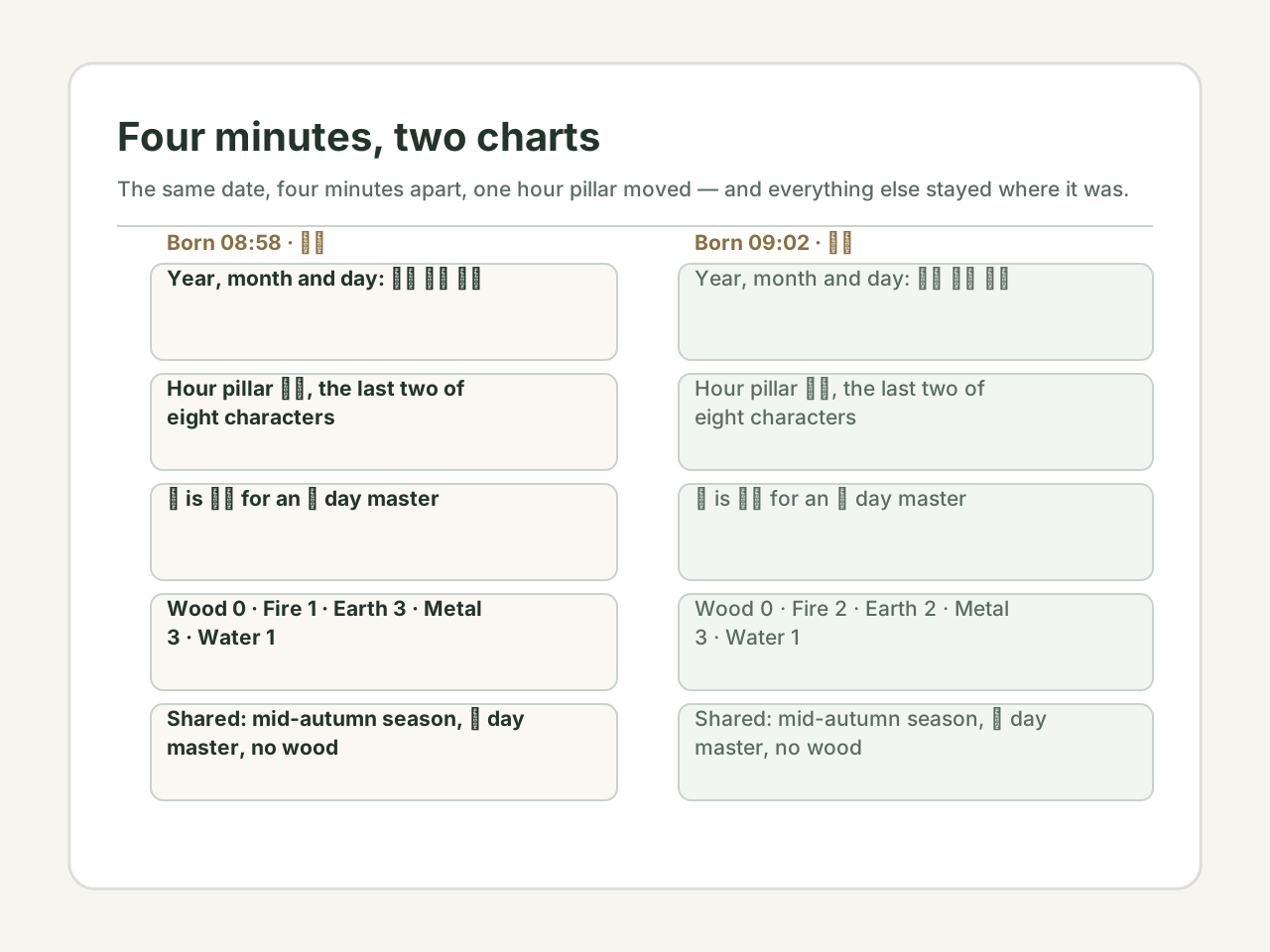
The clearest illustration is an ordinary pair with no exotic boundary: two births on 14 September 1993, four minutes apart, one before 09:00 and one after.
The year, month and day pillars are identical — 癸酉, 辛酉, 戊戌 — and the day master is 戊 earth in both. Only the hour pillar moves, from 丙辰 to 丁巳. The visible consequences are modest but real. Fire rises from one character to two and earth falls from three to two. For an 戊 day master, 丙 is 偏印 and 丁 is 正印: the same resource star at opposite polarity, which changes how the hour pillar is read against the rest of the chart.
The shared part is not trivial. Both charts contain no wood at all, both sit on a 辛酉 month in mid-autumn, and both are read against the same season. A reading that starts from the month and the day master would produce an identical first paragraph for either twin. The divergence appears only in the last of the four characters.
| Born 08:58 | Born 09:02 | |
|---|---|---|
| Year pillar | 癸酉 | 癸酉 |
| Month pillar | 辛酉 | 辛酉 |
| Day pillar and day master | 戊戌, day master 戊 earth | 戊戌, day master 戊 earth |
| Hour pillar | 丙辰 (辰, 07:00–09:00) | 丁巳 (巳, 09:00–11:00) |
| Hour stem as a ten god | 偏印 | 正印 |
| Element count | wood 0 · fire 1 · earth 3 · metal 3 · water 1 | wood 0 · fire 2 · earth 2 · metal 3 · water 1 |
| Luck pillars, same sex | identical | identical |
What the shared chart still holds, and the one case where it does not
For same-sex twins inside one 时辰, almost everything downstream is shared. The month pillar fixes the season, so the strength argument and the useful-element discussion begin from the same place. The start of the luck pillars is calculated from the distance to the neighbouring 节, which is identical for both. The annual pillars arrive on the same schedule. One reading can therefore be given to two people without anything being miscomputed — the reading is simply about conditions they hold in common.
Opposite-sex twins are the exception, and it is the only place where the method itself separates a pair that shares four characters. The direction of the luck pillars depends on the polarity of the year stem and on gender: a yang year runs forward for a man and backward for a woman, and a yin year reverses that. Born in 癸酉, a yin year, a boy steps backward from the month pillar into 庚申, 己未, 戊午, 丁巳, while his sister steps forward into 壬戌, 癸亥, 甲子, 乙丑. Same chart, opposite decades.
The 立春 case is sharper still. A pair born either side of 04:02 on 4 February 2026 receives 乙巳 and 丙午 — a yin year and a yang year — so even two brothers would run their luck pillars in opposite directions, one minute apart.
The classical workarounds, and what they add
Traditions that noticed this problem did not ignore it, but their answers fall into two kinds that are worth separating.
The first kind adds description rather than resolution. Zi Wei Dou Shu has a 兄弟宫, a palace for siblings, and it can be read for what a sibling relationship is like. Both twins carry the same 兄弟宫, so it cannot say which twin is which; it describes the pair from a single point of view.
The second kind adds an input. Some later schools narrow the two-hour 时辰 further — 铁板神数, for instance, traditionally requires 考刻, a step that subdivides the 时辰 and then asks the family questions to settle on one division. The answer becomes finer, but the extra information came from the family rather than from the birth record. As a test of the method that is circular: the person supplies the detail that is then used to describe the person.
Neither kind adds resolution to the four characters. The four characters remain a function of the date and the two-hour window, and no re-reading of them separates two people who share that window.
What identical twins show about any instrument built on a birth moment
Identical twins are the harder case, because they remove the genetic variable and the answer still does not arrive. Monozygotic twins come from a single fertilised egg that splits very early into two embryos, and they occur in three to four births per thousand worldwide. They share a genome. They do not share fingerprints, and they diverge in health, temperament and outcome anyway.
That comparison sets the size of the problem. If two people with identical DNA and identical birth data still live differently, the birth moment was never carrying the whole explanation — for twins or for anyone else. A chart precise to the minute would meet the same wall; the limit is not the clock, it is what one moment can hold.
A second effect keeps a shared chart feeling personal. Descriptions of temperament and fortune are typically broad and favourable, and broad favourable descriptions are accepted as accurate by most of the people who receive them — the Barnum effect, documented as a general feature of how people judge personality feedback. A chart shared by everyone born in the same two hours still reads as a portrait, because portraits of that width fit almost anyone.
A five-step check for a twin pair
The practical version, in the order that saves the most time:
- Get the minutes, then ask which clock produced them. A hospital clock, a phone and a family memory can disagree by several minutes, and near a boundary that disagreement is the whole difference.
- Test the pair against the four boundaries before assuming one chart: the two-hour 时辰, 23:00, a 节, 立春. If the pair straddles one, compute both charts separately instead of splitting one reading in half.
- If the charts are identical, read them as shared conditions — season, day master, element balance, the missing element. Those are true statements about the pair, and they are the same statement for both.
- For opposite-sex pairs, run the luck-pillar direction twice. It is the only structural difference the method produces, and it is worth more than any attempt to assign one chart to one twin.
- Stop where the resolution runs out. A chart built on a two-hour window cannot explain why one twin became ill and the other did not, why one married and the other did not, or why their incomes diverged. Using it for that is not a deeper reading; it is a different claim wearing the same vocabulary.
Disclaimer: This content is for informational and cultural reference purposes only. It does not constitute professional medical, legal, financial, or psychological advice. Readers should exercise their own judgment and consult qualified professionals for specific concerns.
Sources and review basis
Traditional references explain historical vocabulary and context. Official practical sources support only the observable safety, comfort, or environmental points noted in the article; they do not validate metaphysical claims.
Practical source
MedlinePlus Genetics: Is the probability of having twins determined by genetics?US National Library of Medicine · Accessed 2026-10-28
The source for the two biology facts used in the twins article: monozygotic twins come from a single fertilised egg that splits very early into two embryos, and they occur in three to four births per thousand worldwide. It is a US National Library of Medicine genetics page and says nothing about birth charts; it is cited only for how identical twins form and how often.
Practical source
APA Dictionary of Psychology: Barnum effectAmerican Psychological Association · Accessed 2026-07-14
A psychology reference for why broad, favourable personality descriptions can feel personally accurate. It does not evaluate BaZi calculations themselves.