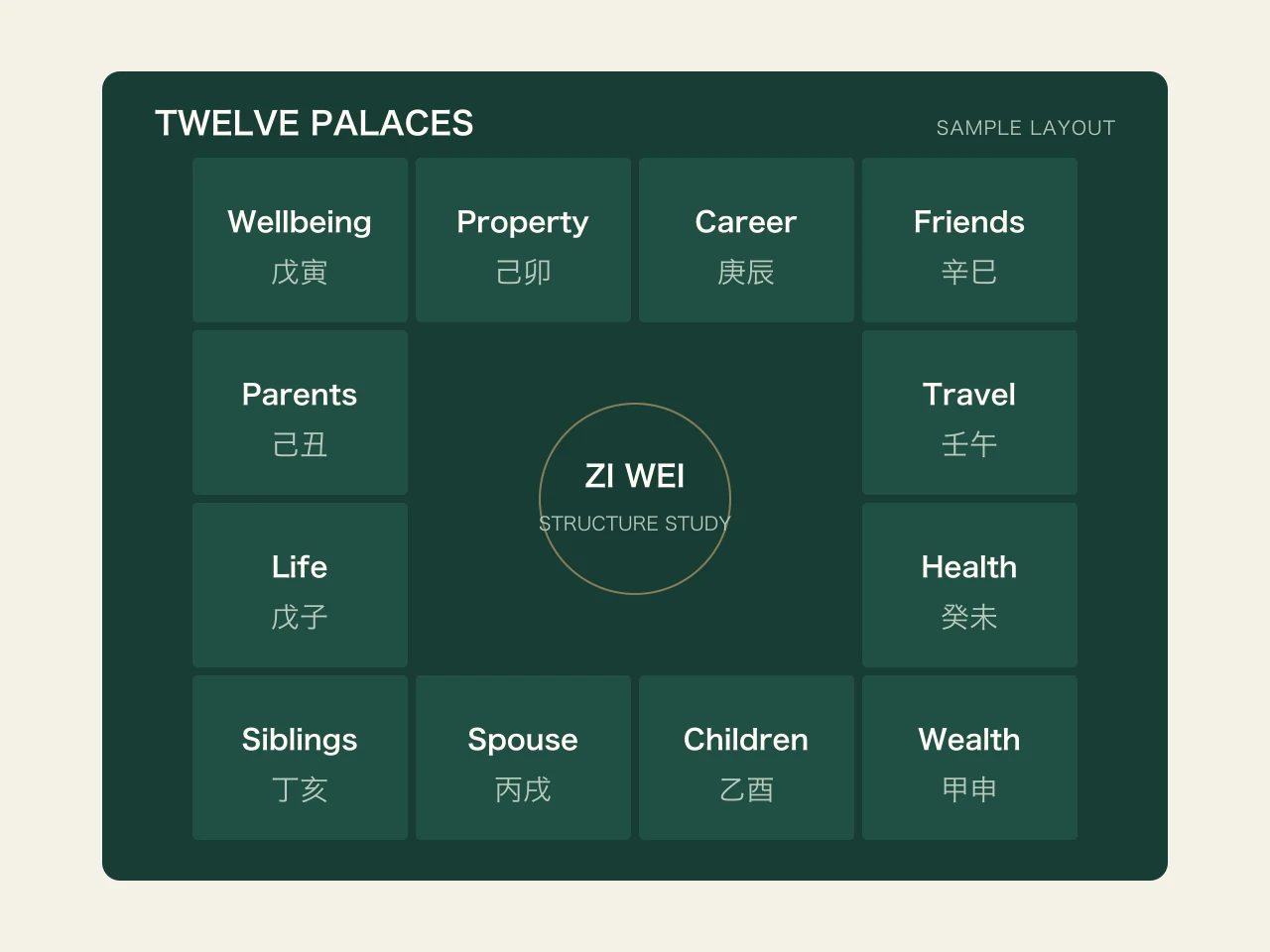
Fourteen main stars go into twelve palaces, so some palaces must come out empty
Zi Wei Dou Shu uses fourteen main stars and twelve palaces. Fourteen into twelve does not divide, and the remainder is not spread evenly: stars occupy palaces in clusters of one or two, so every chart carries empty palaces and some charts carry four.
The arithmetic is stricter than it first looks. A palace holds zero, one or two main stars and never three. Enumerating 936 charts across twenty-six years gives 11,232 palace slots, of which 15.9 percent hold no main star, 51.5 percent hold one and 32.6 percent hold two. Three never occurs.
Which palaces are empty is decided by where 紫微 sits
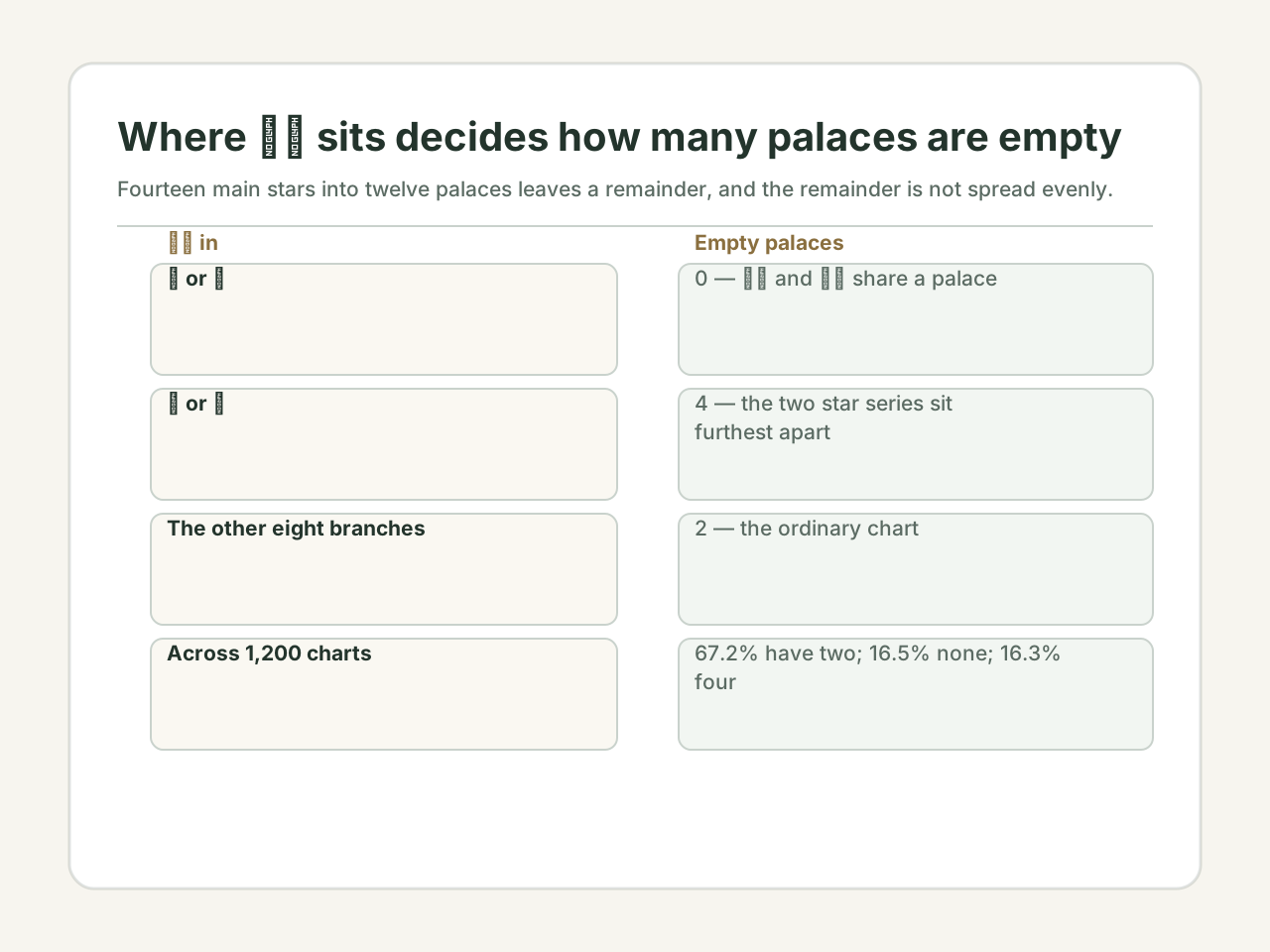
The fourteen stars are not placed independently. 紫微's palace fixes 天府 as its mirror across the 寅–申 axis, and the other twelve follow at constant offsets from those two. The count of empty palaces is therefore a function of 紫微's palace alone:
| 紫微 in | Empty palaces | Why |
|---|---|---|
| 寅 or 申 | 0 | 紫微 and 天府 land on the same palace, tightening the ring |
| 巳 or 亥 | 4 | the two star series sit furthest apart |
| any other branch | 2 | the ordinary case |
Measured across a century, two empty palaces is the normal chart
Counting the chart for the 15th of every month from 1950 to 2049 gives 1,200 charts:
- No empty palace: 16.5 percent.
- Two empty palaces: 67.2 percent.
- Four empty palaces: 16.3 percent.
- 命宫 itself empty: 16.8 percent.
An empty 命宫 is a one-in-six event, not an anomaly
Roughly one chart in six has no main star in the life palace, which makes the question of how to read an empty 命宫 a common one rather than an unusual one. It also means the empty-palace question is not about a rare configuration; it is about the ordinary middle of the distribution.
The same measurement shows why the count cannot be read as a score. Two thirds of charts have exactly two empty palaces, one sixth have none and one sixth have four. A feature that most charts share carries very little information about the person.
The opposite palace is the borrowing source, and its offset is always six
The convention for an empty palace is to read the palace directly opposite. That palace is always six branches away — 命宫 in 申 faces 寅, 命宫 in 辰 faces 戌, 命宫 in 午 faces 子 — so the borrowing partner is fixed by the same geometry that fixes the ring.
A concrete case shows the shape. A 命宫 in 未 with no main star faces 迁移 in 丑 holding 天同 and 巨门, both at low brightness; its trine partners are 官禄 in 亥 holding 太阴 and 财帛 in 卯 holding 太阳 and 天梁. The borrowed pair is dim, but both trine partners are populated, so an empty 命宫 here does not mean an empty set.
A second case reads differently. A 命宫 in 子 with no main star faces 午 holding 天同 and 太阴, both dim, while 官禄 in 辰 is also empty and 财帛 in 申 holds 太阳 and 巨门. Two palaces in the set are empty, so the borrowing has one source for two slots and the reading has to lean on auxiliary stars and transformations.
What borrowing does and does not do
Borrowing is a reading convention, not a transfer. It does not move a star into the empty palace, and it does not make the empty palace equivalent to the opposite one. Both palaces keep their own stems, their own decade ranges and their own transformations. What the convention does is direct attention to the only main-star information available in the set.
Two limits follow. When the opposite palace is also empty, borrowing has no source, and the reading has to fall back on auxiliary stars, brightness, transformations and the decade overlay. When the opposite palace is bright and the empty one is not, borrowing can make an empty palace read louder than a populated one — which is a reason to check the opposite palace before concluding anything from star count alone.
Where the count stops being informative
An empty palace is a fact about the distribution of fourteen objects across twelve slots. It is not evidence of a deficiency or of something missing from a life, and the arithmetic gives no support to that reading.
- Check the opposite palace first. The offset is always six, and it is the only borrowing source.
- Check whether the trine partners are populated. An empty 命宫 with two populated trine palaces differs from one with two empty ones.
- Check the auxiliary stars. The main-star count says nothing about them, and they are what separates two charts sharing a ring.
- Never read the count as a score. The distribution is set by the placement rules, not by the person.
Disclaimer: This content is for informational and cultural reference purposes only. It does not constitute professional medical, legal, financial, or psychological advice. Readers should exercise their own judgment and consult qualified professionals for specific concerns.
Sources and review basis
Traditional references explain historical vocabulary and context. Official practical sources support only the observable safety, comfort, or environmental points noted in the article; they do not validate metaphysical claims.
Traditional reference
Zi Wei Dou Shu Quanshu (紫微斗數全書)Wikisource digital text · Accessed 2026-10-14
A classical source for the twelve palaces, the main stars, and the four transformations that Zi Wei Dou Shu terminology is built on.
Practical source
APA Dictionary of Psychology: Barnum effectAmerican Psychological Association · Accessed 2026-07-14
A psychology reference for why broad, favourable personality descriptions can feel personally accurate. It does not evaluate BaZi calculations themselves.