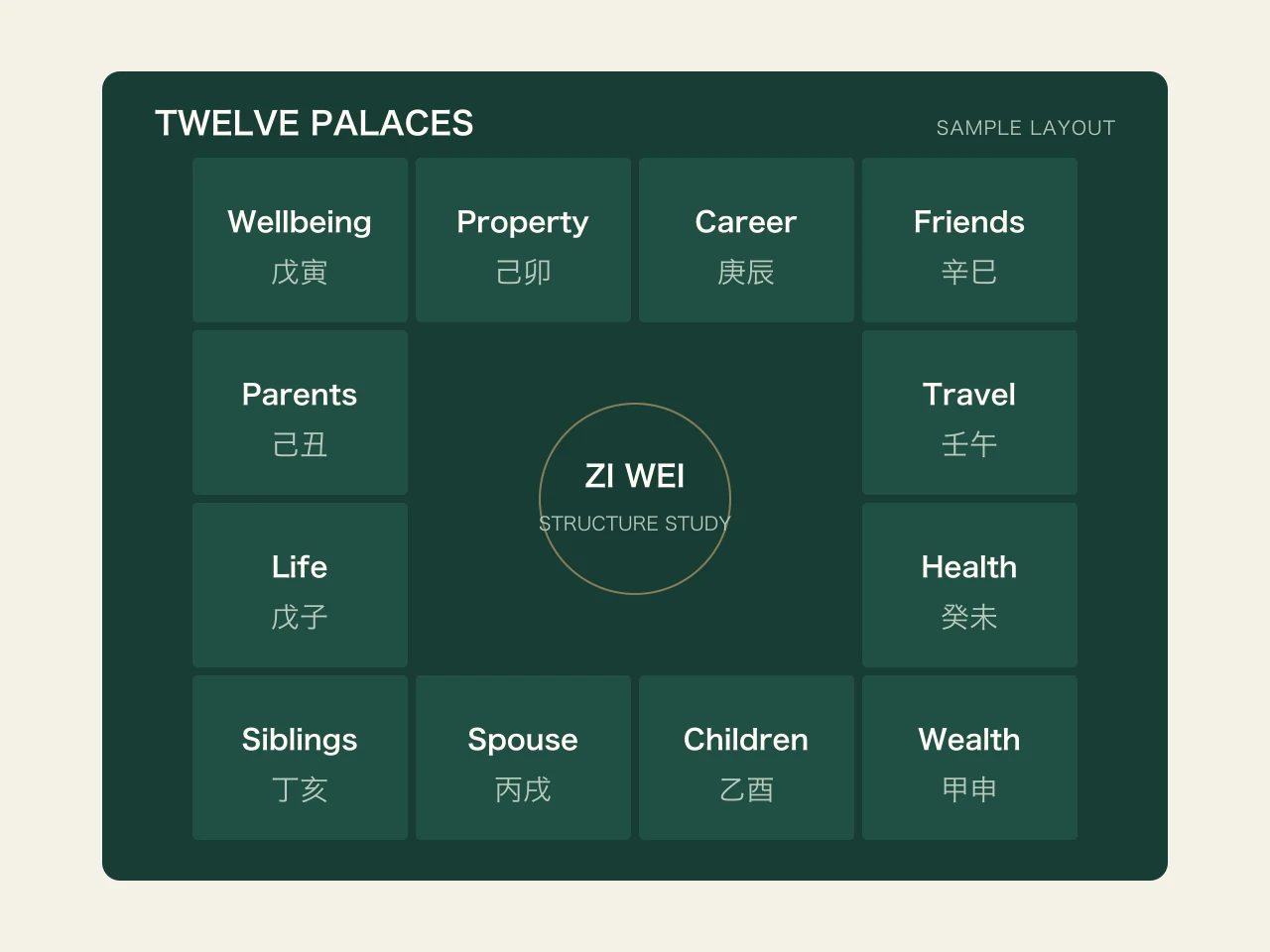
One star's position decides the other thirteen
In a Zi Wei chart the fourteen main stars are not placed one at a time. 紫微 is placed first, 天府 is placed as its mirror, and the remaining twelve sit at constant offsets from those two. The whole star ring is therefore determined by a single position.
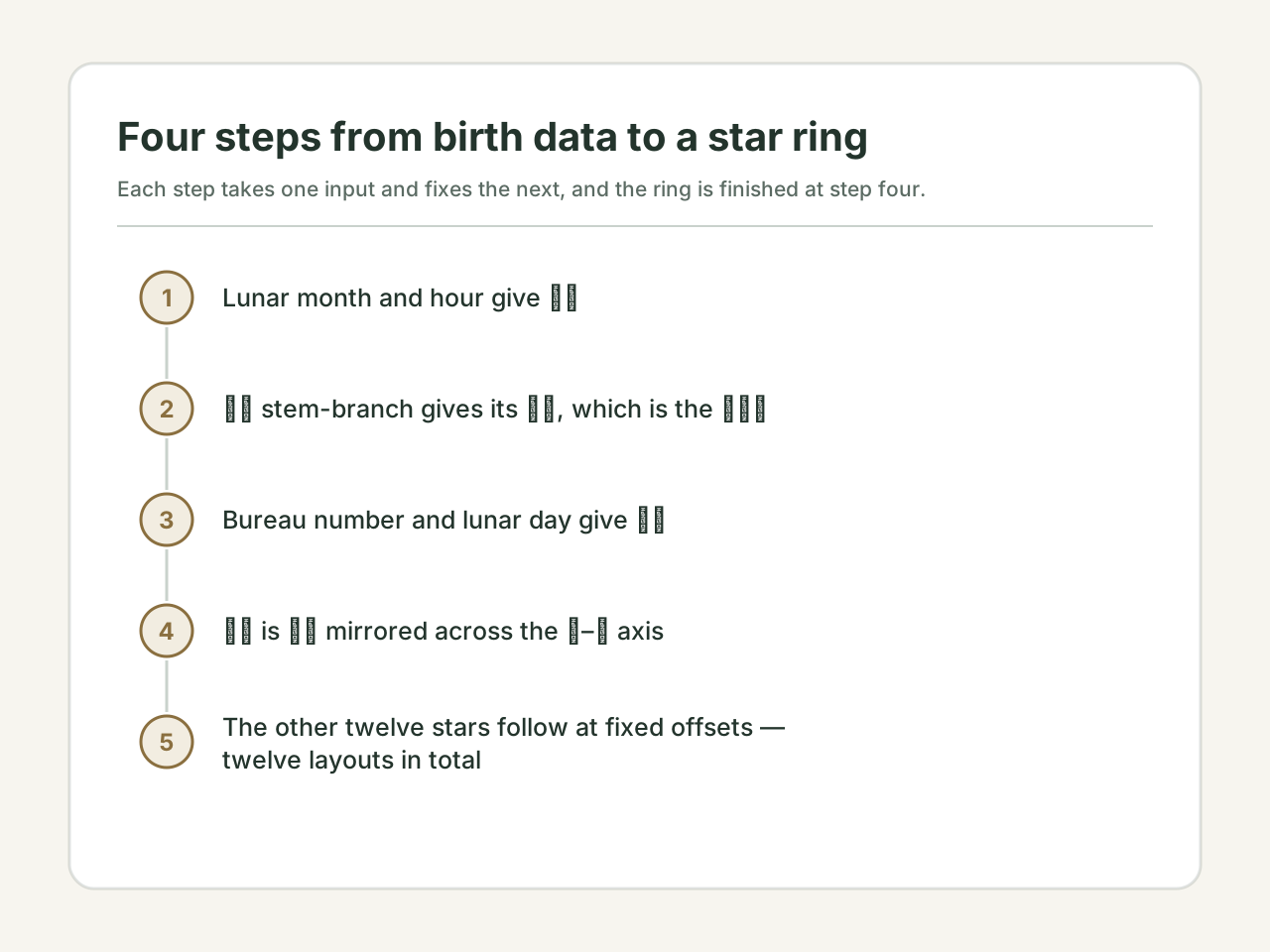
The chain runs in four steps: the lunar month and hour give 命宫; 命宫's stem-branch pair gives its 纳音 element, which is the 五行局; the bureau number and the lunar day give 紫微's palace; and the rest of the ring follows. Change any one of the four and the ring changes; nothing else in the birth data touches it.
The bureau and the day, as arithmetic
The classical rule uses the bureau number and the lunar day. Take the day as the dividend and the bureau as the divisor. If the day divides evenly, the quotient is the count. If it does not, add the smallest number that makes it divide, take that quotient, and then compensate: an odd addition steps back that many palaces and an even one steps forward. Counting starts at 寅.
A worked case: 金四局, lunar day seven. Seven does not divide by four; add one, giving eight, quotient two. Count two palaces from 寅, which lands on 卯, then step back one because the addition was odd. 紫微 sits in 寅.
The rule reproduces a modern calculator exactly. Checking 1,932 charts across all five bureaus and a spread of lunar days produced no mismatches, which is worth knowing before treating the rule as approximate.
Five bureaus against the first twelve days
Reading the rule across bureaus shows why some positions are common and others are not:
| Bureau | 1 | 2 | 3 | 4 | 5 | 6 | 7 | 8 | 9 | 10 | 11 | 12 |
|---|---|---|---|---|---|---|---|---|---|---|---|---|
| 水二局 | 丑 | 寅 | 寅 | 卯 | 卯 | 辰 | 辰 | 巳 | 巳 | 午 | 午 | 未 |
| 木三局 | 辰 | 丑 | 寅 | 巳 | 寅 | 卯 | 午 | 卯 | 辰 | 未 | 辰 | 巳 |
| 金四局 | 亥 | 辰 | 丑 | 寅 | 子 | 巳 | 寅 | 卯 | 丑 | 午 | 卯 | 辰 |
| 土五局 | 午 | 亥 | 辰 | 丑 | 寅 | 未 | 子 | 巳 | 寅 | 卯 | 申 | 丑 |
| 火六局 | 酉 | 午 | 亥 | 辰 | 丑 | 寅 | 戌 | 未 | 子 | 巳 | 寅 | 卯 |
The twelve positions are not equally likely
The same palace appears on different days within one bureau — 金四局 puts 紫微 in 寅 on both day four and day seven — and the twelve positions do not receive equal shares of the calendar. Over 1,200 charts the branch 子 carried 紫微 in 4.6 percent of cases and 辰 in 11.3 percent.
That unevenness propagates. Since the count of empty palaces depends on where 紫微 sits, the frequencies of zero-empty and four-empty charts follow the frequencies of the branches that produce them rather than a clean twelve-way split.
天府 is the mirror, and the other twelve follow at fixed steps
天府 is placed as 紫微's reflection across the 寅–申 axis: those two branches are fixed points and the remaining ten pair off symmetrically. 紫微 in 寅 puts 天府 in 寅; 紫微 in 申 puts 天府 in 申; 紫微 in 子 puts 天府 in 辰; 紫微 in 午 puts 天府 in 戌. Twelve 紫微 positions produce twelve 天府 positions and no others.
From there the offsets are constant. The 紫微 series runs backward from 紫微: 天机 one palace back, 太阳 three, 武曲 four, 天同 five, 廉贞 eight. The 天府 series runs forward from 天府: 太阴 one, 贪狼 two, 巨门 three, 天相 four, 天梁 five, 七杀 six, 破军 ten. Fourteen stars, two anchors, fixed steps.
Twelve layouts, and no thirteenth
Because the ring is generated from one position and that position has twelve values, there are exactly twelve main-star layouts. Hashing the star-per-palace signature across several hundred charts returns twelve distinct results and no more.
The variation between two people therefore comes from somewhere else. 命宫 is placed independently from the month and hour, so one ring can be read from twelve vantage points. Auxiliary stars follow their own placement rules. The four transformations depend on the year stem and on palace stems. Brightness changes with the palace a star occupies. None of these alter the ring; all of them alter what the ring means.
What the arithmetic settles
The placement rule is a lookup, and it is worth keeping separate from everything layered on top of it.
- Given the bureau and the lunar day, 紫微's palace is determined and the other thirteen follow. There is no interpretive step in the placement.
- The bureau is not an element label for the person. It is the 纳音 of 命宫's stem-branch pair, and its number serves as the divisor.
- A wrong birth date moves the ring; a wrong birth hour moves 命宫. The two failures look different and should be reported differently.
- Twelve layouts is a small space. A chart presented as uniquely fitted to one person is describing the interpretation, not the placement.
Disclaimer: This content is for informational and cultural reference purposes only. It does not constitute professional medical, legal, financial, or psychological advice. Readers should exercise their own judgment and consult qualified professionals for specific concerns.
Sources and review basis
Traditional references explain historical vocabulary and context. Official practical sources support only the observable safety, comfort, or environmental points noted in the article; they do not validate metaphysical claims.
Traditional reference
Zi Wei Dou Shu Quanshu (紫微斗數全書)Wikisource digital text · Accessed 2026-10-14
A classical source for the twelve palaces, the main stars, and the four transformations that Zi Wei Dou Shu terminology is built on.
Traditional reference
Sanming Tonghui (三命通会)Wikisource digital text · Accessed 2026-07-14
A historical compilation used to cross-check traditional BaZi concepts; it is not scientific validation.