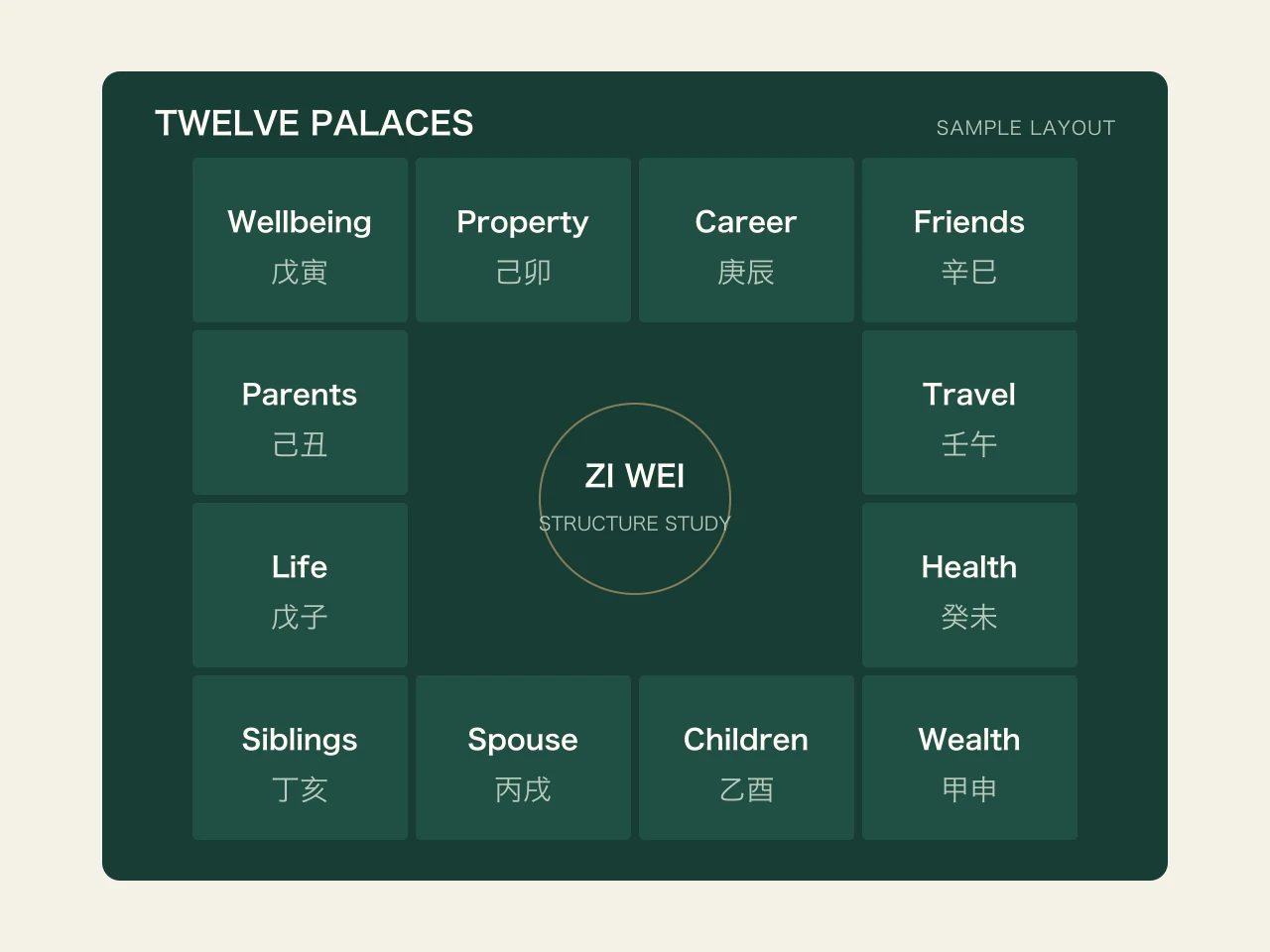
The twelve palaces are one ring, and only the starting point moves
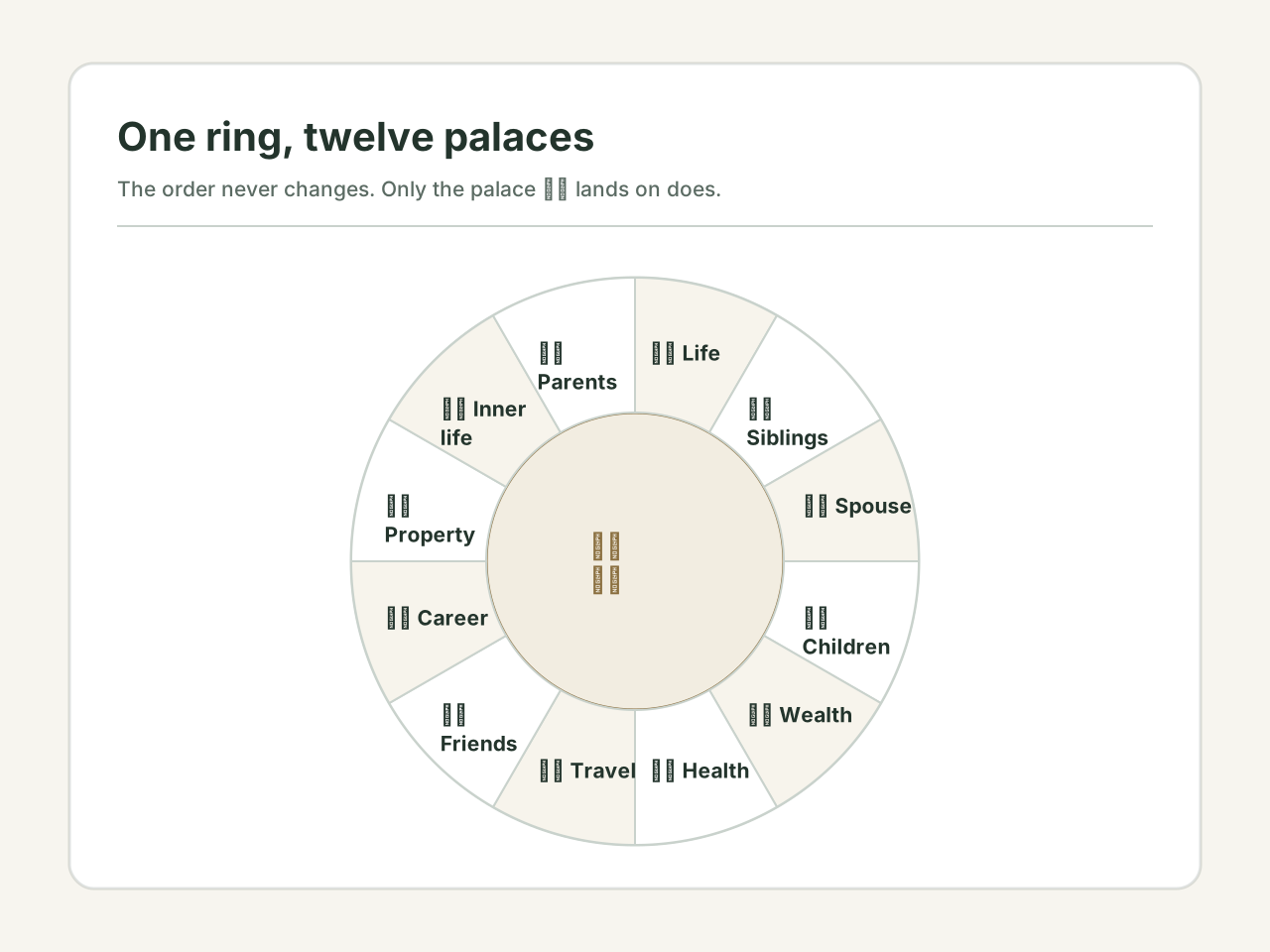
The twelve palaces are not twelve categories assigned to twelve places. They are a single fixed sequence laid around a circle, and the only thing that varies from chart to chart is where the sequence begins. Once 命宫 is placed, every other palace follows in order and cannot be moved on its own.
The order is 命宫, 兄弟, 夫妻, 子女, 财帛, 疾厄, 迁移, 交友, 官禄, 田宅, 福德, 父母. Read it as a sequence rather than a list. 夫妻 always sits two steps along from 命宫, 财帛 four, 官禄 eight, 父母 eleven, in the same direction, in every chart, without exception.
命宫 is a count from 寅, and its two inputs cancel
命宫 is fixed by two inputs only: the lunar birth month and the birth hour. Start at 寅, count forward one palace per lunar month to the birth month, then count backward one palace per double-hour to the birth hour. Nothing else enters, not the year, not the day, not the sex of the person.
Because the month counts forward and the hour counts backward, the two cancel. 正月 子时, 二月 丑时 and 三月 寅时 all put 命宫 in 寅: each extra month is undone by one extra double-hour. Written as a formula, the palace is 寅 + (month − 1) − hour, so what 命宫 records is the difference between the month and the hour and nothing about either one separately.
The consequence is that 命宫 cannot identify a birth moment. All 144 combinations of twelve lunar months and twelve double-hours distribute evenly across twelve palaces, twelve combinations each. Three birthdays show the count and what it does and does not fix:
| Birth moment | Lunar month | Double-hour | 命宫 | 身宫 |
|---|---|---|---|---|
| 1990-05-15, 10:00 | 4th month | 巳, 09:00–11:00 | 子 | 戌 |
| 1975-08-20, 00:00 | 7th month | 子, 23:00–01:00 | 申 | 申 |
| 2000-01-01, 08:00 | 11th month | 辰, 07:00–09:00 | 申 | 辰 |
The twelve questions
The names are not topics in the modern sense. Each palace is a question the chart is asked, and the answer is whatever sits in that palace. Read as questions, the ring stops looking like a list of life areas:
| Palace | The question it asks |
|---|---|
| 命宫 | Who is asking — the vantage point the other eleven are measured from |
| 兄弟 | Siblings and peers of the same generation, and how those ties behave |
| 夫妻 | The partner, and what the person commits to |
| 子女 | Children, and what the person puts out into the world |
| 财帛 | What arrives, and what is done with it |
| 疾厄 | The body and the ways it fails |
| 迁移 | The outside: travel, and how the person reads away from home |
| 交友 | Friends and colleagues, the people the person depends on |
| 官禄 | Work, position, and what the person is known for |
| 田宅 | Property, and the household the person keeps |
| 福德 | What the person enjoys, and how much of it they want |
| 父母 | Parents, superiors, and the authorities the person answers to |
三方四正 is +4, +8 and +6, and that is the entire rule
The four palaces that form a reading set with 命宫 are found by fixed offsets. The offsets are counted through the branches, which run opposite to the palace order, so 官禄 is eight steps along the sequence and four steps this way, and both describe the same palace:
| Offset from 命宫 | Palace | What the offset is doing |
|---|---|---|
| +0 | 命宫 | the vantage point |
| +4 | 官禄宫 | one third of the ring away, a trine partner |
| +8 | 财帛宫 | the other trine partner |
| +6 | 迁移宫 | directly opposite |
The offsets land on trine and clash partners, which is why the set closes at four
The offsets are not interpretive choices. +4 and +8 land on the two branches that form a three-harmony combination with 命宫's branch, and +6 lands on its clash partner. A 命宫 in 申 puts 官禄 in 子 and 财帛 in 辰, the 申子辰 frame, with 迁移 in 寅, the opposite branch.
That is why the set is closed. There is no fifth palace related to 命宫 by either relation, so a reading that keeps adding palaces is not extending the geometry; it is adding interpretation.
Because of that geometry, 夫妻 always faces 官禄
夫妻 sits two steps from 命宫, which places it directly opposite 官禄 at eight steps. The two are in opposition in every chart. This is not a claim that marriage and career compete. It is a claim about where the information sits: any reading of the spouse palace is reading a palace that faces the career palace, so work rhythm is structurally inside the relationship question rather than beside it.
迁移 and 命宫 stand in the same relation, which is why the travel palace reads as the outward-facing half of the self rather than as a separate topic. Six such pairs exist and never change: 命宫 with 迁移, 兄弟 with 交友, 夫妻 with 官禄, 子女 with 田宅, 财帛 with 福德, 疾厄 with 父母.
身宫 reaches six palaces and can never reach the other six
身宫 is placed by shifting from 命宫 by the birth hour, but forward instead of backward, which makes its offset twice the hour. Twice an hour is always an even number of branches, so the shift lands on only six of the twelve palaces: 命宫, 福德, 官禄, 迁移, 财帛 and 夫妻.
Each of those six is reachable from exactly two of the twelve double-hours, so 身宫 has a one-in-six chance of sitting in any one of them and a zero chance of sitting in 兄弟, 子女, 疾厄, 交友, 田宅 or 父母. Whatever 身宫 is taken to mean, the arithmetic confines it to the self, the inner state, the career, the outward move, the money and the spouse. It cannot land in a palace about a relative.
命宫 and 身宫 together still leave two candidates
If 命宫 records month minus hour and 身宫 records month plus hour, then having both should recover the birth month and hour. It almost does. Adding and subtracting the two gives twice the month and twice the hour, and halving a value modulo twelve has two answers, six apart.
So the pair narrows 144 combinations to exactly two, and the two differ by six lunar months and six double-hours. A person born in the 4th lunar month at 巳时 has 命宫 in 子 and 身宫 in 戌; so does a person born in the 10th month at 亥时. The palaces sit in identical positions and the readings are not identical, because the star ring is placed from the lunar day and the two dates are half a year apart.
What the ring settles and what it leaves open
The ring settles positions. It does not settle readings.
- Position is arithmetic. Two charts sharing a lunar month and hour have 命宫 in the same palace even when every star differs.
- Opposition is fixed at six. A reading that pairs 夫妻 with anything other than 官禄 has mis-drawn the ring.
- A 财帛 reading without 命宫, 官禄 and 迁移 has read a quarter of the set. The other three are not context; they are part of the definition.
- Nothing in the ring says which palace matters more. Weighting is an interpretive act and should be declared as one.
- A reading that leans on 命宫 will feel accurate to almost anyone, because the descriptions that go with it are broad enough to fit most people. That is a property of the description, not evidence about the chart.
Disclaimer: This content is for informational and cultural reference purposes only. It does not constitute professional medical, legal, financial, or psychological advice. Readers should exercise their own judgment and consult qualified professionals for specific concerns.
Sources and review basis
Traditional references explain historical vocabulary and context. Official practical sources support only the observable safety, comfort, or environmental points noted in the article; they do not validate metaphysical claims.
Traditional reference
Zi Wei Dou Shu Quanshu (紫微斗數全書)Wikisource digital text · Accessed 2026-10-14
A classical source for the twelve palaces, the main stars, and the four transformations that Zi Wei Dou Shu terminology is built on.
Practical source
APA Dictionary of Psychology: Barnum effectAmerican Psychological Association · Accessed 2026-07-14
A psychology reference for why broad, favourable personality descriptions can feel personally accurate. It does not evaluate BaZi calculations themselves.