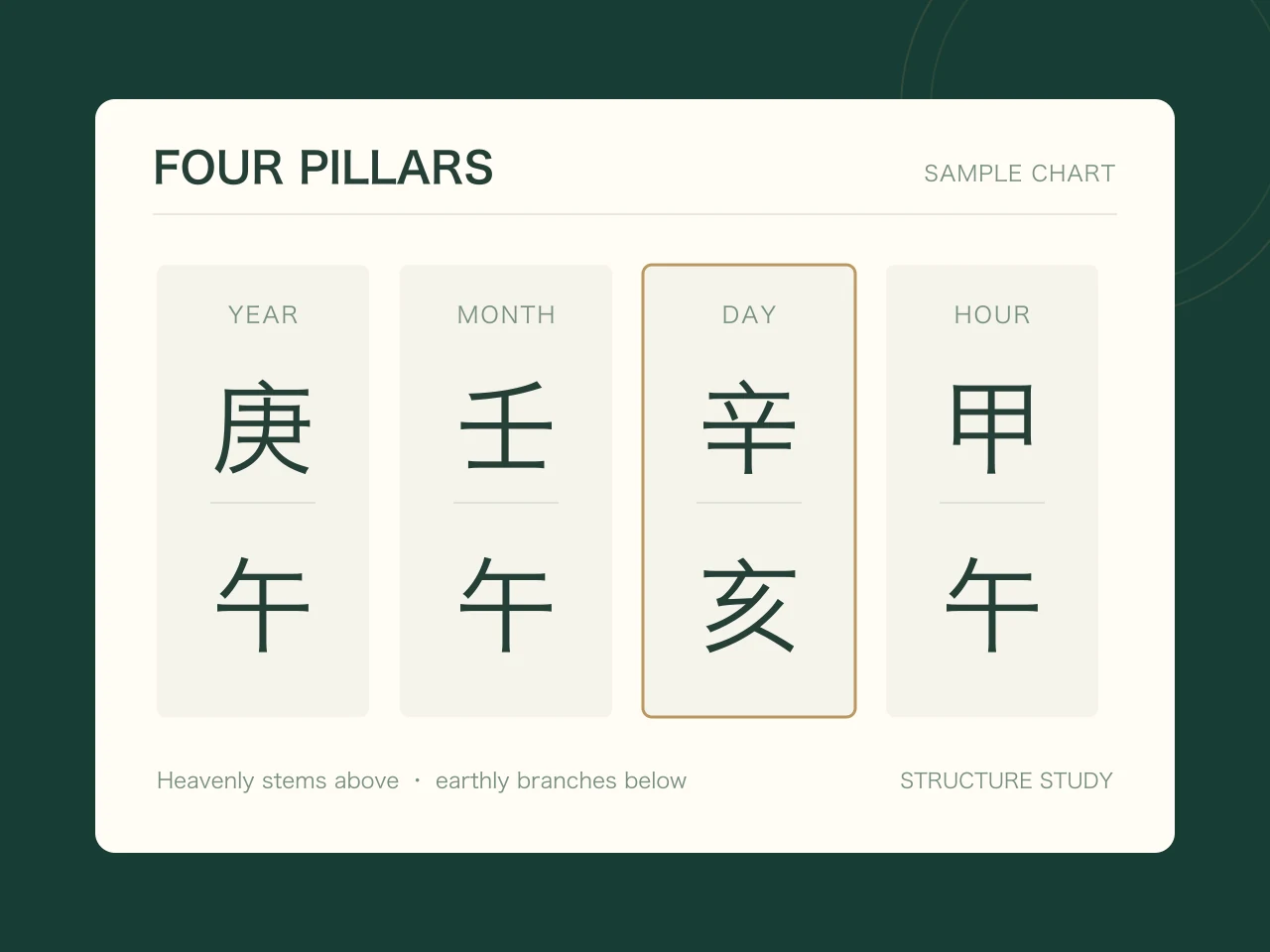
The two systems do not agree on what year a person was born in
BaZi and Zi Wei Dou Shu are usually described as two ways of reading the same birth data. They are not reading the same data. They use different year boundaries, different month boundaries and different day boundaries, and in the days between those boundaries they assign different labels to the same person.
This is not a dispute between schools. It is a difference in what the year is for. BaZi's year pillar is tied to the sun's position; Zi Wei's year label is tied to the lunar calendar. Both are internally consistent, and they diverge on schedule.
立春 against 正月初一, measured
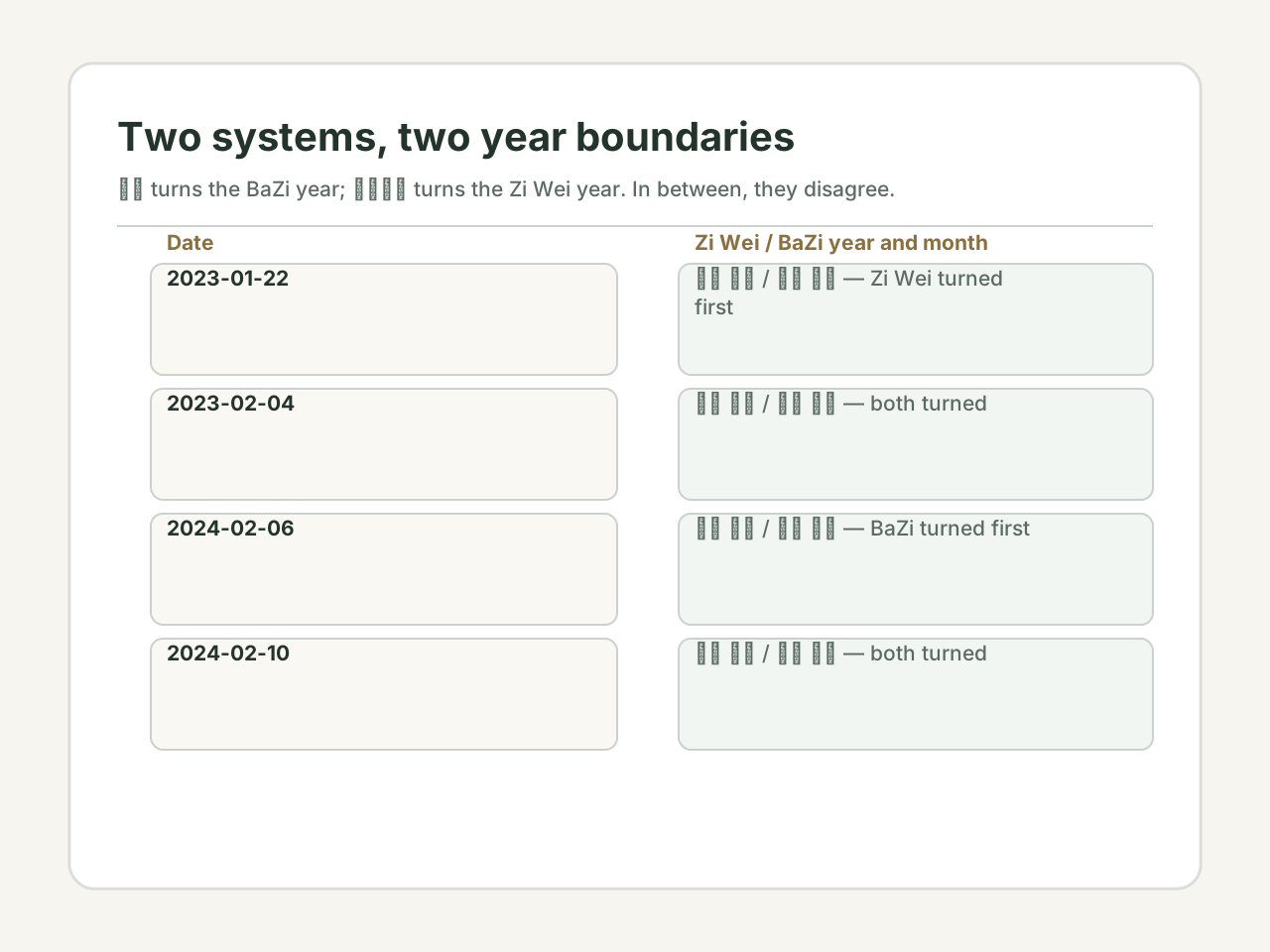
In 2023 the first day of the lunar year fell on 22 January and 立春 fell on 4 February, so the lunar year turned thirteen days before the solar one. In 2024 the order reversed: 立春 came on 4 February and the new moon on 10 February, leaving a six-day window in which BaZi had changed year and Zi Wei had not.
| Date | Zi Wei year and month | BaZi year and month | State |
|---|---|---|---|
| 2023-01-22 | 癸卯 甲寅 | 壬寅 癸丑 | Zi Wei has turned, BaZi has not |
| 2023-02-04 | 癸卯 甲寅 | 癸卯 甲寅 | both have turned |
| 2024-02-06 | 癸卯 乙丑 | 甲辰 丙寅 | BaZi has turned, Zi Wei has not |
| 2024-02-10 | 甲辰 丙寅 | 甲辰 丙寅 | both have turned |
The window is not small, and it opens in both directions
In 2021 the lunar new year fell on 12 February against a 立春 on 3 February, a nine-day gap in the other direction. Anyone born inside one of these windows gets two different year pillars from the two systems, and neither is a mistake.
Because the lunar year runs about eleven days short of the solar year, the new moon drifts earlier against 立春 by roughly that much each year until a leap month pulls it back. The window therefore does not stay the same size or the same sign. Some years the lunar year turns first, some years the solar one does, and in a minority of years the two land within a day of each other and the window nearly closes.
The month boundary is a different boundary as well
Zi Wei takes the lunar month as its month unit; BaZi takes the solar term. The two coincide only by accident. 命宫 is counted from 寅 one palace per lunar month, so a birth in the last days of a lunar month and a birth in the first days of the next differ by a full palace even when the sun has barely moved.
The clearest demonstration is already in the table. On 6 February 2024, Zi Wei still reads the month as 乙丑 because the lunar month had not turned, while BaZi reads 丙寅 because 立春 had passed. 命宫 on that date is 未 with a 火六局; on 10 February, once the lunar month turns, it becomes 申 with a 金四局. The palace and the bureau both move on the new moon, not on 立春.
Both systems change the day at 23:00, but only one has a slot for it
Zi Wei carries thirteen time slots rather than twelve: 早子时 at the start of the day and 晚子时 at its end, both mapped to the 子 branch. BaZi carries twelve. The practical effect is the same in both — the day pillar advances at 23:00 rather than at midnight — but Zi Wei names the hour that straddles the change instead of folding it into the next day silently.
Measured on 12 February 2024: 早子时 gives a day pillar of 丙午, 晚子时 gives 丁未. The lunar date stays 正月初三 in both cases, and 命宫 stays in 寅 because both slots are the 子 hour. What changes is the day pillar and, through it, everything the day pillar feeds.
What follows when the two charts disagree
A disagreement between the systems is a fact about the calendars, not a fault in either chart.
- State the boundary convention. A chart that does not say whether it uses 立春 or 正月初一 has not answered which year it is reading.
- Check whether the birth falls inside a divergence window. The windows run from a few days to a fortnight and occur once a year, and they are exactly where the two systems part.
- Do not treat the disagreement as an error to correct. Two year pillars from two conventions is an accurate description of the data.
- Do not mix layers. A Zi Wei palace read against a BaZi year pillar is reading two calendars at once, and the mismatch is structural rather than interpretive.
Where the comparison runs out
The two systems also differ in what they are built to describe. BaZi works from four pillars and the relations among them; Zi Wei works from a twelve-palace ring and a star set. Comparing their year boundaries is comparing calendars, and that can be settled by arithmetic.
Comparing their readings cannot be settled the same way, because the two do not produce the same kind of statement. Which is why the useful question is not which system is right. It is which calendar the chart in front of you is using, and whether the birth data sits inside a window where the answer changes.
Disclaimer: This content is for informational and cultural reference purposes only. It does not constitute professional medical, legal, financial, or psychological advice. Readers should exercise their own judgment and consult qualified professionals for specific concerns.
Sources and review basis
Traditional references explain historical vocabulary and context. Official practical sources support only the observable safety, comfort, or environmental points noted in the article; they do not validate metaphysical claims.
Traditional reference
Zi Wei Dou Shu Quanshu (紫微斗數全書)Wikisource digital text · Accessed 2026-10-14
A classical source for the twelve palaces, the main stars, and the four transformations that Zi Wei Dou Shu terminology is built on.
Traditional reference
Yuanhai Ziping (渊海子平)Wikisource digital text · Accessed 2026-07-14
A classical source for Four Pillars terminology, element relationships, and the Day Master framework.