What a five-elements name selection actually computes
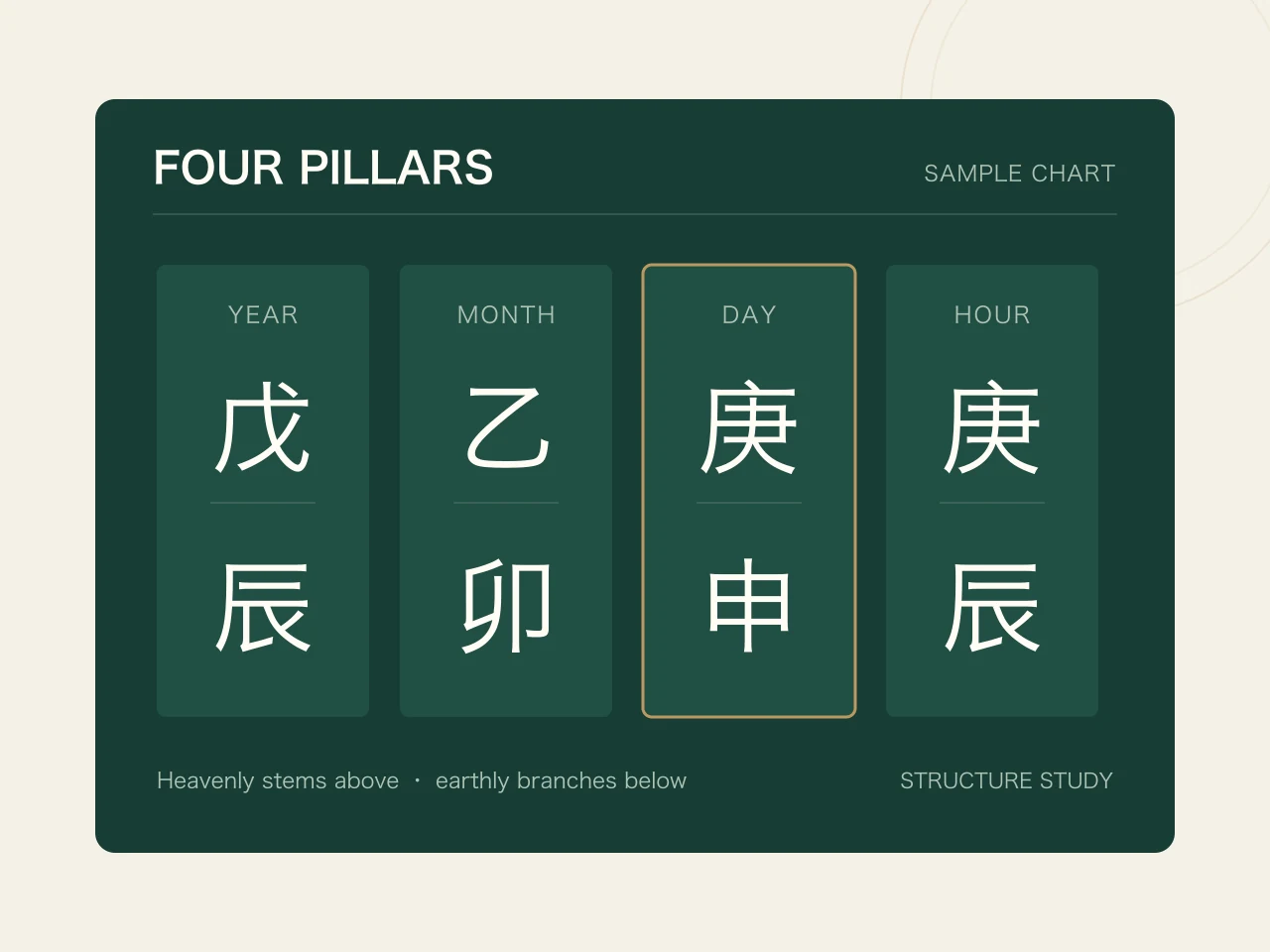
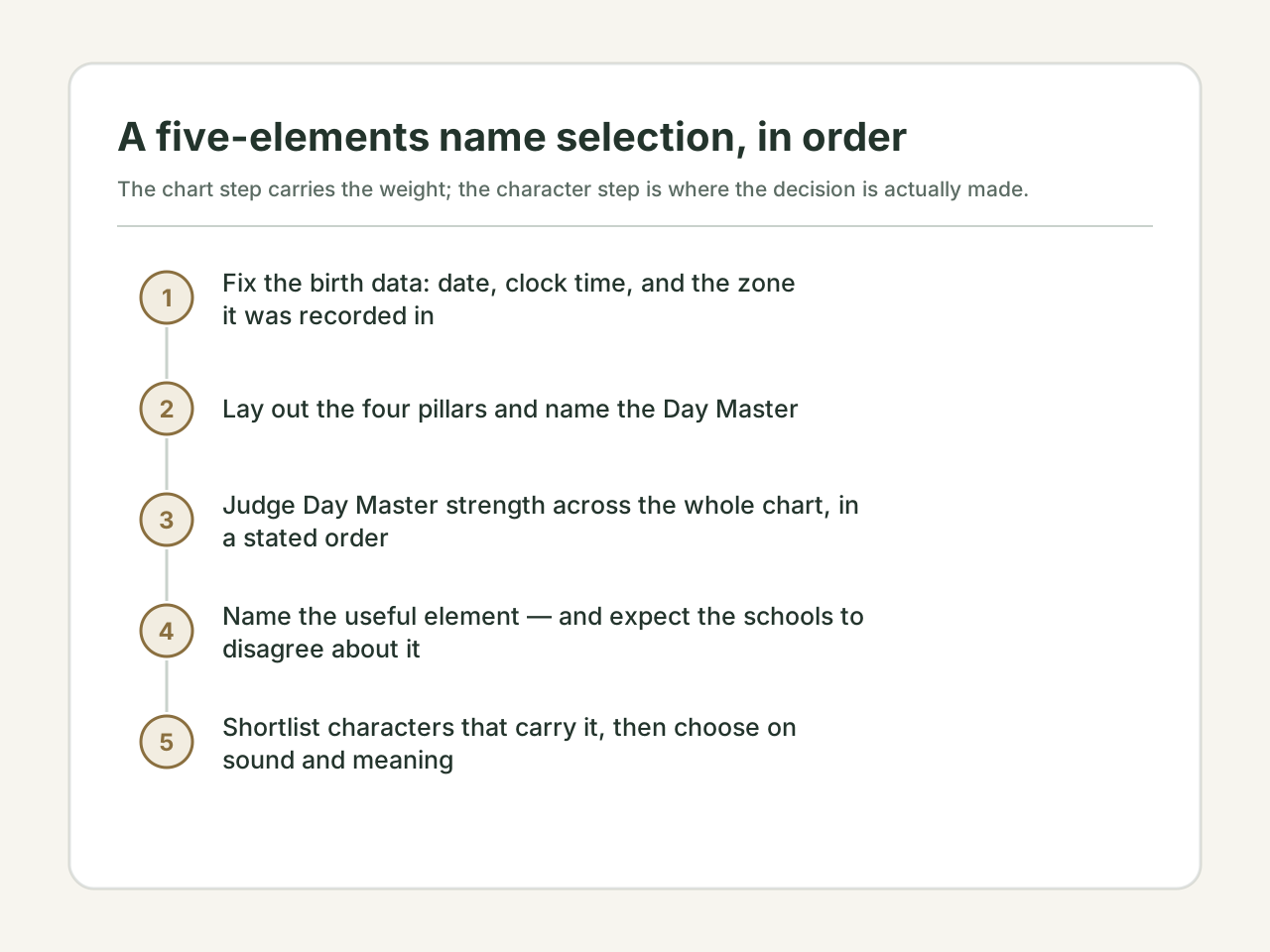
Five-elements name selection starts from a birth chart and ends at a shortlist of characters. In between it does four things: it fixes the birth data, it lays out the four pillars, it names the Day Master, and it judges which element the chart is short of. Everything after that — which characters, which sounds, which meanings — is a human choice made inside whatever shortlist those four steps produced.
The calculator runs those four steps and shows its work. You enter a birth date, a clock time, and the zone that time was recorded in, and it returns the four pillars with their stems, branches, hidden stems and element distribution. It does not return a name. That boundary is the honest one: the arithmetic is reproducible, the character choice is not.
The step that carries the weight: judging the Day Master
The Day Master is the day stem, and the whole selection hangs on a judgement about it — whether it stands strong or weak in the chart it sits in. That judgement is made by counting support: how many other stems and branches share its element, whether the season it was born in is on its side, and what the month branch contributes.
- The chart has to be built before it can be judged. A wrong birth time moves the hour pillar and sometimes the day pillar, which changes the Day Master itself.
- Strength is a judgement about the whole chart, not about one element. A chart can be missing an element and still not want it.
- The month branch does more work than any other single character, because it carries the season and the hidden stems.
- Two schools read the same chart and reach opposite conclusions about the same Day Master, and they do it in the open. One weighs the season heavily; the other weighs the raw count of supporting characters. Neither is an arithmetic error — they are different conventions, and the useful element they name can be opposite.
How candidates get compared
Once a useful element is named, the selection becomes a comparison. Each candidate character is read for the element it is assigned, for its sound, and for its meaning, and the shortlist is whoever survives all three.
- The element assignment is the weakest link. A character is assigned to a phase through its meaning, through its radical, or through its pronunciation, and the three routes can disagree. 峰 is earth by meaning and by radical; 炎 is fire by meaning and by form; but 明 is assembled from the sun radical and the moon, which sit in different phases.
- Character-to-element dictionaries are conventions that were compiled, not measured. Two of them can place the same character in different phases, and neither is wrong in a way you can demonstrate.
- Sound and meaning are compared separately from the element, and they are the parts a family can actually check by saying the name out loud.
- The calculator shows the chart, the strength judgement and the element distribution, then leaves the ranking to be read against the other two criteria rather than on its own.
A worked example: three characters for one chart
A parent has a chart whose Day Master is 壬 — yang water — born in a winter month. Winter is water's season, so the chart is already heavy with water. One school reads the Day Master as strong and names earth as the useful element, to give the water something to hold. Another reads the same chart as strong but cold and names fire, to warm it. Three characters are on the table.
峰 (peak) is assigned to earth, by meaning and by radical, so it fits the first reading. 昀 (sunlight) is assigned to fire, by meaning and by the sun radical, so it fits the second. 涵 (to contain, as water holds something) is water, which fits neither reading and is the first one both schools drop.
The calculator shows the chart and both readings side by side and leaves the parent to choose. In this case the parent chose 峰, because a peak is the meaning they wanted to hand their son and the earth reading was the one their own adviser used. That is a legitimate way to decide. What is not legitimate is presenting the score as though the chart had produced the name.
What the selection cannot decide
Four limits keep the method in proportion:
- It cannot tell you whether a name is good. Sound, meaning, and how the name feels when the family says it out loud are the parts that stay with a person, and no element score touches them.
- It cannot settle the chart question. Two schools will name different useful elements from the same four pillars, and the calculator shows both rather than picking one.
- It cannot reach the future. A name assigned to a useful element is a character the family likes; it arranges nothing about school, work, health or relationships.
- It cannot replace the registrar. For a business name, the trademark register, the domain and the local company-name rules decide what is available; the element reading comes after all of them.
Disclaimer: This content is for informational and cultural reference purposes only. It does not constitute professional medical, legal, financial, or psychological advice. Readers should exercise their own judgment and consult qualified professionals for specific concerns.
Sources and review basis
Traditional references explain historical vocabulary and context. Official practical sources support only the observable safety, comfort, or environmental points noted in the article; they do not validate metaphysical claims.
Traditional reference
Yuanhai Ziping (渊海子平)Wikisource digital text · Accessed 2026-07-14
A classical source for Four Pillars terminology, element relationships, and the Day Master framework.
Practical source
APA Dictionary of Psychology: Barnum effectAmerican Psychological Association · Accessed 2026-07-14
A psychology reference for why broad, favourable personality descriptions can feel personally accurate. It does not evaluate BaZi calculations themselves.