The oldest text on naming is an argument about cost
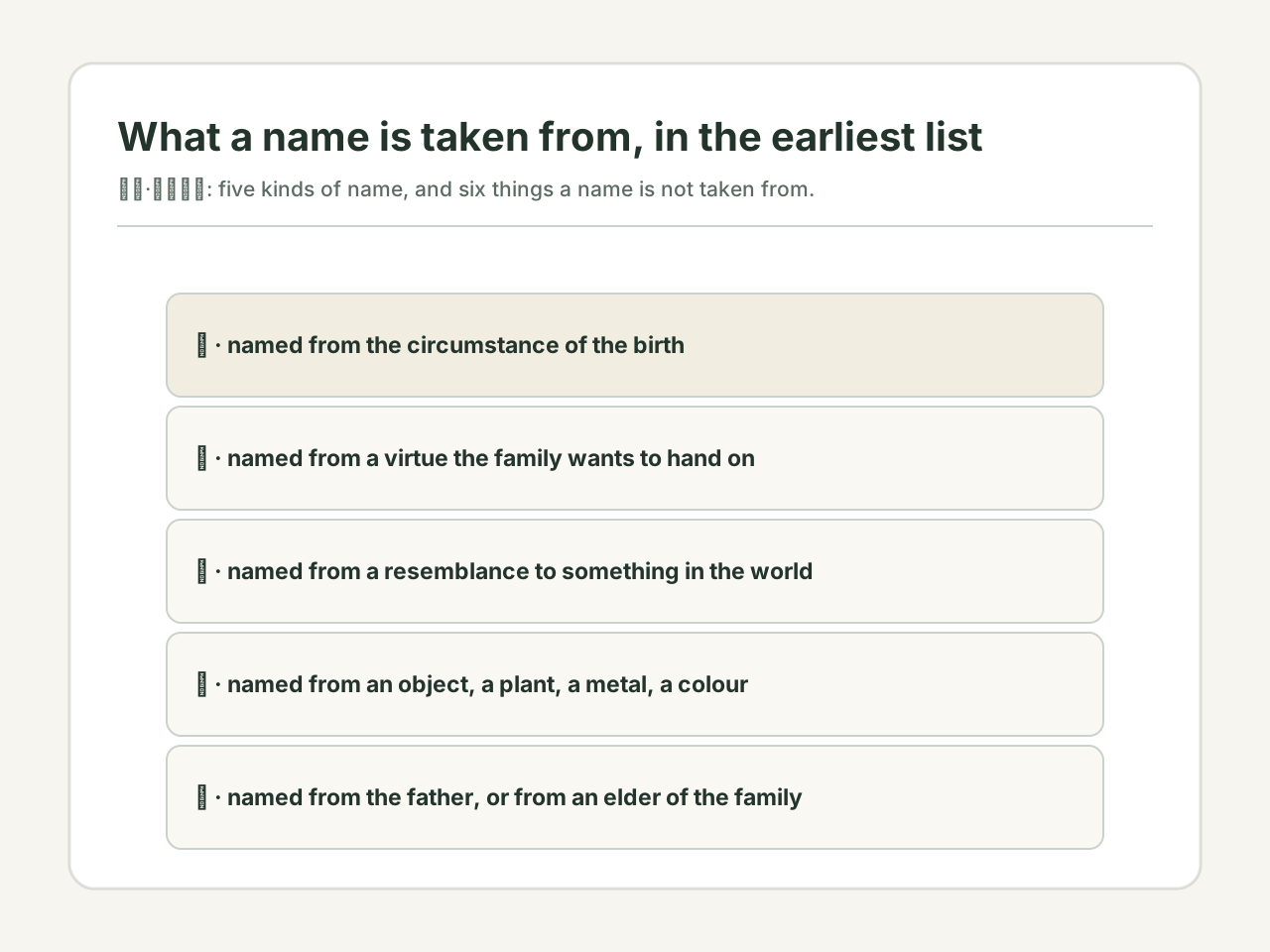
The earliest systematic statement on Chinese naming that survives is a short answer in the Zuo Tradition. Duke Huan of Lu asks Shen Xu what to name his newborn son, and Shen Xu answers that names come in five kinds: from the circumstance of the birth (信), from a virtue (义), from a resemblance (象), from an object (假), and from the father (类).
He then lists six things a name is not taken from — a state, an office, a mountain or river, a hidden illness, a domestic animal, a ritual vessel — and the reason he gives is not about fortune. It is about what happens to the word afterwards. The Zhou used tabooing in the service of the spirits, and every name will eventually be tabooed, so a name taken from a state retires the state's name, one taken from an office retires the office, one taken from a mountain retires the mountain.
That is the whole argument, and it is a cost argument. A name is a word you hand into a system that is obliged to stop using it. Choose one whose retirement costs nothing. What is absent from the passage is equally telling: no stroke count, no five-phase fit, no score, and no claim that the name will make the child anything.
The six avoidances are one rule with six worked cases
Read as a list of superstitions the six look arbitrary. Read as cost accounting they are consistent: each one names something the ritual system has to keep saying, and each one retires it.
The last entry is the exception, and it is the interesting one. A hidden illness is not something the system needs to keep saying, so the cost argument does not reach it. The author gave no reason because he thought none was needed: a name should not remind its bearer of a defect every time it is used.
| Not taken from | What is retired | Why the cost is high |
|---|---|---|
| A state | The state's name | A whole polity has to be referred to obliquely |
| An office | The office | Jin retired 司徒 and Song retired 司空 after rulers took those names |
| A mountain or river | The presiding name | The place's rites have to be conducted around the word |
| A domestic animal | The sacrifice | The offering is organised by the animal's name |
| A ritual vessel | The rite | The vessel's name is part of the ceremony |
| A hidden illness | Nothing — no reason given | The cost is to the bearer, not to the system |
The modern method does something different with the same word
The scheme that dominates naming advice now is built on stroke counts. Five grids are derived from them: 天格 from the surname plus one, 人格 from the surname and the first given character, 地格 from the given name plus one, 总格 from every stroke in the name, and 外格 from the difference. The last digit of the first three is then mapped onto a phase — one and two to wood, three and four to fire, five and six to earth, seven and eight to metal, nine and zero to water — and that triple is read as the name's 三才.
This is a real change of subject, and it is worth being precise about what kind. The word stops being a word. It becomes an integer, and the integer is what gets judged. That has one genuine advantage over the classical passage: arithmetic can be checked by anyone, and the classical passage cannot. It also has one genuine weakness, and the weakness is fatal to the method's claim to be about a particular name rather than about a script.
The number is not stable, because the strokes are not
Take a two-character name, 张伟. Counted in the simplified forms the surname is 7 strokes and the given name 6; counted in the traditional forms they are 11 and 11. Run both through the same formulas.
Four of the five grids move. The 三才 follows: 8, 13 and 7 give 金, 火 and 金, while 12, 22 and 12 give 木, 木 and 木. One of those triples is a clash — fire over metal — and the other is like with like, which the same tables rate as harmonious. So the identical person, with the identical name, is given opposite readings depending on which writing system the practitioner counted in.
Nothing in the method says which form to count. That is not a gap in the instructions; it is the method describing a property of the script and calling it a property of the person. A name cannot be good in one writing system and bad in another, because the name is the same name.
| Grid | 张伟 (simplified) | 張偉 (traditional) |
|---|---|---|
| 天格 | 7 + 1 = 8 → 金 | 11 + 1 = 12 → 木 |
| 人格 | 7 + 6 = 13 → 火 | 11 + 11 = 22 → 木 |
| 地格 | 6 + 1 = 7 → 金 | 11 + 1 = 12 → 木 |
| 总格 | 13 | 22 |
| 外格 | 2 | 2 |
Tone: what the name sounds like when it is not read one character at a time
A name is spoken in connected speech, and connected speech in Mandarin changes tones at the seams. The rule that catches names most often is the third-tone pair: when two third tones meet, the first is pronounced as a second. A third tone followed by any other tone loses its rise and is realised as the fall alone, a half third.
So a name chosen for the softness of three dipping tones does not sound like three dipping tones. 李小雨 is written 3-3-3. Spoken, it is 2-2-3: 李 rises, 小 rises, 雨 is the only one that dips. A parent who picked three third tones for a gentle, low sound has chosen a name that opens with two rising tones and ends on a fall — which is a perfectly good shape, but not the one they thought they were choosing.
The check takes ten seconds and is worth doing before anything else: say the full name, surname included, at conversational speed, and listen for where the tones actually land rather than where the dictionary puts them.
The seam between the syllables, and why the spelling has to carry it
Mandarin has about 1,300 tone-bearing syllables and about 400 without tone. General use runs to roughly 3,500 characters. Divide and the density falls out: about three characters share each tone-bearing syllable, and about nine share each toneless one. Homophony is not an occasional hazard in this language; it is the default, and the written form is what separates the cases.
That is why the seam between two syllables matters so much in a romanised name. When the second syllable has no initial consonant, it fuses with the final of the first, and the apostrophe exists precisely to stop it: 西安 is Xī'ān, and written without the mark it becomes 先. The same thing happens to names. 张安 written properly is Zhang'an; written Zhangan, as forms and databases routinely render it, it reads back as 张干.
A name therefore has to survive two reductions at once — the loss of tone marks, and the loss of the apostrophe — because systems do both. The test is to write the pinyin the way a database would store it, all lowercase, no marks, no punctuation, and read it back as a stranger would.
Meaning: what the oldest dictionary actually gives you
An entry in the Shuowen Jiezi has three parts: a gloss, a component analysis, and a pronunciation note. All three are worth reading, and the middle one is the one people skip.
The character usually offered as the easy example is 明, explained as sun and moon together. The Shuowen does not say that. Its entry is 朙, glossed 照也, and analysed as 从月从囧 — moon and a window, not moon and sun. The 日-plus-月 form is later, and the sun-and-moon reading is a much later folk analysis that happens to be more memorable than the original. Both readings are now in circulation, which is exactly the situation a name has to be chosen inside.
The practical instruction that follows is unglamorous. Read the full gloss, not the first line of it; a character whose primary sense is attractive can carry a secondary sense the dictionary also lists. Read the component analysis and notice when it disagrees with the story you were told. And read the character in both scripts, because the name will be written in whichever one the household and the register actually use.
The order to check in
Each step can eliminate a candidate outright, so run them in this order and stop when one fails:
- Say the whole name aloud at conversational speed, several times, and listen for the tone sandhi rather than the dictionary tones.
- Write the pinyin the way a database would store it — lowercase, no tone marks, no apostrophe — and read it back cold.
- Write the name in both scripts, count the strokes in each, and notice whether the two counts would give the same reading. If they would not, the number is not about the name.
- Read the full gloss and the component analysis of every character, and check the secondary senses.
- Check the local dialect if the household speaks one, since the name will be heard in it at home and in Mandarin everywhere else.
- Only then compare whatever is left on element or number, if that matters to you. It is the last filter, and it is the only one that cannot be checked.
Disclaimer: This content is for informational and cultural reference purposes only. It does not constitute professional medical, legal, financial, or psychological advice. Readers should exercise their own judgment and consult qualified professionals for specific concerns.
Sources and review basis
Traditional references explain historical vocabulary and context. Official practical sources support only the observable safety, comfort, or environmental points noted in the article; they do not validate metaphysical claims.
Traditional reference
Zuo Tradition, Duke Huan year 6 (左傳·桓公六年)Wikisource digital text · Accessed 2026-10-26
The passage where Shen Xu lists five kinds of name — from the circumstance of birth, from a virtue, from a resemblance, from an object, from the father — and six things a name is not taken from. Cited for that list; it says nothing about stroke counts or five-phase fit.
Traditional reference
Shuowen Jiezi (說文解字)Wikisource digital text · Accessed 2026-10-26
The Eastern Han dictionary that organises characters by shared form component and glosses each one with its component analysis and a fanqie pronunciation. Cited for the structure of a character entry; it is a philological work, not a naming manual.