A ten-year decision made in an afternoon
A tree is the only element in a garden that keeps growing after you have finished paying for it. That single fact reorganises the whole question. Paving is roughly final, a fence is roughly final; a tree is a commitment that changes shape every year, and the errors compound in one direction — more shade, more root, more leaf litter, more weight on whatever is underneath.
The useful way to choose a position is to imagine the mature tree and ask whether that version is still welcome there. Most disappointing garden trees were not badly chosen. They were planted at a size that no longer exists, and the photograph taken on planting day is the least useful record you will keep, because it captures the only moment when the spacing looks generous.
Three measurements before you pick a spot
Three numbers decide the position, and all three are knowable before you buy: mature canopy spread, mature height, and mature root spread. The first two are on the nursery label. The third rarely is, but a workable proxy is that the feeding roots — the ones that take up water and heave paving — sit in the top half metre of soil and extend well past the canopy edge.
Write the numbers on the label in pencil, then mark the mature canopy on the ground at full size with a stick and a length of string. Standing inside a circle the size of the eventual canopy changes the decision faster than any advice. Most people find that the spot they had in mind puts the crown over the path, the gutter, or the boundary line.
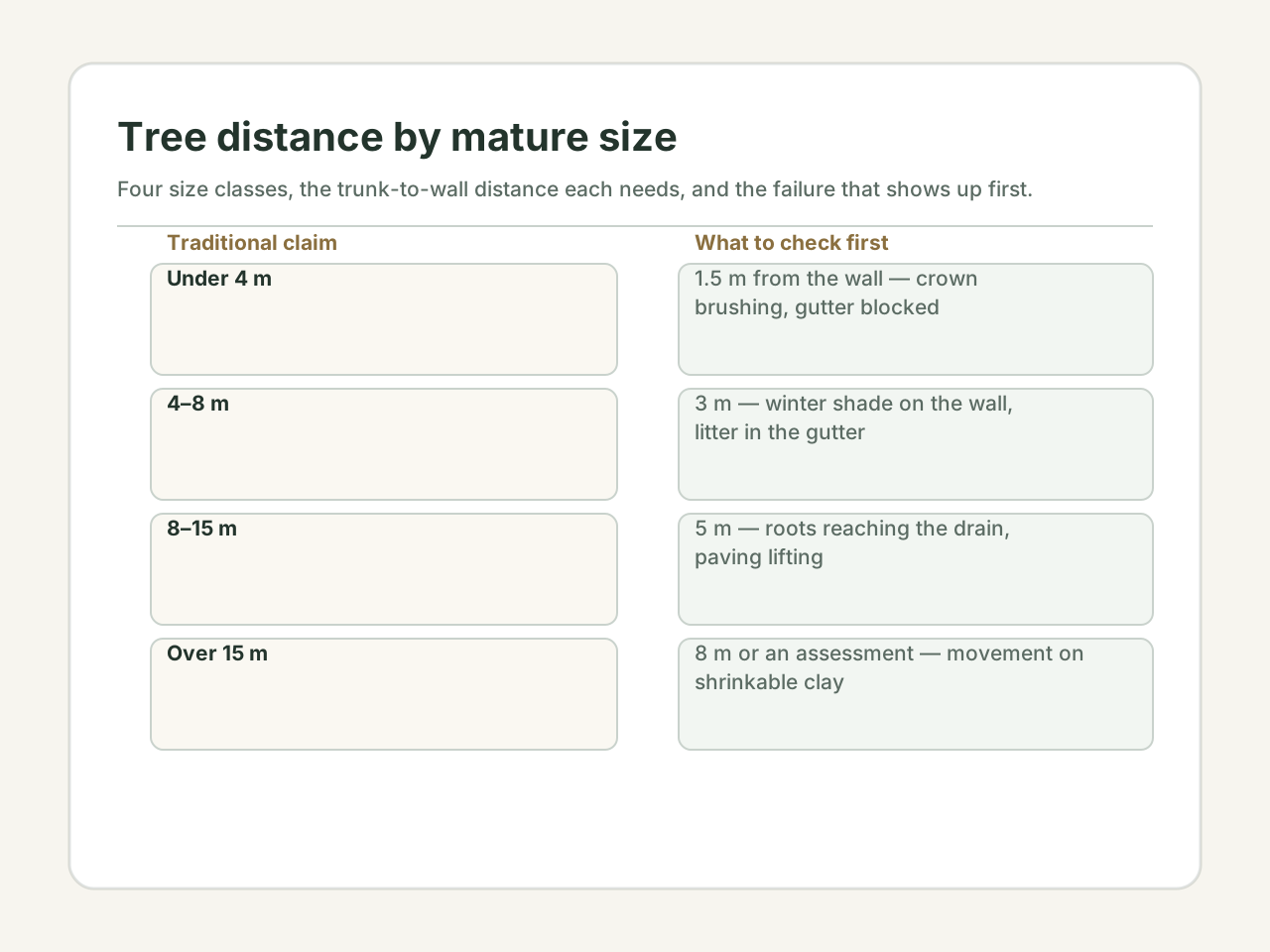
Distance from the wall, by size class
The table is a starting point, not a survey. It assumes ordinary loam, a wall with a normal footing, and a tree in open ground rather than a raised bed pressed against the wall. Shrinkable clay, a shallow water table, or an old drain under the spot all push the figure outward.
| Mature height | Minimum trunk-to-wall distance | What fails first |
|---|---|---|
| Under 4 m | 1.5 m | Crown brushing the wall; gutter blocked |
| 4–8 m | 3 m | Winter shade on the wall; litter in the gutter |
| 8–15 m | 5 m | Roots finding the drainage run; paving lifting |
| Over 15 m | 8 m, or a professional assessment | Movement on shrinkable clay; light blocked |
Which side, and what the shade actually does
Once the distance is fixed, the side decides what the tree does to the house. In the northern hemisphere a deciduous tree on the sunny face gives shade in summer and drops its leaves in time to let winter light through. An evergreen in the same position gives shade all year, and is the more common reason a room behind that wall feels cold and damp.
The winter case is the one people forget, because the loss is invisible in summer, when the room is comfortable either way. If the room already struggles with damp, planting an evergreen against that wall adds a windbreak exactly where you needed drying.
Roots, drains, and what you cannot see
Roots are not drills. They follow water and oxygen, and they exploit openings that already exist — a cracked pipe, an old soakaway, a joint that has separated. A sound footing is rarely damaged by roots alone; a leaking drain beside a large tree is a different problem. In a small garden the drainage run therefore matters more than the wall, and the planting position should be checked against the sewer, the storm drain, and any soakaway before the hole is dug.
Two habits remove most of the remaining risk. Plant small and let it grow, because a young tree planted at the right distance overtakes a large specimen within a few years and establishes better. And keep the root flare clear: the point where the trunk widens into the roots must sit at or slightly above ground level, never buried under mulch, or the tree spends its first years short of air.
What the old readings were pointing at
Classical garden writing gives a tree a position and a verdict: the large tree at the entrance is read as blocking, the tree behind the house as support, the tree over the gate as pressure. Read only as symbolism, the rules look arbitrary. Read as descriptions of a physical situation, they are close to what a surveyor would say. A big tree at the entrance does block light and sight lines, and does drop leaves on the path people use most. A tree behind the house does shelter it from the prevailing wind.
The reading is best used as a list of positions worth examining, not as a verdict on a species. When the traditional objection and the physical objection land on the same tree, the case for moving it is strong. When they diverge — a species called unlucky that is simply too big for the spot — size is still the reason to act, and the fix is the same.
The check to run before you dig
Five minutes with a tape and a phone camera answers most of what the decision turns on.
- Draw the mature canopy on the ground at full size and walk the circle; note what it covers.
- Measure trunk-to-wall and compare the figure with the table above.
- Locate the sewer, the storm drain, and any soakaway; keep the trunk clear of all three.
- Photograph the wall at midday in winter, so you know what light the tree will take.
- Check whether the species is toxic to pets or children before it goes beside a path.
- Confirm the root flare will sit at ground level once the hole is backfilled.
Disclaimer: This content is for informational and cultural reference purposes only. It does not constitute professional medical, legal, financial, or psychological advice. Readers should exercise their own judgment and consult qualified professionals for specific concerns.
Sources and review basis
Traditional references explain historical vocabulary and context. Official practical sources support only the observable safety, comfort, or environmental points noted in the article; they do not validate metaphysical claims.
Traditional reference
Huangdi Zhaijing (黄帝宅经)Wikisource digital text · Accessed 2026-07-14
Historical context for traditional residential orientation and spatial vocabulary. Modern recommendations are judged against real conditions.
Practical source
ASPCA: Toxic and Non-Toxic PlantsAmerican Society for the Prevention of Cruelty to Animals · Accessed 2026-07-14
A plant-safety reference for homes with cats, dogs, or other pets.