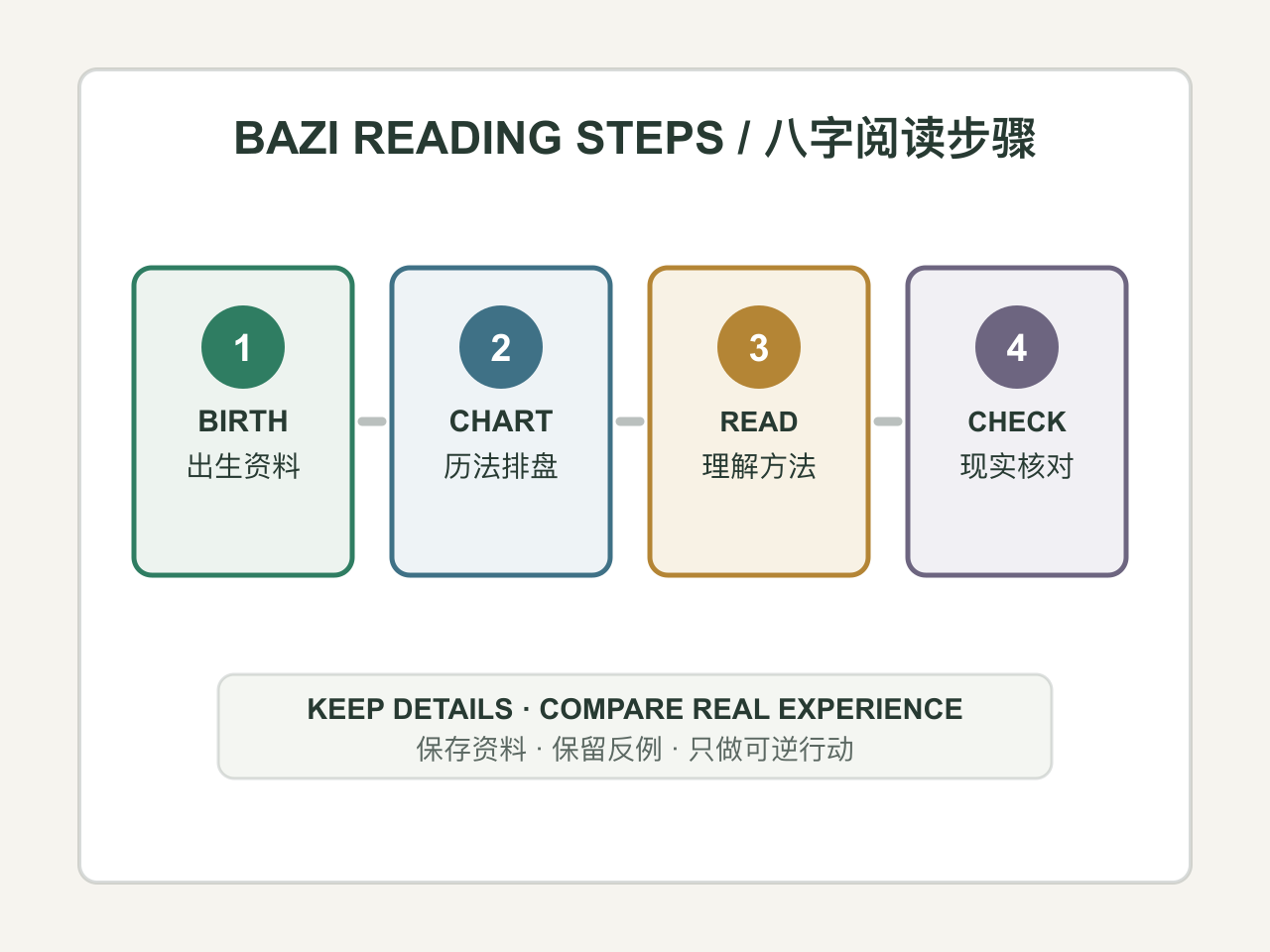
BaZi review path from birth input and chart calculation to method disclosure and real-world review

Naming

Wu Ge Name Analysis

Analyze a Chinese name through stroke counts, five-grid structure, three-talent elements, and clear notes when a character needs estimation.

Before you start

Prepare these details to see these results

Check which details are required before entering personal information. If something is missing, the page explains the effect instead of guessing for you.

What to prepare

  1. 1

    Surname

    Supplies the family-name characters required for the naming calculation.

  2. 2

    Given name

    Supplies the given-name characters used in the stroke-grid calculation.

What you will see

What you need before you start

Before starting, confirm that dates, times, and other details are accurate, and note which items are required or optional. Do not replace missing required information with a guess.

Surname

required

type in required

Supplies the family-name characters required for the naming calculation.

Example: Zhang

What to enter: Remove accidental extra spaces and enter only the information requested.

If you leave it out: The tool cannot produce a reliable result without this required value.

Given name

required

type in required

Supplies the given-name characters used in the stroke-grid calculation.

Example: Minghua

What to enter: Remove accidental extra spaces and enter only the information requested.

If you leave it out: The tool cannot produce a reliable result without this required value.

How it works

This tool uses the details you enter on the page to produce a result. It is free to use, and your information is not sent to a third-party AI service.

Verify the stroke convention

Save the exact simplified or traditional characters, the dictionary or stroke table used, every character count, and all five formulas. Check the result again when a written form changes. Compare pronunciation, meaning, ambiguity, identity, and registration use separately from the numerical result. A grid score cannot measure character, health, worth, compatibility, or future success.

Define the input before using the result

Use Wu Ge Name Analysis as a method record, not as an answer machine. Begin by writing the exact question, the input supplied, the date, and the convention used. The page concerns character form, Kangxi strokes, five grids, three talents, estimated characters, and naming context; those terms have a history and may be defined differently by different schools. In a case such as a character is counted differently by two dictionaries, preserve the original information before correcting or interpreting it. Label an input exact, reported, estimated, or unknown.

Read the output in context

After using Wu Ge Name Analysis, place the output beside the real question rather than reading it in isolation. For character form, Kangxi strokes, five grids, three talents, estimated characters, and naming context, write one traditional association, one directly observable fact, and one ordinary explanation. This prevents a vivid label from becoming the only explanation for a complicated situation. If the input is near a calendar, time, character, or measurement boundary, show the alternative rather than hiding it.

A worked comparison

For a worked Wu Ge Name Analysis comparison, use character form, Kangxi strokes, five grids, three talents, estimated characters, and naming context. Create two rows with the input, method, output, interpretation, uncertainty, cost, and review date. If two schools or dictionaries produce different results, preserve both results and explain the reason. Do not average them without a stated rule. A transparent comparison is more useful than a single impressive number.

Responsible use and consent

Use Wu Ge Name Analysis carefully when another person is involved. Ask permission before analysing a name, palm, chart, relationship, or shared space. Explain the method and allow the person to refuse. For character form, Kangxi strokes, five grids, three talents, estimated characters, and naming context, avoid language that fixes identity, worth, health, compatibility, or destiny. Say traditionally associated, one school reads this as, or this input may suggest.

Review the record

At the review date, compare the original question with what was actually observed after using Wu Ge Name Analysis. Include inconvenient details, changed circumstances, and evidence that did not fit the reading. If the action helped, identify practical factors that may have contributed. If it did not help, revise or undo it instead of blaming the user or buying a more elaborate solution.

What this tool cannot establish

Wu Ge Name Analysis can support structured study of character form, Kangxi strokes, five grids, three talents, estimated characters, and naming context, but it cannot establish a diagnosis, guarantee income, prove a relationship outcome, or determine a person’s fixed character. Its result depends on declared inputs and a chosen tradition. The page should make those dependencies visible beside the output.

A detailed worked case

A detailed case study for Wu Ge Name Analysis starts with a character is counted differently by two dictionaries. Write the exact user question, input values, date, source, and convention. The tool can organise character form, Kangxi strokes, five grids, three talents, estimated characters, and naming context, but its output is only as reliable as those declared assumptions. Preserve unknown or estimated information instead of silently filling it. Explain what each displayed field means in plain language and which later interpretation is optional.

Compare two results when a dictionary, calendar, time boundary, or measurement convention can change the output. Put the assumptions above the result, then list agreements, differences, and the practical evidence still needed. This prevents a number or label from sounding more authoritative than the method warrants.

Use one low-risk follow-up action: verify a source, repeat a measurement, ask the affected person, compare another assumption, or observe the situation for a fixed period. Keep the action reversible and record cost, consent, and review date. A change that follows a reading is not automatically caused by it; include ordinary factors and inconvenient results.

The tool is for cultural learning and structured reflection. It cannot diagnose health, guarantee income, determine compatibility, fix a person’s character, or replace professional advice. If the output creates fear or pressure to purchase, pause. The reader may disagree, seek another source, or stop.

A month-long reading and review

Read Wu Ge Name Analysis as a sequence of decisions rather than a score. Start with the user’s purpose and check whether the input is suitable for the method. Then inspect character form, Kangxi strokes, five grids, three talents, estimated characters, and naming context in the order displayed. Write a short note explaining which field is directly calculated, which field comes from a lookup table, and which conclusion is added by interpretation. If the page uses a historical term, give its source context and avoid translating it into a modern promise.

A robust tool page gives the reader a way to challenge the result. Show the boundary cases, missing inputs, alternate calendar or dictionary rules, and the reason two outputs could differ. Ask another person to read the method without seeing the conclusion and note whether they can reproduce it. This is especially useful when the output looks precise but the underlying convention is uncertain.

For a month-long review, choose one ordinary question connected to the tool. Keep a dated record of the output, your expectation, the action taken independently, and what happened. Include events that do not fit. Do not change the input repeatedly until a preferred result appears. A result is a prompt for reflection, not evidence that the tool predicts a person’s future.

When the subject touches health, money, employment, law, safety, or relationship consent, move the decision to the relevant evidence and professional or shared process. Do not use the tool to pressure another person, justify a purchase, or create dependence. A reader should be able to save the method, disagree with the interpretation, and leave without penalty.

Dictionary and character check

Wu Ge analysis depends on character form and stroke convention. Check the exact traditional or simplified character, the dictionary edition, and any estimated stroke count before interpreting the five grids. A different dictionary can produce a different number without either reader being dishonest. Record the uncertainty beside the result.

Then discuss whether the name works in everyday speech, writing, search, and family context. The number may be part of a cultural conversation, but it cannot establish a person’s ability, health, luck, or future. Make the final decision understandable without the numerical system.

When two dictionaries disagree

If two dictionaries give different strokes for a character, show both counts and name the source. Check whether the disagreement comes from simplified versus traditional form, a variant character, or a different dictionary convention. Do not hide the lower or less favourable number. The comparison is part of the lesson and lets a family understand why the output changes.

After the technical comparison, return to pronunciation, meaning, writing, regional use, and the people affected by the name. A grid can organise a cultural preference, but it cannot establish character, ability, health, income, or future. Make the practical choice explainable without the score.

A character verification record

Before interpreting a Wu Ge result, make a character verification record. Write the exact form, traditional or simplified status, dictionary name, stroke count, variant handling, and the reason that source is appropriate for the intended audience. If another source counts differently, display the disagreement and explain it. Then move outside the grid: read the name aloud, write it by hand, search it, and ask how a speaker unfamiliar with the character would pronounce it. These checks matter because a technically neat number can still produce an impractical name. Keep the five-grid result as a cultural reference, not as evidence of fixed personality, health, success, or future events. Let the people affected explain their priorities, and keep the decision reversible until those practical questions have been answered.

A final name review

Use this final wu-ge-name-analysis review to place the method beside the decision it is meant to support. Check the original input, the named convention, the ordinary evidence, the people affected, the cost, and the review date. If a result remains uncertain, write that uncertainty plainly. A tool should make a question clearer, not make a person feel obliged to accept a number, direction, or ranking.

Keep the next action small and reversible. Record what would change your mind and where professional or shared advice takes priority. The reader can value traditional knowledge while rejecting a conclusion, postponing action, or choosing a practical explanation.

A final case note

A final lesson note about Wu Ge Name Analysis should connect the named method with a concrete case. Preserve the input, source, date, convention, and uncertainty, then describe the ordinary situation before applying specialist vocabulary. Compare the traditional interpretation with one practical explanation and state which conclusion remains unproven.

Use one small reversible exercise and set a review date. Record cost, consent, affected people, and what actually changed, including inconvenient results. If the topic touches health, money, law, safety, work, or relationship boundaries, use the relevant professional or shared process. The method supports cultural learning and reflection; it does not guarantee an outcome.

Why can the same Chinese character have different stroke counts?

Name-analysis systems commonly use Kangxi-dictionary stroke counts, which can differ from the way a modern simplified character is written by hand. Variant forms and uncommon characters may also map differently between references. The tool marks estimated characters so you can verify the traditional form and count before comparing results.

What do the five grids measure?

The Heaven, Human, Earth, Outer, and Total grids are arithmetic combinations of surname and given-name strokes. Traditional name studies assign symbolic themes to each grid and then compare the three-talent element pattern. They are a historical naming framework, not a scientific personality or outcome test.

Should a high Wu Ge score decide which name to use?

No. Use the result only as one comparison point. Pronunciation, meaning, writing clarity, family language, cultural associations, and the person's own preference matter more in everyday life. A numerically preferred name cannot guarantee health, relationships, academic success, or career outcomes.

What should appear in a transparent five-grid calculation?

Show the exact simplified or traditional characters, the declared dictionary or stroke convention, the count assigned to every character, and the formulas for the Heaven, Human, Earth, Outer, and Total grids. Make any one-character surname or given-name adjustment explicit. If another convention produces a different count, show the alternative rather than hiding it. Keep pronunciation, meaning, ambiguity, identity, and registration use outside the numerical score. The grids cannot measure personality, health, worth, compatibility, or future success.

Try next

Related tools