Business opening dates are about intentional beginnings, not magical success
Traditional Chinese date selection for business openings involves checking the stem-branch of the proposed opening date against the business owner's BaZi chart and the industry's associated element. The idea is to choose a date when the energy is supportive of the business venture.
The honest view: the date you open a business does not determine its success. Business success depends on your product, your market, your operations, your team, and your execution. A business opened on the most 'auspicious' date will fail if the fundamentals are wrong. A business opened on an 'inauspicious' date can succeed if the fundamentals are right. The date is a symbol of intention. It is not a guarantee.
What to check when selecting a business opening date
Here are the key factors in traditional business opening date selection:
| Factor | What to check | Practical advice |
|---|---|---|
| Business readiness | Is the business actually ready to open? Are permits in place, staff hired, operations tested? | This is the most important factor. Do not rush the opening to meet an 'auspicious' date. Open when the business is ready. A delayed opening on a well-prepared business is better than a rushed opening on an 'auspicious' day |
| Owner's year branch clash | Does the day's branch clash with the owner's year branch? | Check the day branch against the owner's year branch. Eliminate dates that clash. This is the primary traditional check for business openings |
| Industry element | Does the day's stem support the element associated with the industry? | Each industry is associated with an element. Restaurants are Fire (cooking), technology is Water (information flow), real estate is Earth (property). Choose a day whose stem is the element that supports the industry. For example, a restaurant (Fire) would benefit from a day with Wood (which generates Fire) or Fire (which is the same element) |
| Avoid certain days | Is the day marked as generally inauspicious in the almanac? | Some days are traditionally considered unsuitable for new beginnings. These are marked in the almanac. If you are consulting an almanac, avoid these days |
A worked example: opening a restaurant
A chef is opening a restaurant. She was born in 1986 (丙寅, Fire Tiger, Yin branch). Restaurants are associated with the Fire element. She has two possible opening dates: March 15, 2027 and March 22, 2027.
March 15, 2027 is a 癸卯 (Gui Mao) day. The day branch is Mao (卯). Mao does not clash with Yin (寅). The day stem is Gui (癸), which is Water. Water controls Fire, so this is not ideal for a Fire-element business.
March 22, 2027 is a 甲子 (Jia Zi) day. The day branch is Zi (子). Zi does not clash with Yin (寅). The day stem is Jia (甲), which is Wood. Wood generates Fire, so this is favourable for a Fire-element business.
She checks the almanac: March 22 is marked as generally auspicious. She checks her business readiness: the kitchen is tested, the staff is trained, the permits are in place. She confirms the date with her team. She opens on March 22. The date is a nice symbol, but the success of the restaurant depends on the quality of the food, the service, and the operations — not on the date.
A soft opening before the official opening day
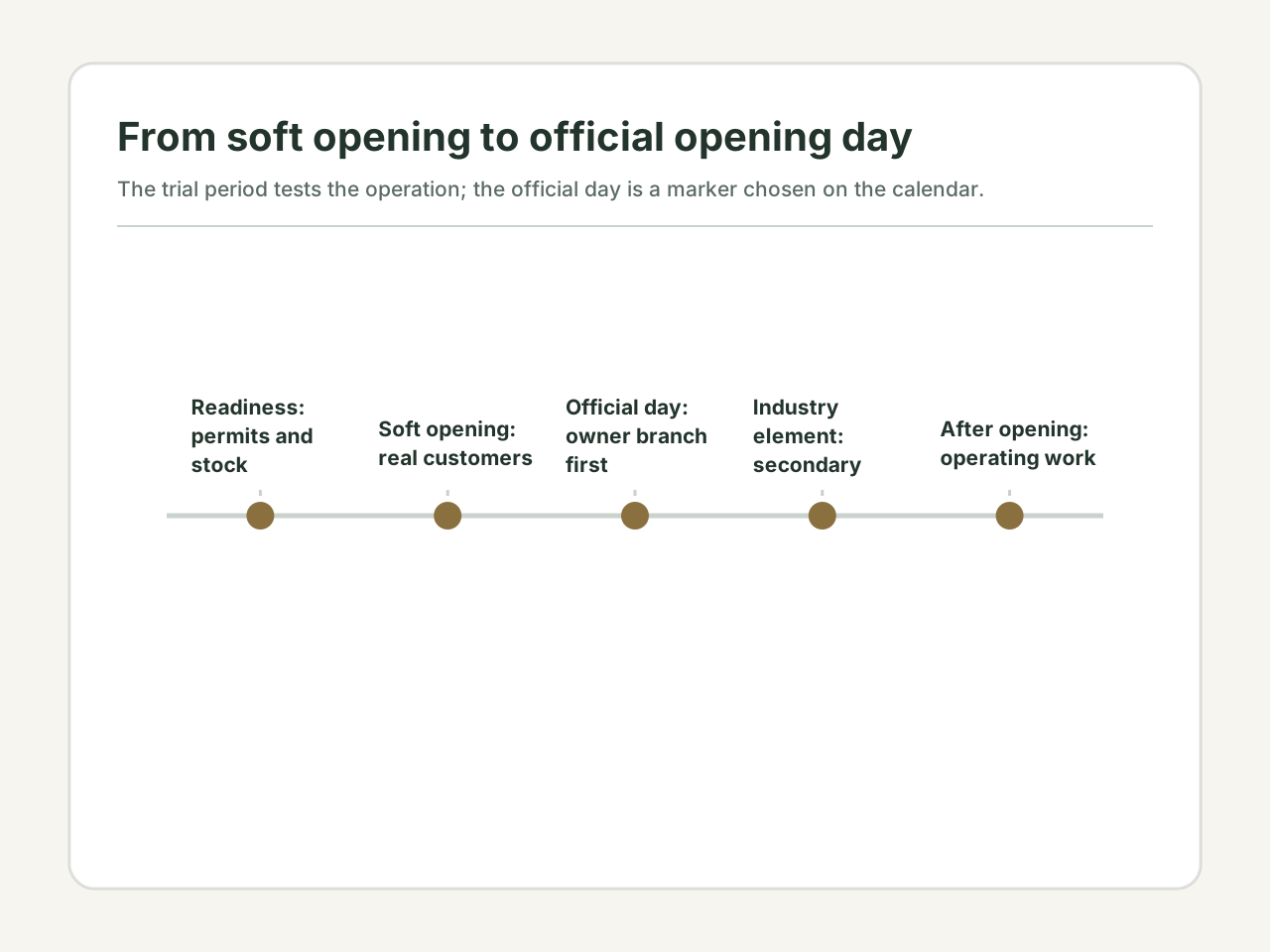
Most businesses now run a soft opening — a quiet trial period with real customers but no announcement — and the traditional check applies to the official day rather than to the trial. Separating the two removes most of the pressure. The trial period is where the queue, the payment terminal, the kitchen timings and the staffing rota get tested; the official day is a marker, and it can be chosen on the calendar without also carrying the question of whether the business works.
- Run a trial period with real transactions before the official day, so the opening becomes a repetition of something that already worked once
- Filter the official date against the owner's year branch first; the industry-element comparison is a secondary refinement, not a substitute for readiness
- Keep the opening-day programme reversible: something short, easy to extend or end, with a written list of who handles what
- Write down who the date is for — a marker for staff and customers — so that a slow first month is not read as a verdict on the day
Where auspicious business opening dates advice stops
Business opening date selection is a traditional practice that helps business owners choose a meaningful date. It is not a guarantee of business success. The success of a business depends on the fundamentals — product, market, operations, team, execution. The date is a symbol of intention. Use it to mark the beginning of a venture, but do not rely on it to ensure the outcome. The work comes after the opening.
Disclaimer: This content is for informational and cultural reference purposes only. It does not constitute professional medical, legal, financial, or psychological advice. Readers should exercise their own judgment and consult qualified professionals for specific concerns.
Sources and review basis
Traditional references explain historical vocabulary and context. Official practical sources support only the observable safety, comfort, or environmental points noted in the article; they do not validate metaphysical claims.
Traditional reference
Yuxia Ji (玉匣記)Wikisource digital text · Accessed 2026-10-15
A household almanac whose 入宅 and 移徙 sections show how traditional date selection for moving house was organised. It documents a convention, not evidence that a date changes an outcome.
Practical source
APA Dictionary of Psychology: Barnum effectAmerican Psychological Association · Accessed 2026-07-14
A psychology reference for why broad, favourable personality descriptions can feel personally accurate. It does not evaluate BaZi calculations themselves.