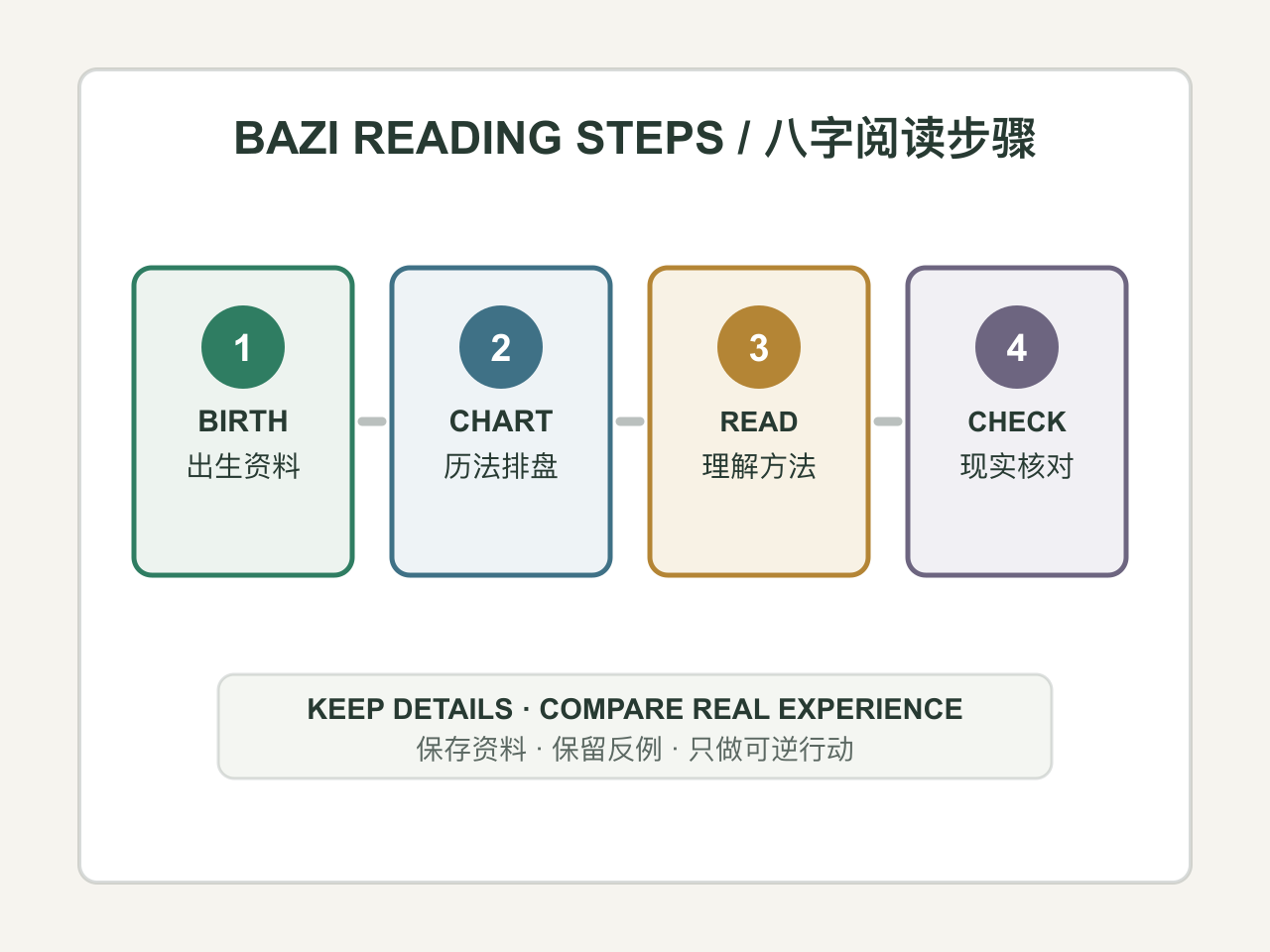
BaZi review path from birth input and chart calculation to method disclosure and real-world review

Divination

Qi Men Dun Jia Planning Board

A lightweight Qi Men Dun Jia planning board for question framing, timing context, useful directions, and caution zones.

Before you start

Prepare these details to see these results

Check which details are required before entering personal information. If something is missing, the page explains the effect instead of guessing for you.

What to prepare

  1. 1

    Question or situation

    Defines the decision or situation that the result should address.

  2. 2

    Reading date

    Sets the date used to construct this event-specific reading.

  3. 3

    Reading time

    Sets the time used to construct this event-specific reading.

What you will see

What you need before you start

Before starting, confirm that dates, times, and other details are accurate, and note which items are required or optional. Do not replace missing required information with a guess.

Question or situation

required

type in required

Defines the decision or situation that the result should address.

Example: Describe the decision or situation

What to enter: Remove accidental extra spaces and enter only the information requested.

If you leave it out: The tool cannot produce a reliable result without this required value.

Reading date

date optional

Sets the date used to construct this event-specific reading.

Example: Optional

What to enter: Use a valid calendar date that is not in the future.

If you leave it out: The tool will continue with reduced detail and will not infer the missing value.

Reading time

time optional

Sets the time used to construct this event-specific reading.

Example: Optional

What to enter: Use a valid local time; leave it blank only when this item is optional.

If you leave it out: The tool will continue with reduced detail and will not infer the missing value.

How it works

This tool uses the details you enter on the page to produce a result. It is free to use, and your information is not sent to a third-party AI service.

Use the board as a decision record

Save the exact question, local date and time, time zone, available options, constraints, stakeholders, facts still needing verification, and fallback plan. Compare the board with these real conditions instead of selecting a direction in isolation. At the next milestone, record what occurred and whether the chosen action worked. This simplified board is educational and must not direct investment, gambling, medical, legal, or safety decisions.

Define the input before using the result

Use Qi Men Dun Jia Planning Board as a method record, not as an answer machine. Begin by writing the exact question, the input supplied, the date, and the convention used. The page concerns question framing, time and direction, nine palaces, useful directions, caution zones, and practical constraints; those terms have a history and may be defined differently by different schools. In a case such as a travel plan has several routes and a fixed departure time, preserve the original information before correcting or interpreting it. Label an input exact, reported, estimated, or unknown.

Read the output in context

After using Qi Men Dun Jia Planning Board, place the output beside the real question rather than reading it in isolation. For question framing, time and direction, nine palaces, useful directions, caution zones, and practical constraints, write one traditional association, one directly observable fact, and one ordinary explanation. This prevents a vivid label from becoming the only explanation for a complicated situation. If the input is near a calendar, time, character, or measurement boundary, show the alternative rather than hiding it.

A worked comparison

For a worked Qi Men Dun Jia Planning Board comparison, use question framing, time and direction, nine palaces, useful directions, caution zones, and practical constraints. Create two rows with the input, method, output, interpretation, uncertainty, cost, and review date. If two schools or dictionaries produce different results, preserve both results and explain the reason. Do not average them without a stated rule. A transparent comparison is more useful than a single impressive number.

Responsible use and consent

Use Qi Men Dun Jia Planning Board carefully when another person is involved. Ask permission before analysing a name, palm, chart, relationship, or shared space. Explain the method and allow the person to refuse. For question framing, time and direction, nine palaces, useful directions, caution zones, and practical constraints, avoid language that fixes identity, worth, health, compatibility, or destiny. Say traditionally associated, one school reads this as, or this input may suggest.

Review the record

At the review date, compare the original question with what was actually observed after using Qi Men Dun Jia Planning Board. Include inconvenient details, changed circumstances, and evidence that did not fit the reading. If the action helped, identify practical factors that may have contributed. If it did not help, revise or undo it instead of blaming the user or buying a more elaborate solution.

What this tool cannot establish

Qi Men Dun Jia Planning Board can support structured study of question framing, time and direction, nine palaces, useful directions, caution zones, and practical constraints, but it cannot establish a diagnosis, guarantee income, prove a relationship outcome, or determine a person’s fixed character. Its result depends on declared inputs and a chosen tradition. The page should make those dependencies visible beside the output.

A detailed worked case

A detailed case study for Qi Men Dun Jia Planning Board starts with a travel plan has several routes and a fixed departure time. Write the exact user question, input values, date, source, and convention. The tool can organise question framing, time, direction, nine palaces, useful directions, and practical constraints, but its output is only as reliable as those declared assumptions. Preserve unknown or estimated information instead of silently filling it. Explain what each displayed field means in plain language and which later interpretation is optional.

Compare two results when a dictionary, calendar, time boundary, or measurement convention can change the output. Put the assumptions above the result, then list agreements, differences, and the practical evidence still needed. This prevents a number or label from sounding more authoritative than the method warrants.

Use one low-risk follow-up action: verify a source, repeat a measurement, ask the affected person, compare another assumption, or observe the situation for a fixed period. Keep the action reversible and record cost, consent, and review date. A change that follows a reading is not automatically caused by it; include ordinary factors and inconvenient results.

The tool is for cultural learning and structured reflection. It cannot diagnose health, guarantee income, determine compatibility, fix a person’s character, or replace professional advice. If the output creates fear or pressure to purchase, pause. The reader may disagree, seek another source, or stop.

A month-long reading and review

Read Qi Men Dun Jia Planning Board as a sequence of decisions rather than a score. Start with the user’s purpose and check whether the input is suitable for the method. Then inspect question framing, time, direction, nine palaces, useful directions, and practical constraints in the order displayed. Write a short note explaining which field is directly calculated, which field comes from a lookup table, and which conclusion is added by interpretation. If the page uses a historical term, give its source context and avoid translating it into a modern promise.

A robust tool page gives the reader a way to challenge the result. Show the boundary cases, missing inputs, alternate calendar or dictionary rules, and the reason two outputs could differ. Ask another person to read the method without seeing the conclusion and note whether they can reproduce it. This is especially useful when the output looks precise but the underlying convention is uncertain.

For a month-long review, choose one ordinary question connected to the tool. Keep a dated record of the output, your expectation, the action taken independently, and what happened. Include events that do not fit. Do not change the input repeatedly until a preferred result appears. A result is a prompt for reflection, not evidence that the tool predicts a person’s future.

When the subject touches health, money, employment, law, safety, or relationship consent, move the decision to the relevant evidence and professional or shared process. Do not use the tool to pressure another person, justify a purchase, or create dependence. A reader should be able to save the method, disagree with the interpretation, and leave without penalty.

Planning board review

A Qi Men planning board is most useful when it sits beside a normal plan. Write the objective, deadline, transport, people involved, budget, and fallback before reading the board’s directions or caution zones. Then note which part is traditional context and which part is an ordinary logistical constraint. A direction cannot replace a safe route, informed consent, or a confirmed appointment.

After the event, compare the plan with what happened and keep the record private where appropriate. Note whether the board changed your attention, not whether it “caused” the outcome. Use the review to improve question framing rather than to create a stronger prediction.

A question-framing example

A good Qi Men question is narrow enough to answer through a decision process. Instead of asking whether a trip will succeed, write which route best fits the time, budget, safety, and obligations already known. Then use the board to record a traditional perspective on timing or direction while keeping the normal travel plan visible. This prevents a symbolic caution zone from replacing a confirmed booking, weather check, or consent from another traveller.

After the decision, review the question rather than grading the prediction. Note what information was available, what changed, and which preparation helped. A planning board can improve the clarity of a conversation; it cannot guarantee an event or transfer responsibility away from the people making the plan.

A planning debrief

After using the planning board, write a debrief rather than a prediction score. Record the question, departure or decision time, available routes, practical constraints, board assumptions, action taken, and what actually happened. Separate the board’s symbolic direction from ordinary facts such as weather, traffic, cost, communication, and another person’s choice. If the plan worked, identify which preparation helped; if it failed, identify which assumption or constraint changed. This protects the reader from hindsight bias and keeps the tool useful as a structured way to discuss options. A Qi Men result should never override a safe route, a confirmed appointment, informed consent, or professional advice. The next use should begin with a narrower question, not with more confidence in an untested forecast.

A final planning review

Use this final qi-men-dun-jia review to place the method beside the decision it is meant to support. Check the original input, the named convention, the ordinary evidence, the people affected, the cost, and the review date. If a result remains uncertain, write that uncertainty plainly. A tool should make a question clearer, not make a person feel obliged to accept a number, direction, or ranking.

Keep the next action small and reversible. Record what would change your mind and where professional or shared advice takes priority. The reader can value traditional knowledge while rejecting a conclusion, postponing action, or choosing a practical explanation.

A final case note

A final lesson note about Qi Men Dun Jia Planning Board should connect the named method with a concrete case. Preserve the input, source, date, convention, and uncertainty, then describe the ordinary situation before applying specialist vocabulary. Compare the traditional interpretation with one practical explanation and state which conclusion remains unproven.

Use one small reversible exercise and set a review date. Record cost, consent, affected people, and what actually changed, including inconvenient results. If the topic touches health, money, law, safety, work, or relationship boundaries, use the relevant professional or shared process. The method supports cultural learning and reflection; it does not guarantee an outcome.

Is this a complete Qi Men Dun Jia lineage chart?

No. It is a simplified cultural planning board that turns a question and time into a deterministic nine-palace direction map. It is useful for reflection, not for deterministic prediction.

How should I use the directions?

Translate directions into practical choices: who to contact, where to sit or meet, which option to prioritize, and which path needs more verification.

Can a favourable direction replace checking the practical route?

No. Travel time, access, weather, safety, permission, cost, and the needs of other people come first. A direction can be a secondary planning prompt only when the practical options are already acceptable.

What makes a Qi Men decision record reviewable?

Save the exact question, local date and time, time zone, board version, available options, known constraints, stakeholders, source facts, chosen action, fallback, and review milestone. Separate facts from symbolic interpretation and list what still needs direct verification. At the milestone, record the outcome before changing the original reading. A reviewable record shows whether the board organized the decision; it does not turn the board into evidence for investing, gambling, medicine, law, travel safety, or another high-stakes choice.

Try next

Related tools