A birth record is not yet a chart input
A Four Pillars chart starts from one moment: a date, a clock reading and a place. The first three pillars follow from the date, and the hour pillar follows from which of the twelve two-hour branches that moment falls into. That structure decides how much a time error actually matters.
A twenty-minute error almost never moves the hour branch. A sixty-minute error usually does. And if the error pushes the reading across 23:00, it can move the day pillar too, because 子时 spans the midnight boundary. This article covers the four conversions that sit between what a birth record says and what a chart tool should be given.
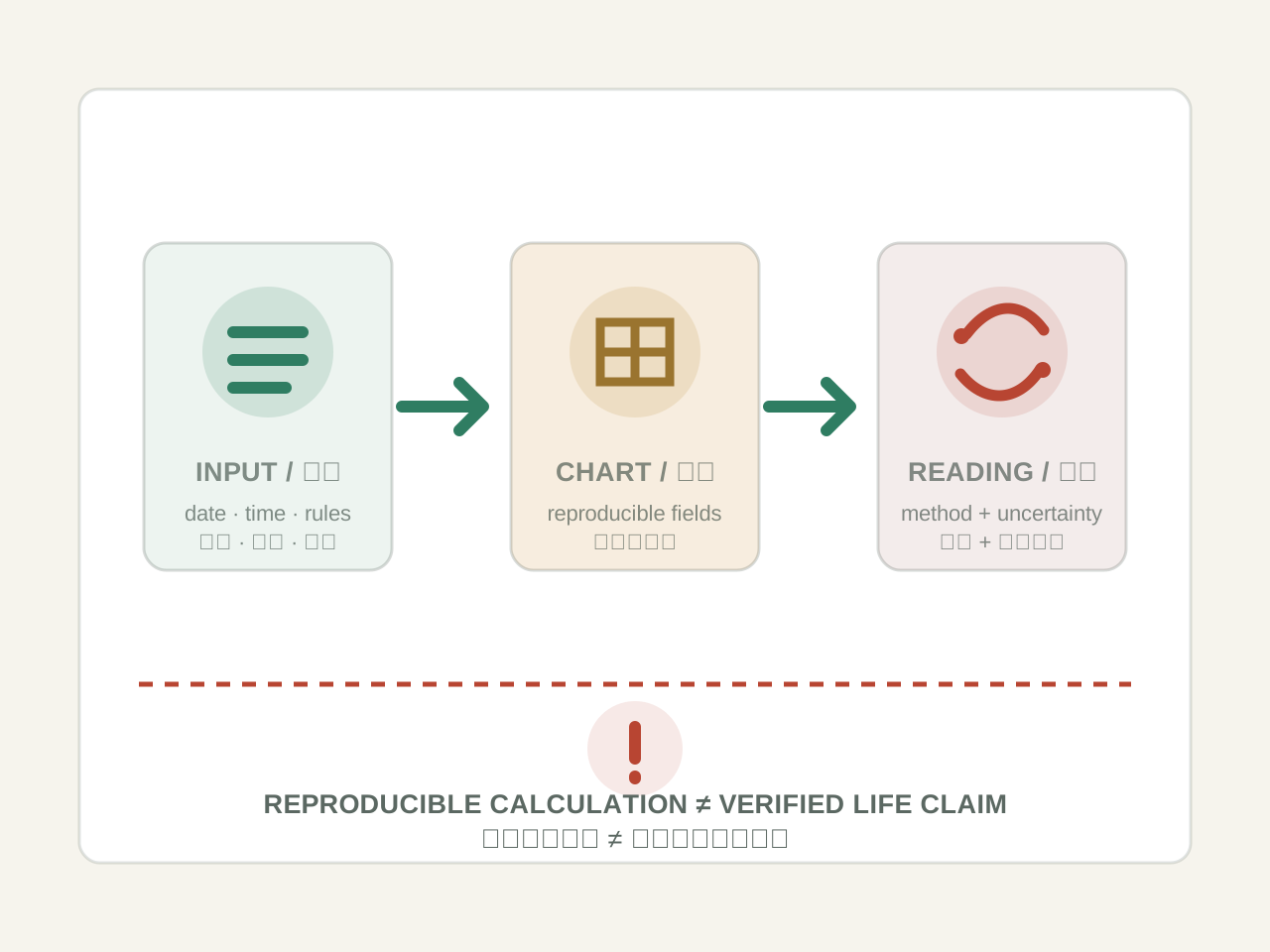
It does not interpret the chart, and it makes no claim about whether a chart says anything about a life. It deals only with getting the input right.
Correction 1: the zone, not the clock reading
China keeps one official offset, UTC+8, measured from the 120° meridian, across a country that spans roughly five geographic zones. A birth recorded in Ürümqi at 09:00 Beijing time is happening at about 06:50 by the sun there. That is not a rounding detail; it is more than one hour branch.
The fix is procedural rather than mathematical. Record the place of birth, convert the recorded civil time to UTC using the offset in force on that date, and only then convert into whichever zone your chart tool works in. Most errors of this kind come from skipping the first step and typing the clock reading straight into the tool.
Correction 2: China's summer time, 1986 to 1991
Between 1986 and 1991 China moved the clocks forward one hour each spring and back each autumn. A birth inside those windows was recorded on the shifted clock, so the reading on the document is one hour ahead of standard time. The practice ended in 1991, which means nothing after 15 September 1991 is affected.
The transition dates are held in the IANA time zone database and can be reproduced for any year. Worked example: a record showing 1 July 1988 at 03:00. Subtract the hour and standard time is 02:00. 02:00 falls in 丑时 (01:00–03:00), while 03:00 falls in 寅时 (03:00–05:00), so the hour pillar changes. One unadjusted hour produced a different chart.
| Year | Clocks forward | Clocks back | Offset through the summer |
|---|---|---|---|
| 1986 | 4 May | 14 September | UTC+9 |
| 1987 | 12 April | 13 September | UTC+9 |
| 1988 | 17 April | 11 September | UTC+9 |
| 1989 | 16 April | 17 September | UTC+9 |
| 1990 | 15 April | 16 September | UTC+9 |
| 1991 | 14 April | 15 September | UTC+9 |
Correction 3: true solar time, and when it changes an answer
Standard time is a political convenience. Local mean solar time is set by longitude: each degree away from the 120° meridian shifts solar noon by four minutes. Beijing sits near 116.4°E, so its solar noon arrives about fourteen minutes after the clock says noon. Ürümqi is nearly two hours and ten minutes behind.
A second term, the equation of time, moves the sun up to about sixteen minutes either side of mean solar noon across the year, because Earth's orbit is not circular and its axis is tilted. The NOAA solar calculator returns both figures for any date and place.
The practical rule is to apply the correction when the birth falls close to a branch boundary, within about thirty minutes of one in the east of the country and within about two and a half hours in the far west, and to write down what you applied. Away from a boundary the correction cannot change the hour pillar, and leaving it out keeps your notes comparable with everyone else's.
Correction 4: which side of 子时 the birth falls on
子时 runs from 23:00 to 01:00 and straddles midnight, so the tradition has two ways to assign the day. Under the 子时 convention the day changes at 23:00; under the midnight convention it changes at 00:00. Both are in current use, and the choice changes the day pillar for any birth between 23:00 and midnight.
Example: 23:40 on 3 May. Under the 子时 rule the day pillar is the one belonging to 4 May; under the midnight rule it is the pillar of 3 May. Two charts from a single birth record, and neither method is an error.
The stake grows when the date is also a month or year boundary, because a shifted day can carry the month or the year pillar with it.
The order to check them in
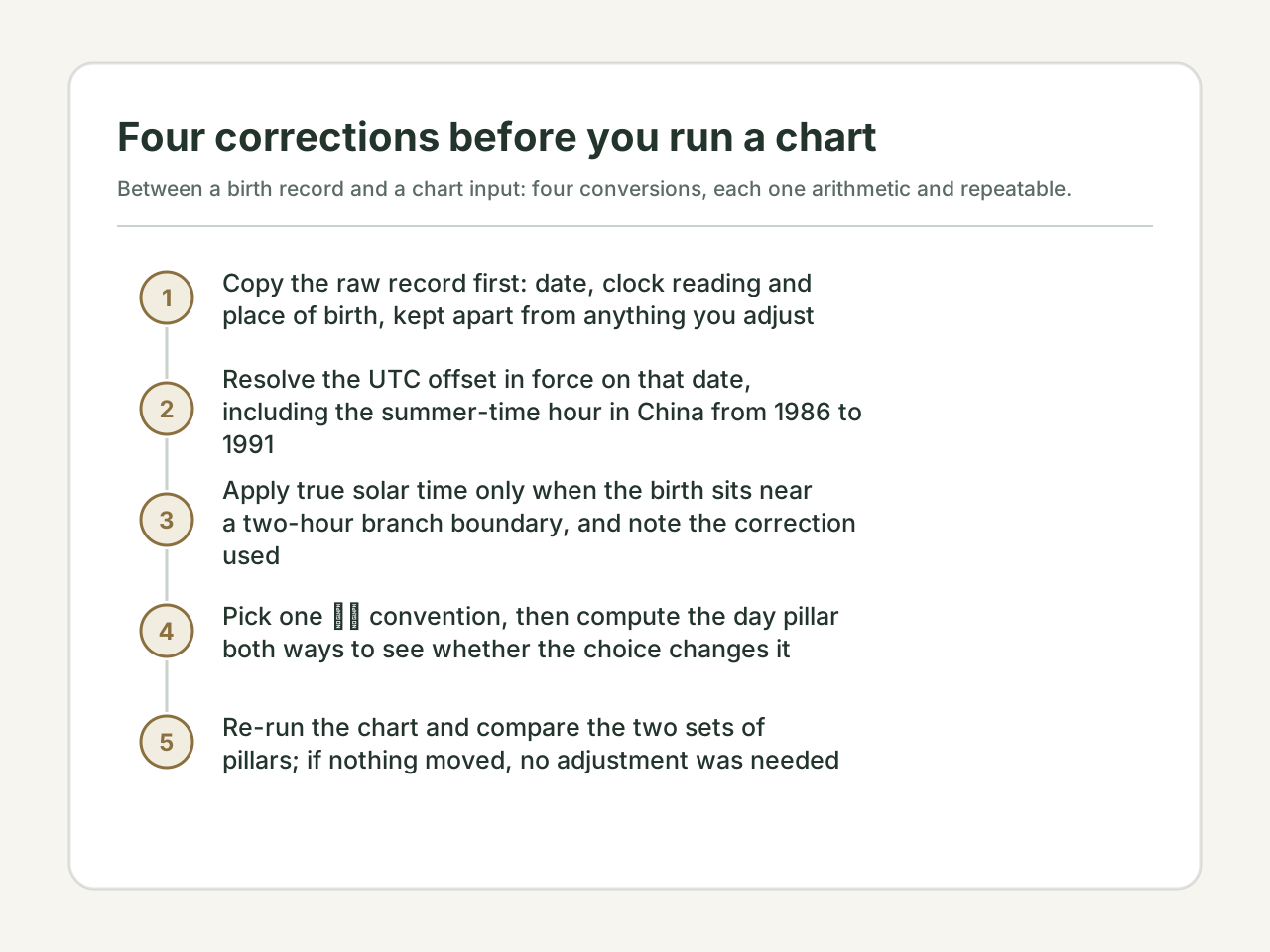
The four corrections interact, so the order matters:
- Write down the raw record first: date, clock reading and place of birth, kept separate from anything you have adjusted.
- Resolve the offset. Convert the clock reading to UTC using the rule in force on that date, including the summer-time hour if the year is 1986 to 1991.
- Apply true solar time only when the birth sits near a branch boundary, and note the correction you applied and where the figure came from.
- Choose one 子时 convention, then compute the day pillar under both so you know whether the choice matters for this chart at all.
- Re-run the chart with the adjusted input and put the two sets of pillars side by side. If nothing moved, the adjustment was not needed.
What a corrected input does and does not buy you
Getting the input right does not make a chart predictive. It makes the computed pillars the pillars that the stated rules produce, which is a different and much smaller claim.
It is still worth doing. A chart built from the wrong hour branch is not a cautious approximation of the right chart; it is a different chart, and comparing it with a practitioner's reading produces a disagreement that looks like a dispute about interpretation when it is really an arithmetic difference.
Keep the raw record and the adjusted record side by side. If you later change tool, or change your mind about the 子时 convention, you can redo the conversion from the original instead of unpicking a chain of adjustments.
Disclaimer: This content is for informational and cultural reference purposes only. It does not constitute professional medical, legal, financial, or psychological advice. Readers should exercise their own judgment and consult qualified professionals for specific concerns.
Sources and review basis
Traditional references explain historical vocabulary and context. Official practical sources support only the observable safety, comfort, or environmental points noted in the article; they do not validate metaphysical claims.
Practical source
IANA Time Zone Database (tzdata)Internet Assigned Numbers Authority · Accessed 2026-10-16
The reference dataset for historical UTC offsets and daylight-saving transitions. Its Asia/Shanghai rules are the source for the 1986–1991 China summer-time dates used in this article.
Practical source
NOAA Solar CalculatorNOAA Global Monitoring Laboratory · Accessed 2026-10-16
Used to check local solar noon and the equation of time, which is the part the true-solar-time correction adds to or subtracts from clock time.
Traditional reference
Yuanhai Ziping (渊海子平)Wikisource digital text · Accessed 2026-07-14
A classical source for Four Pillars terminology, element relationships, and the Day Master framework.
Traditional reference
Sanming Tonghui (三命通会)Wikisource digital text · Accessed 2026-07-14
A historical compilation used to cross-check traditional BaZi concepts; it is not scientific validation.