Moving day selection: timing is practical, not magical
In traditional Chinese culture, choosing an auspicious date for moving house (搬家择日) is a standard practice. The idea is that the day you move into a new home sets the tone for your time there. The practice combines several systems: the Chinese almanac (通书), the twelve day officers (建除十二神), the clash with the householder's zodiac animal (冲煞), and sometimes the personal Ba Zi (八字) of the family members.
The practical reality: moving is a logistical event first. You need a day when the movers are available, the keys are in your hand, the utilities are connected, the weather is cooperative, and you or your family have time off work. The traditional date selection system works best when you use it to choose among the dates that already work logistically — not when you try to force a 'good' date that creates practical problems.
What the traditional system actually checks
The traditional moving-day selection checks several factors. Here is what each one means in plain terms:
| Factor | What it checks | How to check it | What it means in practice |
|---|---|---|---|
| Day officer (建除) | The daily energy quality based on a 12-day cycle | The Chinese almanac lists the day officer for each date. Look for '成' (Completion), '满' (Fullness), or '开' (Opening) days | These are considered the best days for new beginnings. '破' (Destruction) and '闭' (Closure) days are traditionally avoided for moving |
| Zodiac clash (冲煞) | Whether the day's zodiac animal clashes with the householder's birth year animal | The almanac lists the clash for each day. For example, if the day clashes with the Rat (子), and you were born in a Rat year, that day is not recommended | The clash is the most emphasised factor in traditional practice. If you can only check one thing, check the clash |
| Suitable activities (宜) | Whether 'moving house' (入宅 or 移徙) is listed as suitable for that day | The almanac lists 'suitable' and 'unsuitable' activities for each day | A day must list moving as suitable to be considered a good moving day. If moving is not listed as suitable, the day is not a candidate |
| Seasonal fit | Whether the date is in a season that makes moving practical | Spring and autumn are generally the most comfortable seasons for moving in most climates | This is not a traditional factor, but it is the most practical. Moving in extreme heat, cold, or rain increases stress and risk of damage |
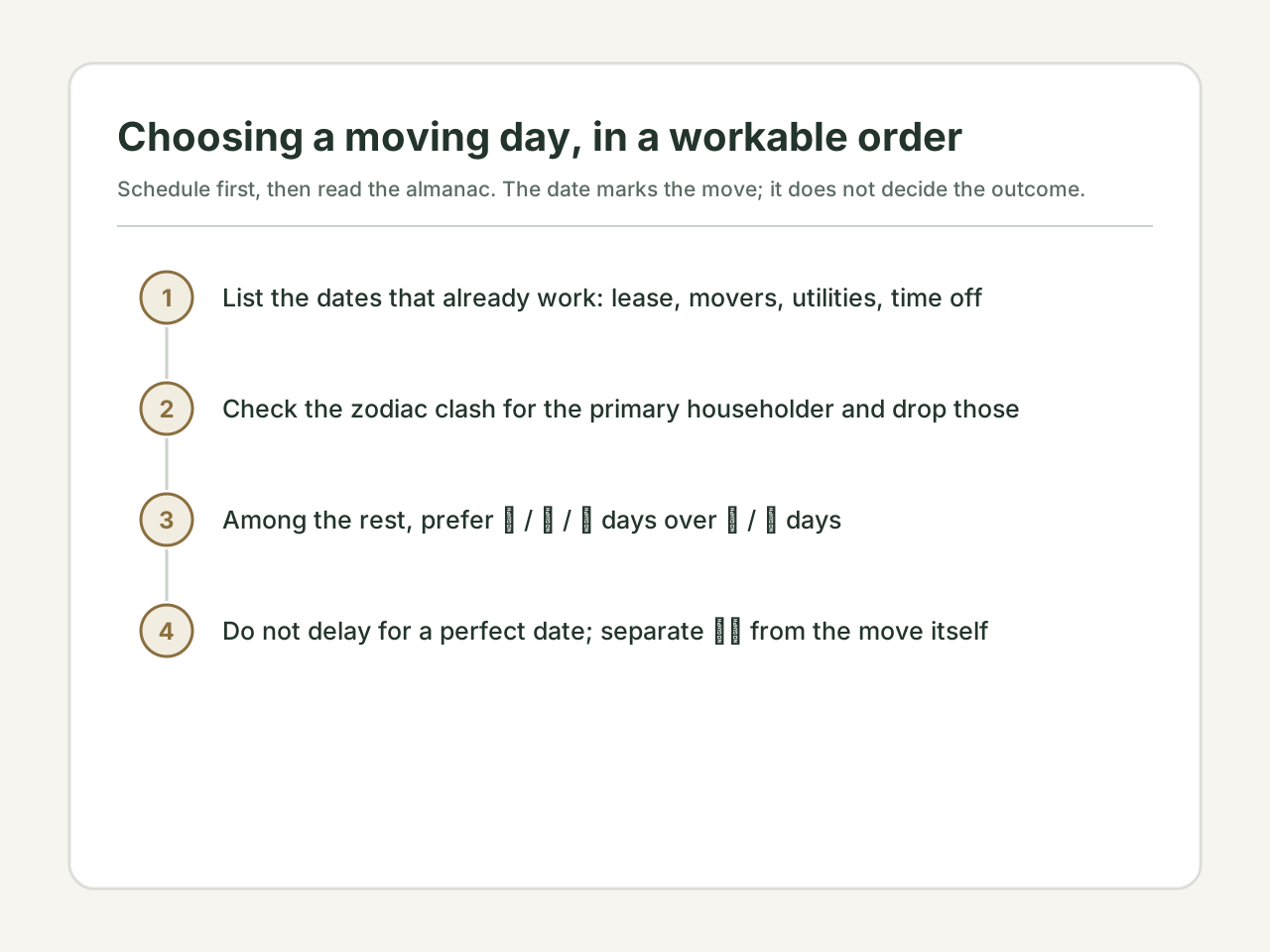
The practical-first approach: schedule logistics, then check dates
Here is the honest approach to choosing a moving day that respects both tradition and reality:
- Start with your real schedule. List all the dates that are logistically possible: when the lease starts or the sale closes, when you can get time off work, when the movers are available, when the utilities will be connected, and when the weather is likely to be reasonable. These are your candidate dates.
- Check the clash for each candidate date. Eliminate any date that clashes with the zodiac animal of the primary householder (the person whose name is on the lease or deed). If there are multiple householders, the primary one takes priority. If all candidates clash, choose the one with the least disruption to your schedule.
- Check the day officer. Among the remaining dates, prefer '成' (Completion), '满' (Fullness), or '开' (Opening) days. Avoid '破' (Destruction) and '闭' (Closure) days if you have a choice. If none of your candidate dates have a good day officer, the clash is more important than the day officer.
- Do not delay moving for a 'perfect' date. If your only candidate dates are all problematic in the traditional system, move on the most practical date. A stressful move on a 'good' date is worse than a smooth move on a neutral date. The quality of the move itself — how organised, calm, and prepared you are — has more impact on your experience of the new home than the date on the calendar.
A worked example: when the 'good' date doesn't work
A family is moving into a new apartment. Their lease starts on 1 August, and they need to move out of their old place by 31 July. The only weekend available is 29-30 July. They check the almanac: 29 July is a '破' (Destruction) day, and 30 July clashes with the husband's zodiac animal (Rooster). The following weekend, 5-6 August, has a '成' (Completion) day on 5 August with no clash — but they would need to pay an extra week of rent at the old place and store their furniture for a week.
The family's decision: they move on 29 July (the 'Destruction' day) because it is the only practical date. They do a small symbolic ritual on 5 August: they enter the new home through the main door, turn on all the lights, open the windows for a few minutes, and have a meal in the kitchen. This is called 'entering the home' (入宅), and it separates the symbolic act of starting life in the new home from the practical act of moving boxes.
The result: the move itself is smooth because they are not rushed. The 5 August ritual gives them a sense of marking the occasion. The separation of practical moving from symbolic entering is a common and sensible approach in traditional Chinese practice. It acknowledges that the calendar does not always cooperate with real life.
What feng shui auspicious dates for moving house can and cannot do
Choosing an auspicious moving date is a tradition that helps people feel that they are starting their new home on the right foot. It is a ritual of intention, not a guarantee of outcome. The date on the calendar does not determine whether your new home will be happy or prosperous. What determines that is the quality of the home itself — its location, light, layout, and maintenance — and the quality of the relationships within it. Use the moving-day tradition as a way to be intentional about your transition, not as a source of anxiety about getting the date wrong. If you move on a 'bad' date and the home is good, you will be fine. If you move on a 'good' date and the home has structural problems, the date will not save you.
Disclaimer: This content is for informational and cultural reference purposes only. It does not constitute professional medical, legal, financial, or psychological advice. Readers should exercise their own judgment and consult qualified professionals for specific concerns.
Sources and review basis
Traditional references explain historical vocabulary and context. Official practical sources support only the observable safety, comfort, or environmental points noted in the article; they do not validate metaphysical claims.
Traditional reference
Yuxia Ji (玉匣記)Wikisource digital text · Accessed 2026-10-15
A household almanac whose 入宅 and 移徙 sections show how traditional date selection for moving house was organised. It documents a convention, not evidence that a date changes an outcome.
Traditional reference
Huangdi Zhaijing (黄帝宅经)Wikisource digital text · Accessed 2026-07-14
Historical context for traditional residential orientation and spatial vocabulary. Modern recommendations are reviewed separately.
Practical source
APA Dictionary of Psychology: Barnum effectAmerican Psychological Association · Accessed 2026-07-14
A psychology reference for why broad, favourable personality descriptions can feel personally accurate. It does not evaluate BaZi calculations themselves.