The five elements are a classification system, not a personality test
The five elements — Wood (木), Fire (火), Earth (土), Metal (金), and Water (水) — are labels used to classify stems, branches, seasons, and relationships in BaZi (八字). They are phases in a traditional model, not literal substances or measurable energies inside a person. Visible counts can also omit hidden stems, seasonal weighting, and the method used by a particular school.
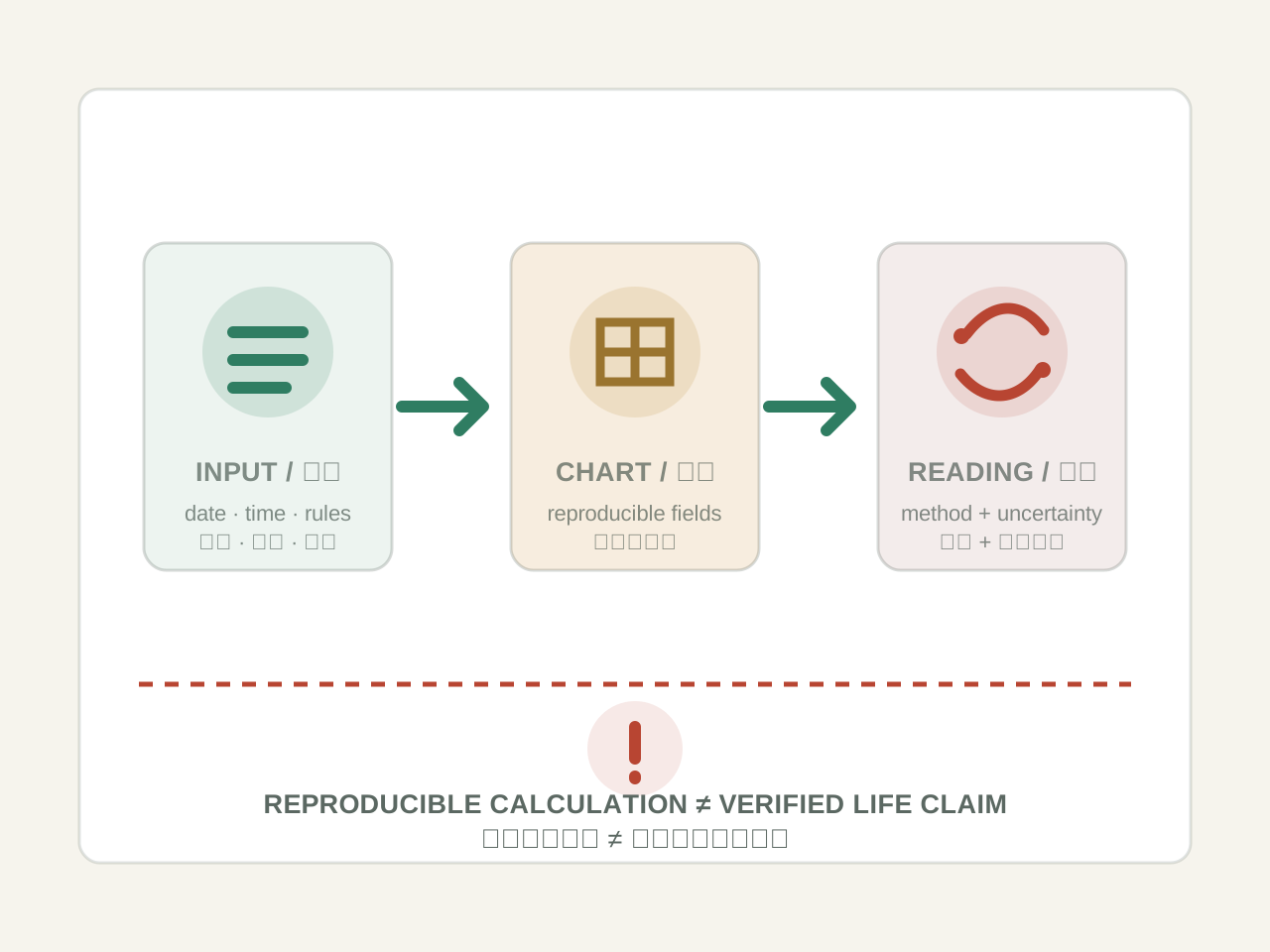
The honest view: this is a pre-modern classification system, comparable historically to other old cosmologies, not a validated personality test. A chart count can be reproduced when its calendar and counting rules are declared; the claim that the count reveals character, need, or future outcomes has not been empirically established.
Traditional associations, without turning them into traits
The final column turns each metaphor into a question to examine. It does not describe a person merely because an element appears often:
| Element | Traditional associations | What it means in plain terms |
|---|---|---|
| Wood (木) | Growth, extension, flexibility, spring | Reflection prompt: what is being started or extended, and what observation supports that description? Do not infer creativity, leadership, or rigidity from Wood alone |
| Fire (火) | Heat, visibility, expression, summer | Reflection prompt: where is expression or visibility relevant? Do not infer sociability, impulsivity, burnout, or physical heat from a chart label |
| Earth (土) | Containment, transition, stability, late summer | Reflection prompt: what requires continuity or maintenance? Do not infer reliability, caution, body type, or digestive health |
| Metal (金) | Contraction, structure, division, autumn | Reflection prompt: where are rules or boundaries being discussed? Do not infer discipline, criticism, emotional distance, or lung health |
| Water (水) | Storage, flow, adaptation, winter | Reflection prompt: what information or change needs to be followed? Do not infer wisdom, anxiety, evasiveness, or kidney health |
Two relationship cycles and what they do not prove
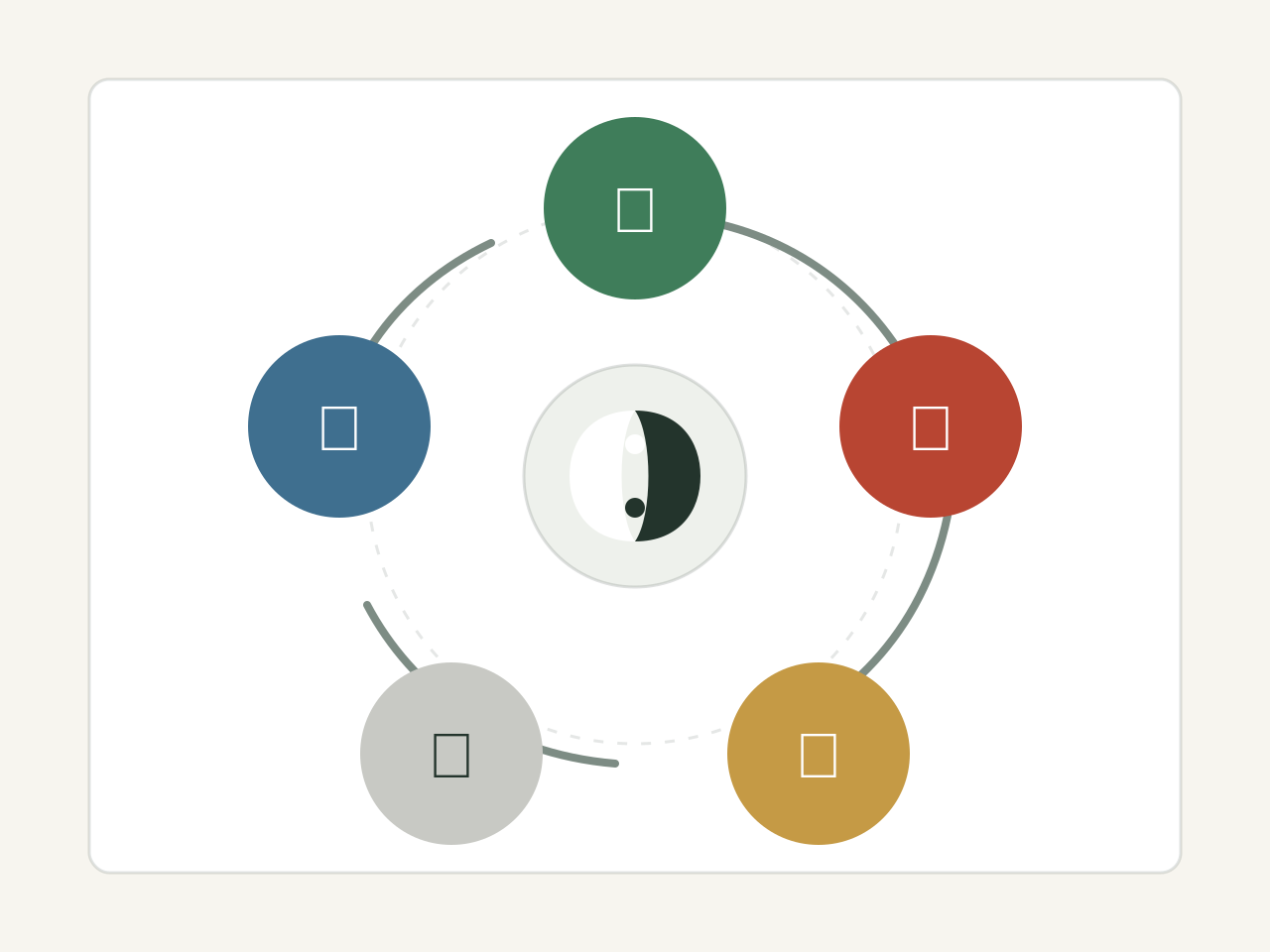
The generating and controlling cycles are internal rules of the model. They help a reader trace relationships; they do not show that an activity, colour, material, or behaviour changes a person's chart:
- Generating (生): Wood generates Fire, Fire generates Earth, Earth generates Metal, Metal generates Water, and Water generates Wood. This is a mnemonic relationship inside the tradition, not a causal instruction to add the associated colour, object, food, occupation, or activity.
- Controlling (克): Wood controls Earth, Earth controls Water, Water controls Fire, Fire controls Metal, and Metal controls Wood. 'Controls' is a technical relation, not a diagnosis of conflict or a direction to suppress a trait or person.
- Neither cycle is inherently lucky or harmful. A count alone also cannot identify the useful element (用神): readers may weight season, roots, hidden stems, combinations, transformations, and chart structure differently. Record the chosen method and competing interpretation.
A worked audit: one chart, two element summaries
A fictional chart has a Yang Wood (甲) Day Master, a winter Chou (丑) month, several visible Water and Earth characters, and fewer visible Fire and Metal characters. A simple counter labels Water and Earth as the largest categories and reports the raw method and all eight characters.
Reader A weights the winter month heavily and calls Water seasonally strong. Reader B gives more weight to roots and hidden stems, then argues that the chart cannot be summarized by the largest visible count. Their summaries differ even though the calendar calculation is the same.
The user should not choose the interpretation that sounds more flattering. The audit questions are: were timezone and solar-term boundaries declared, were hidden stems included, how was seasonal strength weighted, were combinations applied, and would another documented method change the conclusion?
The lesson is methodological. 'My Day Master is Wood', 'Water has the highest count', and 'Wood is useful' are three different claims. None establishes creativity, leadership, caution, health, career fit, or what environment a person needs.
The honest limit
The five elements are a traditional descriptive vocabulary. They can organize a reading and prompt questions, but they do not explain behaviour, measure which environment energises or drains someone, diagnose imbalance, or determine destiny. 'Too much Fire' is not a medical diagnosis; 'missing Metal' is not a defect or instruction to buy Metal objects. Keep the chart calculation, the interpretive method, and real-world evidence visibly separate.
A five-element review you can check again
Record the exact birth date, local clock time, birthplace, time zone, and whether the time is approximate before reading the element distribution. Confirm which calendar and solar-term boundary the calculator uses. Two charts that treat the month boundary or an uncertain hour differently can show different counts, so the calculation record matters more than a single coloured bar.
Read the Day Master, season, roots, combinations, and element flow together. A missing element is not automatically a deficiency, and the most numerous element is not automatically useful. Write one interpretation, one piece of real-life evidence that supports it, and one observation that challenges it. This prevents the chart from becoming a fixed personality label.
Choose one low-risk experiment for the next two weeks, such as changing a work routine, tracking energy across the day, or testing a colour only as an environmental preference. Review the observation at the end of the period. Do not turn an element label into a diagnosis, investment instruction, relationship verdict, or reason to buy a product.
- Save the input, time-zone assumption, and generated pillars.
- Separate the calculated element record from later interpretation.
- Review one observable behaviour instead of trying to change everything.
What the sources can and cannot support
The Yuanhai Ziping and Sanming Tonghui references listed below are historical sources for Four Pillars terminology, the Day Master framework, and element relationships. They can help a reader check whether a modern explanation resembles the tradition. They do not validate a personality, health, career, relationship, or future-outcome claim.
For a boundary case, save two candidate charts instead of hiding the uncertainty. If a birth time is approximate, or the date falls near a solar-term or 23:00 day boundary, calculate each plausible time under the same stated rules. Mark which pillars and element counts change. Restrict any later reflection to the details that remain stable, and keep the unresolved time range beside the result.
For a useful comparison, keep the calendar date, local clock time, time zone, daylight-saving treatment, month and day boundary rules, true-solar-time choice, and whether hidden stems or seasonal weighting were included. Without that note, another reader cannot tell whether a disagreement comes from the calendar method or the interpretation.
Element review record
Use one record for each interpretation so the calculated chart, the chosen method, the real-world observation, and the decision remain separate. A useful note shows what would change the conclusion instead of collecting only matching examples.
If a chart is close to a solar-term, day, or hour boundary, complete the comparison for every plausible chart. Keep both outcomes visible until the birth information is verified.
| Review item | Evidence to save | Decision rule |
|---|---|---|
| Birth details | Local date, clock time, birthplace, time zone, daylight-saving status | Check the chart again when any detail changes |
| Chart structure | Four pillars, hidden stems, season, roots, combinations | Do not infer strength from raw element counts alone |
| Interpretation | Named method and the reasoning from chart to conclusion | Keep competing methods separate |
| Reality check | One supporting and one conflicting observation | Revise when the explanation cannot handle contrary evidence |
| Action | One reversible experiment and a review date | Stop when it creates cost, anxiety, conflict, or harm |
Reading a five-elements lookup without overclaiming
A lookup table is a classification aid, not a complete reading. Begin by identifying exactly what was calculated: the day master, seasonal context, visible stems, hidden stems, or a simplified year-based label. Different calculators may use different conventions, so record the method and input boundaries before comparing results. A result that looks precise can still depend on choices made earlier in the calculation.
Use the table to form questions rather than conclusions. If an element appears prominent, ask how the source defines prominence, what evidence would change the assessment, and whether another method gives a different balance. Keep the language proportional: “this school associates the pattern with…” is more accurate than treating the label as a measured personality or life outcome.
- Check the specific issue described in “Reading a five-elements lookup without overclaiming” before changing the arrangement or interpretation.
- Keep the action reversible and record what evidence would change the decision.
A topic-specific worked comparison
Suppose two charts are both described as wood-heavy. One has strong seasonal support and the other has several controlling relationships. A responsible explanation does not stop at the shared label. It compares the calculation steps, notes the missing information, and explains why the same short label may lead to different traditional interpretations.
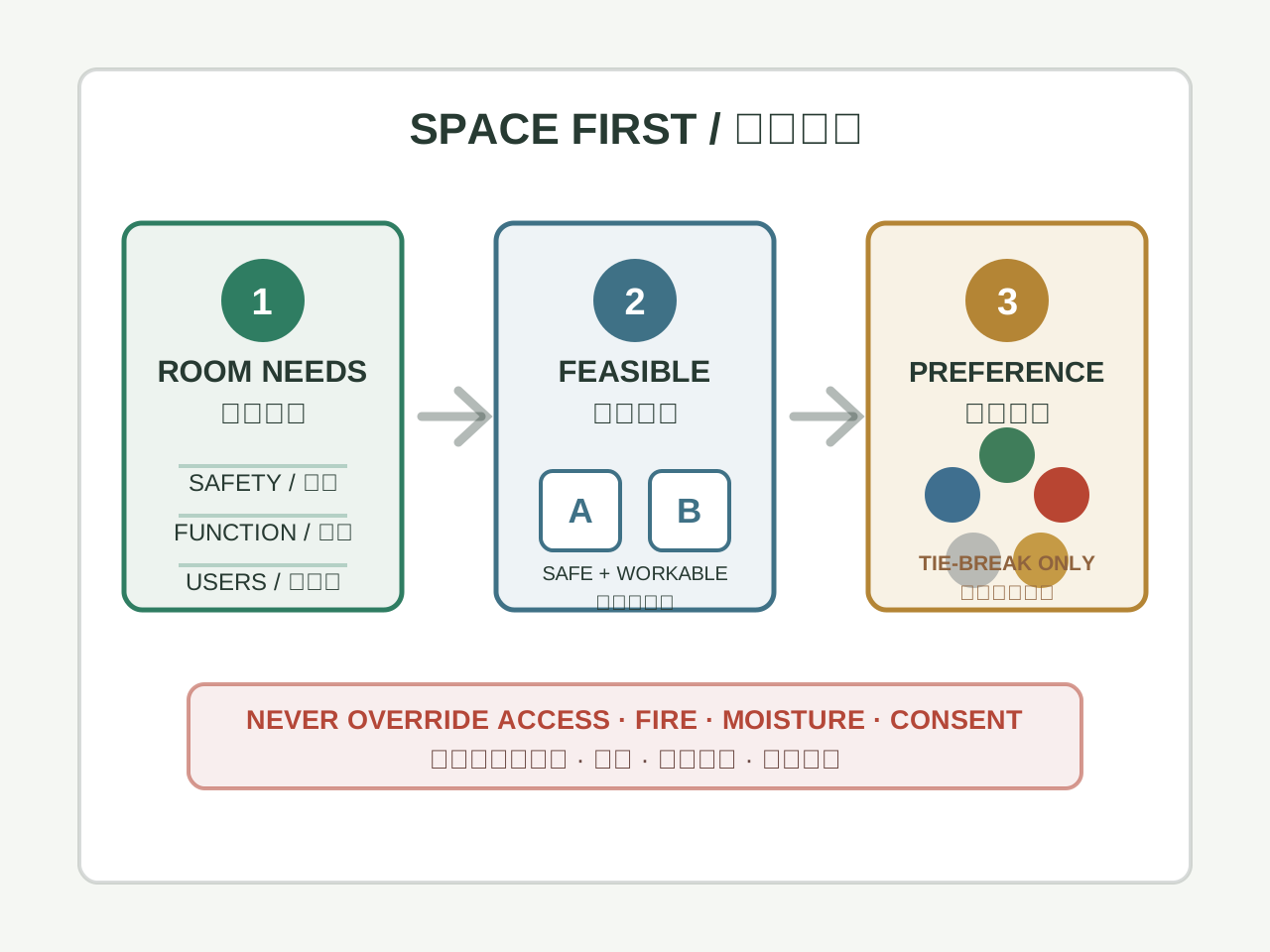
For a reader using the lookup tool, save the inputs and the rule version. If the result is used for a name, date, room, or career discussion, separate the cultural suggestion from the practical decision. Budget, safety, skill, consent, and evidence remain relevant in every case.
- Check the specific issue described in “A worked comparison” before changing the arrangement or interpretation.
- Keep the action reversible and record what evidence would change the decision.
How to use the result responsibly
Treat a five-elements result as one lens among several. It may help organise a study session or provide language for a cultural conversation, but it should not diagnose health, determine a person’s worth, or dictate a major purchase. Ask whether the proposed action is reversible and whether the reader would still choose it if the symbolic explanation were removed.
The best follow-up is a written review: what the tool calculated, what the reader understood, what action was taken independently, and what happened later. This makes selective memory less likely and gives the reader control over the interpretation.
- Check the specific issue described in “How to use the result responsibly” before changing the arrangement or interpretation.
- Keep the action reversible and record what evidence would change the decision.
A concrete reader question
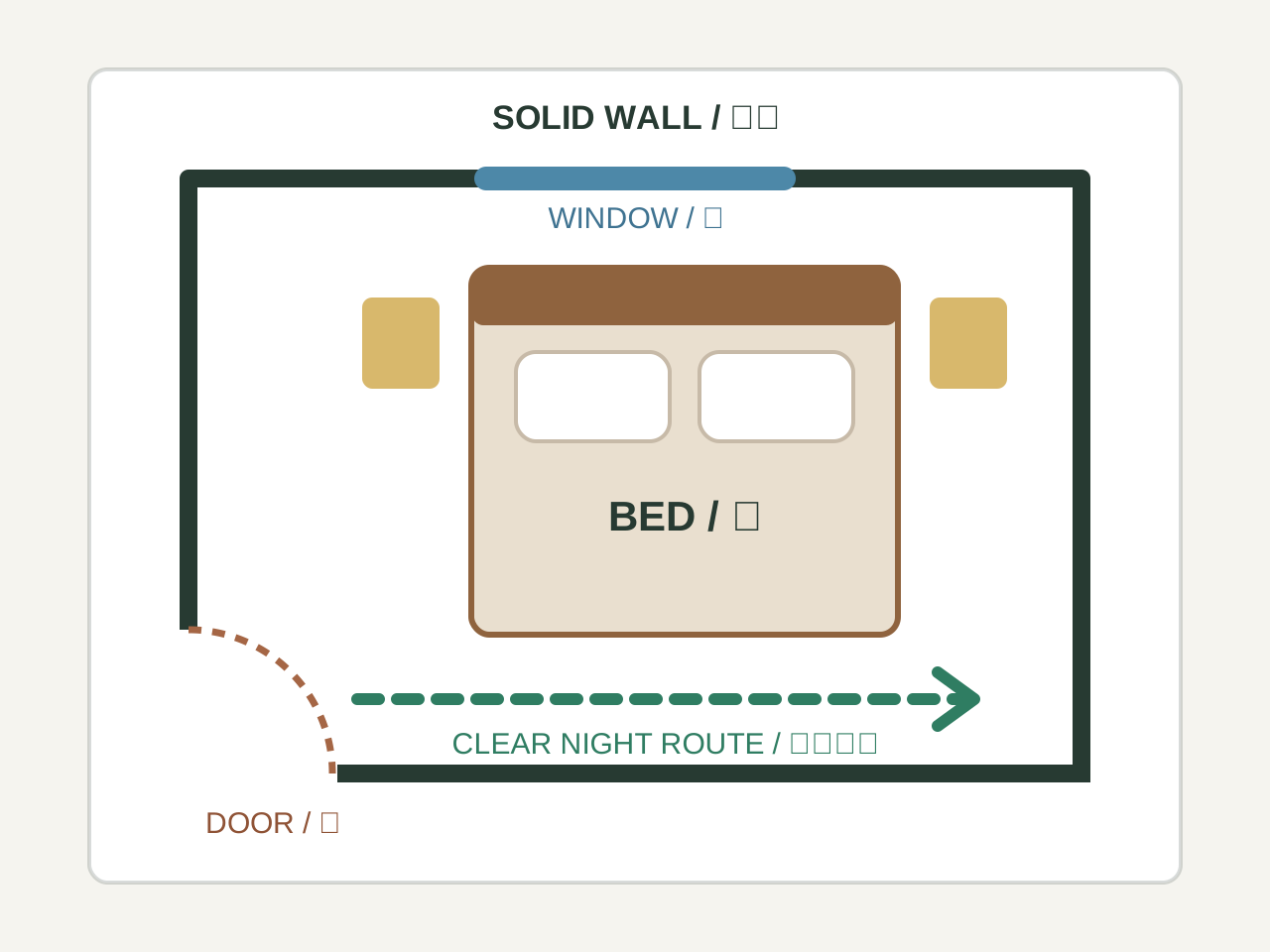
A useful way to read BaZi Five Elements Lookup is to begin with a concrete question rather than a general promise. The page describes a practical introduction to the five elements in bazi and how wood, fire, earth, metal, and water are used in birth profile interpretation. A reader should write down what they want to understand, what information they already have, and what decision still belongs to them. If the question concerns a room, include the people who use it, the route through it, light, sound, maintenance, privacy, and safety. If it concerns a chart, date, symbol, name, dream, face, or palm, preserve the input, source, calendar or dictionary rule, and any uncertainty. This makes the topic specific enough to review instead of allowing a familiar term to stand in for an explanation.
Separate three layers in the notes: what the tradition means, what can be observed now, and what action is practical. A cultural association can be worth studying without being a verified prediction. The distinction is especially important when the topic sounds personal or consequential.
A worked comparison
Use one ordinary case related to BaZi Five Elements Lookup. Describe the situation in plain language before applying specialist vocabulary. Then compare two possible readings or actions in a table: input, method, expected implication, observable evidence, cost, risk, affected people, reversibility, and review date. If the topic involves a proposed arrangement, compare access, lighting, noise, comfort, cleaning, privacy, and shared agreement. If it involves a calculation or interpretation, compare the calendar, time boundary, source, school, dictionary, or weighting rule.
Do not hide a disagreement by averaging incompatible methods. State which conclusion changes under which assumption. Write one ordinary explanation beside the traditional one: workload, sleep, communication, budget, maintenance, camera angle, weather, or a simple input error may explain the same experience. A fair comparison makes room for curiosity and correction.
A low-risk next step
Choose one modest next step connected to BaZi Five Elements Lookup. Check a source, repeat a measurement, ask the person affected, observe the space at another time, compare two declared inputs, or keep a short record for a defined period. Change only one condition. Before acting, record the baseline and obtain consent if another person or shared space is involved. Avoid structural work, large purchases, or irreversible decisions until the practical issue is understood and the appropriate professional advice has been considered.
Review the result without treating sequence as proof of cause. Record what improved, what became harder, and what did not change. If a practical adjustment helps, acknowledge ordinary reasons that may have contributed. If it fails, undo or revise it rather than escalating automatically or blaming the reader. The value of a small test is that it can change the question.
Sources and limits
A reader should be able to see where the explanation comes from. Record the source, author or tradition, date accessed, terminology, and method used for BaZi Five Elements Lookup. Mark whether a statement is historical description, practitioner interpretation, direct observation, or practical advice. These categories should not be blended into a claim of scientific certainty. When two sources use the same word differently, preserve both definitions and explain which one this page follows.
The page is cultural and reflective material. It cannot diagnose illness, guarantee income, determine a person’s fixed character, prove relationship compatibility, replace legal or financial advice, or override safety and consent. Use proportionate language such as traditionally associated, one school interprets, or this input may suggest. Clear limits increase usefulness rather than weakening it.
A review record for future readers
Close a study of BaZi Five Elements Lookup with a record another reader could understand months later: original question, inputs, source, method, interpretation, ordinary explanation, action, cost, affected people, observed result, and next review date. Include evidence that did not fit the preferred explanation. If the original input was uncertain, do not rewrite it after the result is known. This preserves the difference between what was known at the beginning and what was learned later.
The reader remains free to disagree, seek another source, postpone action, or stop. If the issue involves health, safety, law, money, employment, structural work, or relationship coercion, use the relevant professional or shared process. The strongest conclusion is often a clearer question and a reversible next step, not a dramatic promise.
Disclaimer: This content is for informational and cultural reference purposes only. It does not constitute professional medical, legal, financial, or psychological advice. Readers should exercise their own judgment and consult qualified professionals for specific concerns.
Sources and review basis
Traditional references explain historical vocabulary and context. Official practical sources support only the observable safety, comfort, or environmental points noted in the article; they do not validate metaphysical claims.
Traditional reference
Yuanhai Ziping (渊海子平)Wikisource digital text · Accessed 2026-07-14
A classical source for Four Pillars terminology, element relationships, and the Day Master framework.
Traditional reference
Sanming Tonghui (三命通会)Wikisource digital text · Accessed 2026-07-14
A historical compilation used to cross-check traditional BaZi concepts; it is not scientific validation.