What the ninth day of the ninth month actually is
The Double Ninth Festival (重阳节, Chóngyáng Jié) falls on the ninth day of the ninth month of the Chinese lunisolar calendar. In 2026 that is Sunday 18 October.
The month is the part that trips people up. The ninth lunar month is not simply the ninth new moon of the year; it is anchored to the solar terms. The month opens at Cold Dew (寒露), which in 2026 falls on 8 October, and runs until Winter Begins (立冬) on 7 November. Days inside the month are then counted from the new moon, so the ninth day lands on 18 October.
Because the two cycles drift against the Gregorian calendar, the festival moves: 29 October in 2025, 18 October in 2026, 8 October in 2027, 26 October in 2028. Anywhere within roughly three weeks of early October is normal. This is why a calendar app that only converts the month number will disagree with an almanac about the date.
Why the number nine is called yang, and what that label does not claim
In the yin-yang number convention, odd numbers are yang and even numbers are yin. Nine is the largest single digit, so it is old yang (老阳), the far end of the yang range. The I Ching writes every yang line as 九 and every yin line as 六, which is why a nine already means yang inside that system.
So double ninth and double yang are the same statement. The name is a label inside a numbering convention. It is not a measurement of the day, not a peak of any quantity, and not an observation that something specific happens to you on that date. Traditional sources use it to mark the day as notable; they do not define an effect that could be checked.
There is a second, more practical layer. 九 is a homophone of 久, meaning long-lasting. That pun, rather than any numerical property, is why the date became attached to longevity and, much later, to respect for older people. Wordplay is doing the work here, and traditional practice generally treats it as wordplay.
The day as an almanac marks it
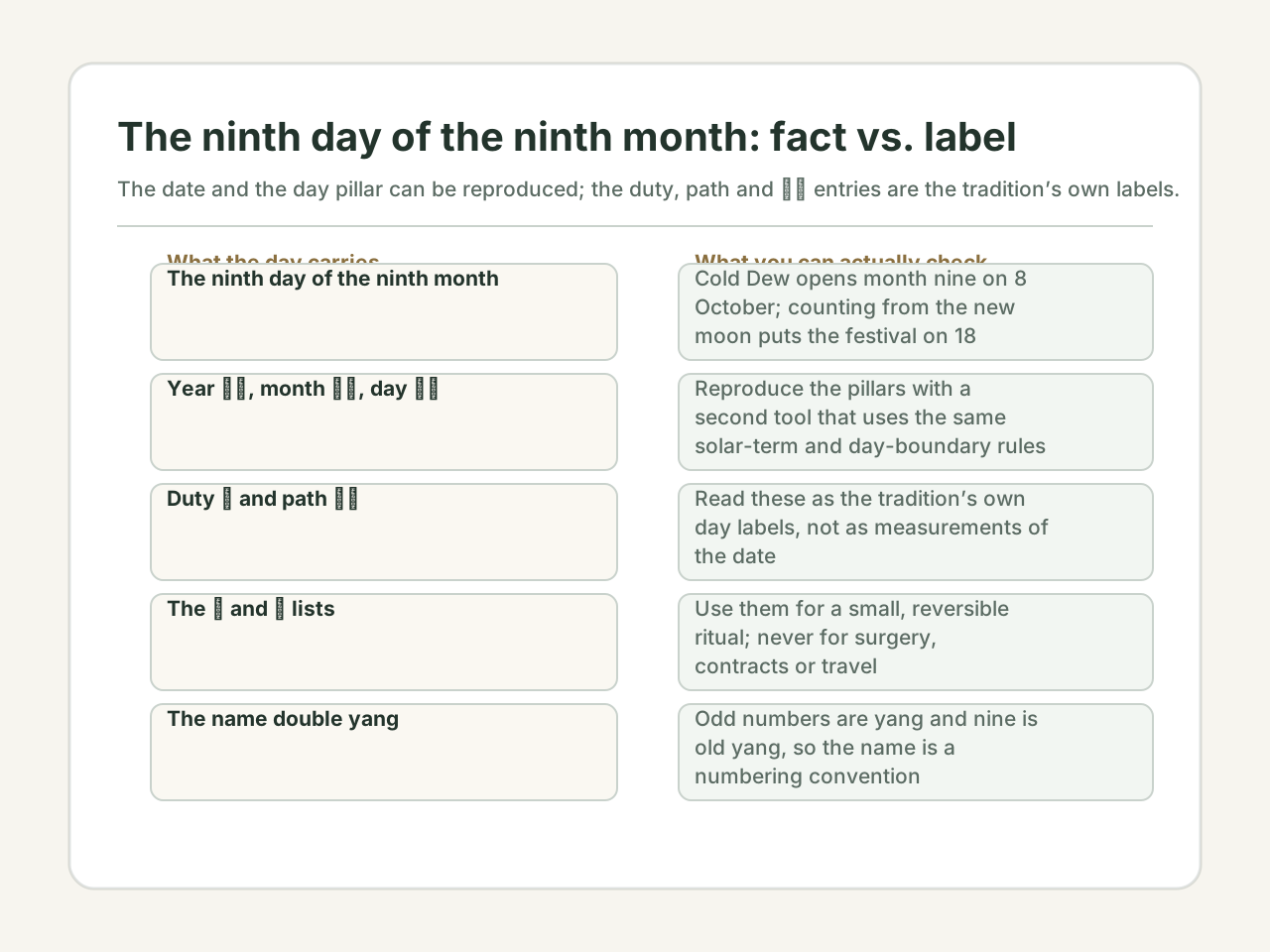
Run 18 October 2026 through the same calculation used by the daily almanac on this site and you get year pillar 丙午, month pillar 戊戌, and day pillar 乙丑. The day is a 平 (píng, level) day in the twelve duties and a 玄武 (Xuánwǔ) day in the yellow-and-black path series, and it clashes with the Goat (未). The 宜 list reads 解除, 祭祀, 修饰垣墙, 平治道涂, 造畜稠, 馀事勿取; the 忌 list reads 嫁娶, 开市, 交易, 入宅, 入学, 安葬.
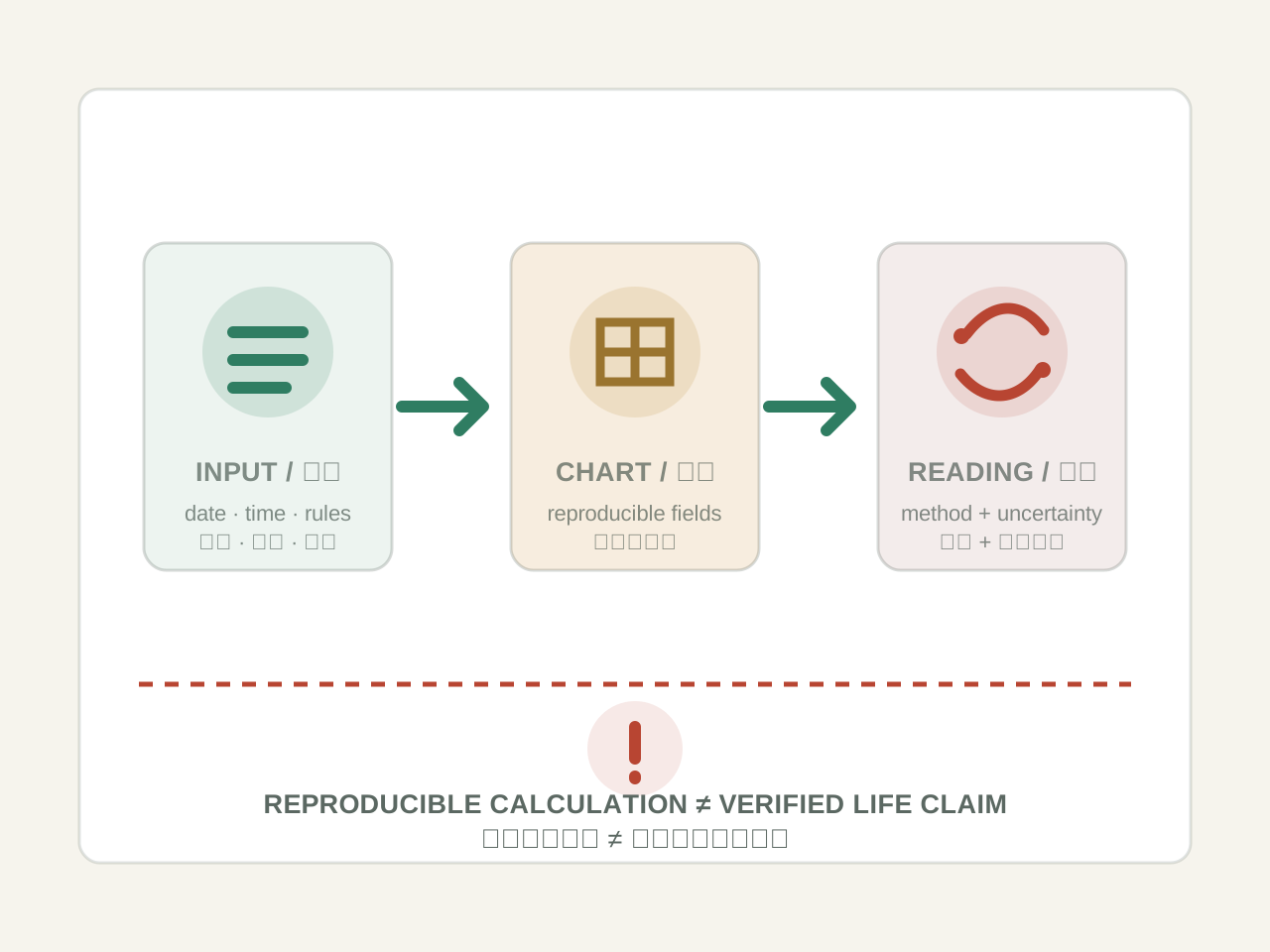
Those values are worth separating by kind, because they are not all the same sort of statement.
| Marker | What it is | What it can support |
|---|---|---|
| Lunar date and solar terms | Calendar arithmetic: the month opens at Cold Dew, days are counted from the new moon | Checking that two tools agree before you plan anything around the date |
| Day pillar 乙丑 | A position in the repeating 60-day stem-branch cycle | Comparing one day with another using one stated convention |
| Duty 平 and path 玄武 | Traditional day classifications generated from fixed cycles | Reading how the tradition labels a day; not a measurement of it |
| 宜 and 忌 lists | Recommendations the tradition attaches to the day | Choosing a small, reversible ritual you already intended to do |
| Festival name | A cultural designation carried by the date | Knowing what you are marking, and why |
Where the climbing, the dogwood and the chrysanthemum come from
The oldest recorded observances are climbing to high ground (登高), wearing 茱萸 (zhūyú, Tetradium ruticarpum), and drinking chrysanthemum wine (菊花酒). The Seasonal Customs of Jing-Chu (荆楚歲時記), a sixth-century record of regional practice, describes the ninth-day outing and the use of 茱萸.
The familiar origin story is later, and it reads as a story. In the Records of Strange Tales Continued (續齊諧記), the immortal 費長房 warns 桓景 that a calamity will fall on his household on the ninth day, and tells him to take the whole family up a hill carrying 茱萸 and chrysanthemum wine. When they come home, their animals are dead. That is an anomaly tale, not a chronicle, and the customs it explains are older than it is.
Both plants are autumn plants with long histories in the traditional materia medica, and 茱萸 is recorded there as warming and as a repellent. That gives the custom a seasonal logic that stands on its own. It does not turn the story's claim, that a plant and a hill averted a disaster, into a finding, and nothing here should be read as a health recommendation.
A checklist for using the date
If you want to use the day deliberately, this is the sequence that keeps it honest:
- Confirm the date in the lunisolar frame before you plan around it. In 2026 the Double Ninth is Sunday 18 October; next year it will not be.
- Note which convention your almanac uses for the month boundary, solar term or new moon, and for the day boundary, midnight or 子时. Keep using the same one. Switching mid-comparison produces disagreements that look meaningful and are not.
- Treat 宜 and 忌 as a symbolic list. Use them to choose a small, reversible ritual you were already going to do, such as making an offering or a family meal. Do not use them to filter surgery, contracts, travel, or a house move.
- If you mark the day with family, the modern association is 敬老, respect for older people: a visit, a shared meal, a phone call. That part needs no calendar justification at all.
- Write down what you did and how the day went. If your record never differs from an ordinary Sunday, that is a result too.
What this date cannot tell you
It cannot forecast your year, your health, your marriage, or your income. No almanac marker is a measurement of those things, and a day pillar is a position in a cycle, not a reading of a life.
It cannot make a date safe or unsafe. For travel, medical procedures, contracts, or moving house, the evidence that matters is the weather, the clinician, the lawyer, the lease, and the people doing the work.
It cannot carry a decision you would not otherwise make. If a choice only looks reasonable because the day is Double Ninth, the date is doing a job that evidence should be doing.
There is also a well-documented reason a broad reading of any single day feels accurate: wide, favourable descriptions are accepted as personally true by almost everyone. Psychology has a name for that tendency, and it is the main reason a date reading can feel convincing while saying nothing specific.
Disclaimer: This content is for informational and cultural reference purposes only. It does not constitute professional medical, legal, financial, or psychological advice. Readers should exercise their own judgment and consult qualified professionals for specific concerns.
Sources and review basis
Traditional references explain historical vocabulary and context. Official practical sources support only the observable safety, comfort, or environmental points noted in the article; they do not validate metaphysical claims.
Traditional reference
Seasonal Customs of Jing-Chu (荆楚歲時記)Wikisource digital text · Accessed 2026-10-14
A sixth-century record of regional seasonal customs. Cited for the earliest written description of the ninth-day outing and the use of 茱萸; it is a historical text, not evidence for any effect of the date.
Traditional reference
Book of Changes (周易)Wikisource digital text · Accessed 2026-10-14
The classical text that writes yang lines as 九 and yin lines as 六, which is where calling the ninth day double yang comes from. Cited for terminology, not for any claim about the date.
Practical source
APA Dictionary of Psychology: Barnum effectAmerican Psychological Association · Accessed 2026-07-14
A psychology reference for why broad, favourable personality descriptions can feel personally accurate. It does not evaluate BaZi calculations themselves.