Frost's Descent in 2026, and where it sits in the year
Frost's Descent (霜降, Shuāngjiàng) is the eighteenth of the twenty-four solar terms. In 2026 it falls on Friday 23 October, fifteen days after Cold Dew (寒露) on 8 October and fifteen days before Winter Begins (立冬) on 7 November.
The twenty-four terms are not a list of weather events. Each marks a fixed point on the sun's apparent path, spaced about 15.2 days apart, so the sequence lands on nearly the same Gregorian dates every year. What moves is the weather. Frost's Descent is named for the frost that becomes likely across much of northern China in late October, but the name labels a position in the calendar rather than a forecast for your address.
The split most calendars blur: 节 and 中气
The twenty-four terms alternate between two kinds, and the difference matters more than it looks.
Twelve of them are 节 (jié, nodes): 立春, 惊蛰, 清明, 立夏, 芒种, 小暑, 立秋, 白露, 寒露, 立冬, 大雪, 小寒. Each one opens a solar month. The other twelve are 中气 (zhōngqì, middle qi): 雨水, 春分, 谷雨, 小满, 夏至, 大暑, 处暑, 秋分, 霜降, 小雪, 冬至, 大寒. Each falls in the middle of one.
霜降 is a 中气. That single fact settles the common question about whether Frost's Descent changes your BaZi month. It does not.
Many almanac apps treat every solar term as a month boundary. Run the calculation and the difference becomes visible. On 7 October 2026 the month pillar is 丁酉. On 8 October, Cold Dew, a 节, it becomes 戊戌. It then stays 戊戌 through Frost's Descent on 23 October, through the rest of the month, and all the way to 6 November. On 7 November, Winter Begins, another 节, it changes to 己亥. Frost's Descent sits in the middle of that run and the pillar does not move.
23 October 2026 as the almanac prints it
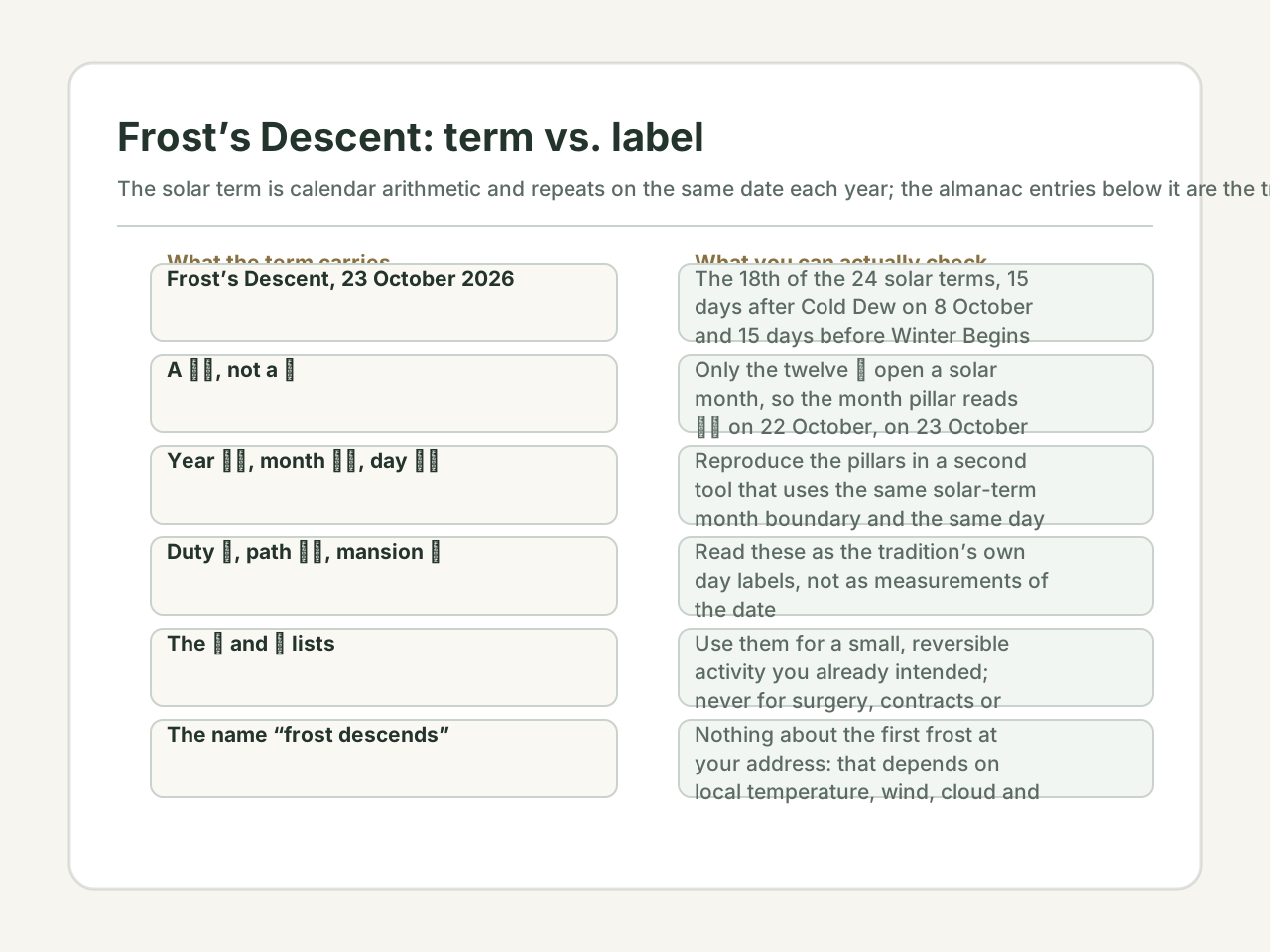
Running 23 October 2026 through the same calculation this site's daily almanac uses gives year pillar 丙午 (the year of the Horse), month pillar 戊戌, and day pillar 庚午. The twelve duties give 成, the yellow-and-black path gives 天刑, the twenty-eight mansion is 牛, and the day clashes with the Rat (子) with the sha to the north.
The 宜 list reads 嫁娶, 纳采, 订盟, 开市, 交易, 立券, 挂匾, 祭祀, 祈福, 开光, 造车器, 出行, 入宅, 移徙, 安床, 安门, 拆卸, 修造, 动土, 栽种, 安葬, 破土, 启钻, 除服, 成服, 入殓, 立碑. The 忌 list reads 探病, 纳畜, 伐木, 起基, 作梁, 盖屋.
Those values are not the same kind of statement, so they are worth separating before you use them.
| Marker | What it is | What it can support |
|---|---|---|
| Solar-term position | Calendar arithmetic: 霜降 is the 中气 between Cold Dew and Winter Begins | Knowing which solar month you are in, and that the month pillar is unchanged |
| Year, month and day pillars | Positions in repeating cycles, computed from fixed rules | Reproducing the result in a second tool that uses the same month and day boundaries |
| Duty 成, path 天刑, mansion 牛 | Traditional day classifications generated from fixed cycles | Reading how the tradition labels a day, rather than measuring the day itself |
| The 宜 and 忌 lists | Recommendations the tradition attaches to the date | Choosing a small, reversible activity you already intended to do |
| The name "frost descends" | A label for a position on the sun's path | Nothing about the weather at your address |
Why the name is not a frost forecast
The 七十二候 (seventy-two pentads) system divides each solar term into three five-day pentads and gives each a phrase. For Frost's Descent they are 豺乃祭兽 (the jackal makes offerings of its prey), 草木黄落 (grass and trees yellow and fall), and 蛰虫咸俯 (hibernating insects all bow down). These are seasonal descriptions written for a particular region, not measurements.
The practical point is sharper. Frost is a local, ground-level event. It depends on the night's temperature, wind, cloud cover, humidity, and the elevation of the particular garden or field. Two places a hundred kilometres apart at the same latitude can see first frost weeks apart. Frost's Descent is therefore a date you can look up, and the first frost where you live is a date you have to observe.
That is not a modern correction bolted onto an old system. It follows from what the term is: a fixed point on the sun's path, defined astronomically and therefore identical for everyone.
Using the date without overclaiming
If you want to use the day deliberately, this sequence keeps it honest:
- Check which convention your tool uses for the month boundary. A tool that moves the BaZi month at every solar term will disagree with a traditional almanac for most of late October.
- Reproduce the pillars with a second tool before relying on them. When two tools disagree, the disagreement is usually about rules, not about the date.
- Treat 宜 and 忌 as a symbolic list. Use it to pick a small, reversible activity you were already planning. Do not use it to filter surgery, contracts, travel, or a house move.
- If you want to act on the season, act on the observable part: frost protection, a heating check, gutters cleared before the first hard freeze. Those depend on your local forecast, not on the almanac.
- Write down what you did and how the day went. If nothing measurable changed, that is a result too.
What a solar term does not do
It does not forecast your year, your health, your marriage, or your income. The markers above are not measurements of those things; a day pillar is a position in a cycle, not a reading of a life.
It does not make a date safe or unsafe. For travel, medical procedures, contracts, or moving house, what matters is the weather, the clinician, the lawyer, the lease, and the people doing the work.
It does not carry a decision you would not otherwise make. If a choice only looks reasonable because the day is Frost's Descent, the date is doing a job that evidence should be doing.
There is also a well-documented reason a broad reading of any single day feels accurate: wide, favourable descriptions are accepted as personally true by almost everyone. Psychology has a name for that tendency, and it is the main reason a date reading can feel convincing while saying nothing specific.
Disclaimer: This content is for informational and cultural reference purposes only. It does not constitute professional medical, legal, financial, or psychological advice. Readers should exercise their own judgment and consult qualified professionals for specific concerns.
Sources and review basis
Traditional references explain historical vocabulary and context. Official practical sources support only the observable safety, comfort, or environmental points noted in the article; they do not validate metaphysical claims.
Traditional reference
Yuanhai Ziping (渊海子平)Wikisource digital text · Accessed 2026-07-14
A classical source for Four Pillars terminology, element relationships, and the Day Master framework.
Traditional reference
Sanming Tonghui (三命通会)Wikisource digital text · Accessed 2026-07-14
A historical compilation used to cross-check traditional BaZi concepts; it is not scientific validation.
Traditional reference
Yuxia Ji (玉匣記)Wikisource digital text · Accessed 2026-10-15
A household almanac whose 入宅 and 移徙 sections show how traditional date selection for moving house was organised. It documents a convention, not evidence that a date changes an outcome.
Practical source
APA Dictionary of Psychology: Barnum effectAmerican Psychological Association · Accessed 2026-07-14
A psychology reference for why broad, favourable personality descriptions can feel personally accurate. It does not evaluate BaZi calculations themselves.