初一 is a day that contains an instant
A Chinese lunar month begins on 初一, and that date is not a choice. It is the calendar day — counted in China Standard Time, UTC+8 — that contains the new moon: the moment the moon and sun share the same ecliptic longitude, which the almanac calls 朔.
Because 朔 is an instant and a calendar counts whole days, 初一 can begin at any hour. On 10 October 2026 the new moon falls at 23:50 CST, so 初一 is 10 October and 初二 starts ten minutes later. The next new moon is at 15:02 on 9 November, so 十月初一 is 9 November. One rule, two very different times of day.
One practical consequence: 初一 is not the evening the first crescent appears. At conjunction the moon sits in the sun's glare, and the crescent usually shows up a day or two later, depending on latitude, haze and how high the moon climbs after sunset.
Why a lunar month has 29 or 30 days and never 29.5
The average interval from one new moon to the next is 29.5306 days — the synodic month. A calendar counts whole days, so a lunar month is either 29 days (小月) or 30 (大月). Nothing in between is possible.
The actual intervals in 2026 run from 29.28 to 29.67 days, which is why the 29/30 sequence looks irregular: it is irregular. Across the eleven months that begin in 2026 the lengths read 30, 29, 30, 29, 29, 30, 29, 29, 30, 30, 30 — three 30-day months in a row from October to December. You cannot predict the next month's length by alternating, and no short cycle will do it either; only the ephemeris decides.
| Month (2026) | 初一 | Length | Full moon (CST) | Day of month |
|---|---|---|---|---|
| 四月 | 17 May | 29 days | 31 May, 16:46 | 十五 |
| 五月 | 15 June | 29 days | 30 June, 07:57 | 十六 |
| 六月 | 14 July | 30 days | 29 July, 22:36 | 十六 |
| 七月 | 13 August | 29 days | 28 August, 12:18 | 十六 |
| 八月 | 11 September | 29 days | 27 September, 00:49 | 十七 |
| 九月 | 10 October | 30 days | 26 October, 12:11 | 十七 |
The full moon is a second instant, and it drifts
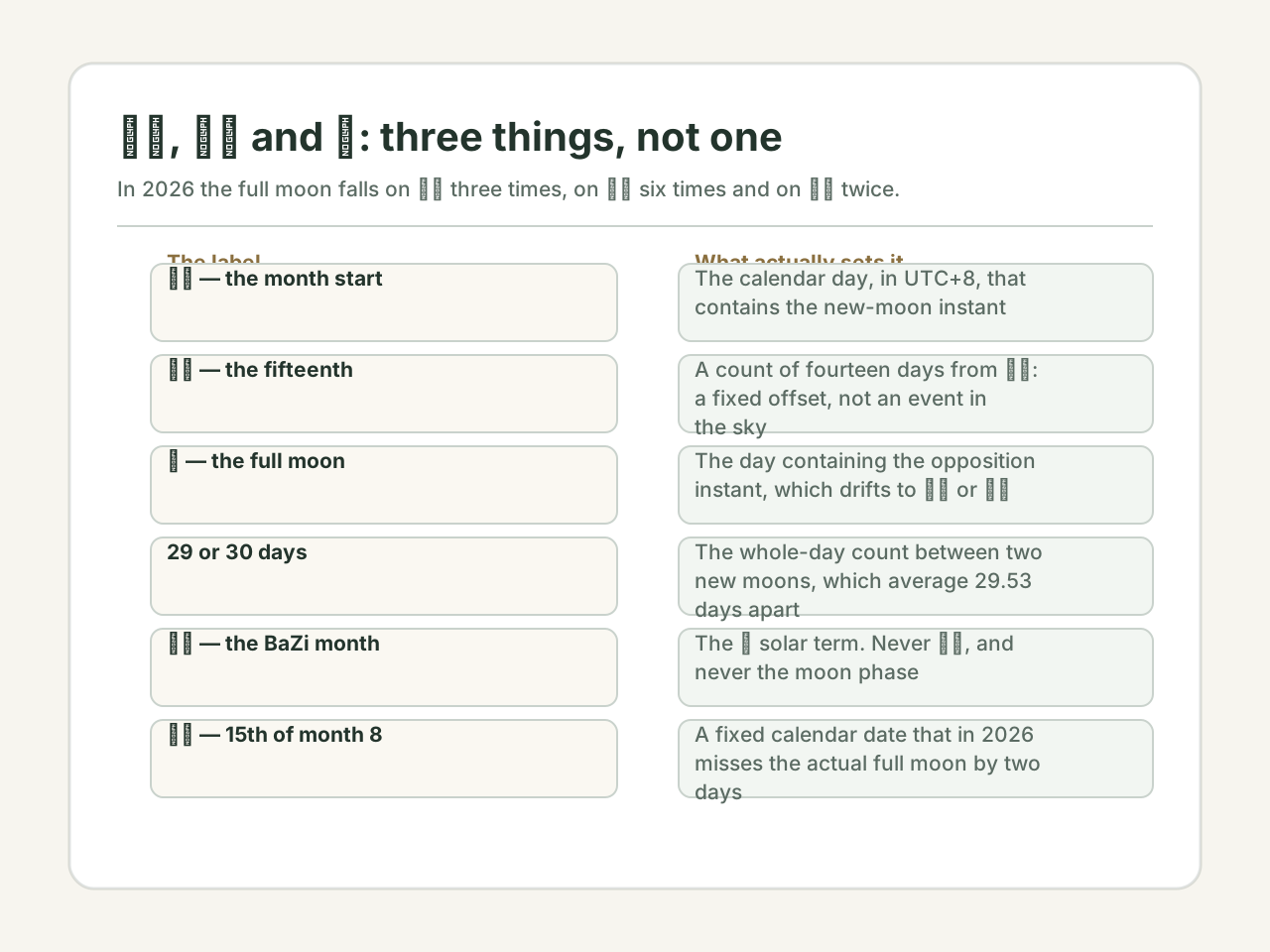
望, the full moon, is opposition: the moon stands 180° from the sun. If the two events were evenly spaced, 望 would fall half a synodic month after 朔 — 14.77 days — putting it late on 十五 or early on 十六 almost every month.
They are not evenly spaced. The moon's orbital speed varies: faster near perigee, slower near apogee, with a further monthly wobble added by the sun's pull. In 2026 the gap from 朔 to 望 ranges from 13.98 days in February to 15.56 days in September.
Two numbers then decide the date written in the almanac: the length of that particular gap, and the clock time of 朔. A 15.56-day gap that starts at 23:50 puts the full moon two days after 十五. Across the eleven lunar months beginning in 2026, 望 lands on 十五 three times, on 十六 six times and on 十七 twice.
That is the mechanism behind 十五的月亮十六圆 — "the moon of the fifteenth is round on the sixteenth". The saying is not a complaint about the calendar. It is an accurate description of a calendar counting days from 初一 while the sky counts from the conjunction.
A 2026 case: Mid-Autumn on the 15th, full moon on the 17th
八月十五 2026, the Mid-Autumn Festival, falls on Friday 25 September. The new moon that opened that month came at 11:27 on 11 September. The full moon arrives at 00:49 on 27 September, which is 八月十七 — two days after the festival. The day pillar on the festival is 壬寅; on the actual full moon it is 甲辰.
九月 shows the same effect from a different cause. Its 初一 is 10 October, because the new moon fell at 23:50 that night. The full moon comes at 12:11 on 26 October, so 望 is 九月十七. Had that new moon been sixteen hours earlier, the whole month would have shifted back a day and 望 would have read 十六.
Neither date is wrong. The festival is a fixed calendar date; the full moon is an astronomical event. When someone insists the moon "should" be full on the fifteenth, they are treating the two as one thing.
What this changes in a BaZi chart: nothing
The month pillar does not follow 初一, and it does not follow the moon. It changes at the twelve 节 — 立春, 惊蛰, 清明, 立夏, 芒种, 小暑, 立秋, 白露, 寒露, 立冬, 大雪, 小寒 — which are 15° divisions of the sun's longitude. The other twelve terms, the 中气, do not open a month at all.
So 八月十五 and 八月十七 2026 both sit inside the 丁酉 month that began at 白露 on 7 September. The month turns to 戊戌 at 寒露 on 8 October and to 己亥 at 立冬 on 7 November. None of those switches is tied to a new moon or a full moon.
There is no moon column either. A Four Pillars chart has four — year, month, day, hour — and each is a stem-branch pair. 初一 and 十五 cannot appear in it, and "born on a full moon" is not a category a chart can read. The almanac's 宜 and 忌 entries are keyed to the day's stem-branch inside the solar month, not to the phase.
Checking a date yourself, in four steps
The method needs nothing beyond an ephemeris that lists new and full moons in UTC. Times here are converted to UTC+8, because that is the meridian the Chinese calendar uses.
- Find the new-moon instant in UTC and add eight hours. The resulting date is 初一 for that month.
- Find the next full-moon instant and convert it the same way. That date is 望, whatever day number the almanac gives it.
- Count the days between the two dates and add one. That is the lunar day of the full moon — 15, 16 or 17 in nearly every month.
- Check the month pillar separately, against the solar terms rather than against 初一, and if two sources disagree by a day, compare their UTC offsets before doubting either one.
Three things that are close together, not the same thing
初一, 十五 and 望 are separate events that happen to fall within a day or two of each other most months. The month start is arithmetic on an instant; the fifteenth is a count of days; the full moon is astronomy. Knowing which is which is the difference between reading a date and guessing at one — and it is the difference between a check anyone can repeat and a claim nobody can.
Disclaimer: This content is for informational and cultural reference purposes only. It does not constitute professional medical, legal, financial, or psychological advice. Readers should exercise their own judgment and consult qualified professionals for specific concerns.
Sources and review basis
Traditional references explain historical vocabulary and context. Official practical sources support only the observable safety, comfort, or environmental points noted in the article; they do not validate metaphysical claims.
Practical source
NASA Science: Moon PhasesNASA Science · Accessed 2026-10-17
Used for the definition of a phase as the moon's position relative to the sun and Earth, and for the 29.5-day synodic month. It describes the astronomy; it says nothing about calendars or fortune.
Practical source
IANA Time Zone Database (tzdata)Internet Assigned Numbers Authority · Accessed 2026-10-16
The reference dataset for historical UTC offsets and daylight-saving transitions. Its Asia/Shanghai rules are the source for the 1986–1991 China summer-time dates used in this article.
Traditional reference
Yuanhai Ziping (渊海子平)Wikisource digital text · Accessed 2026-07-14
A classical source for Four Pillars terminology, element relationships, and the Day Master framework.