The wealth line is a minor crease, and tradition reads it last
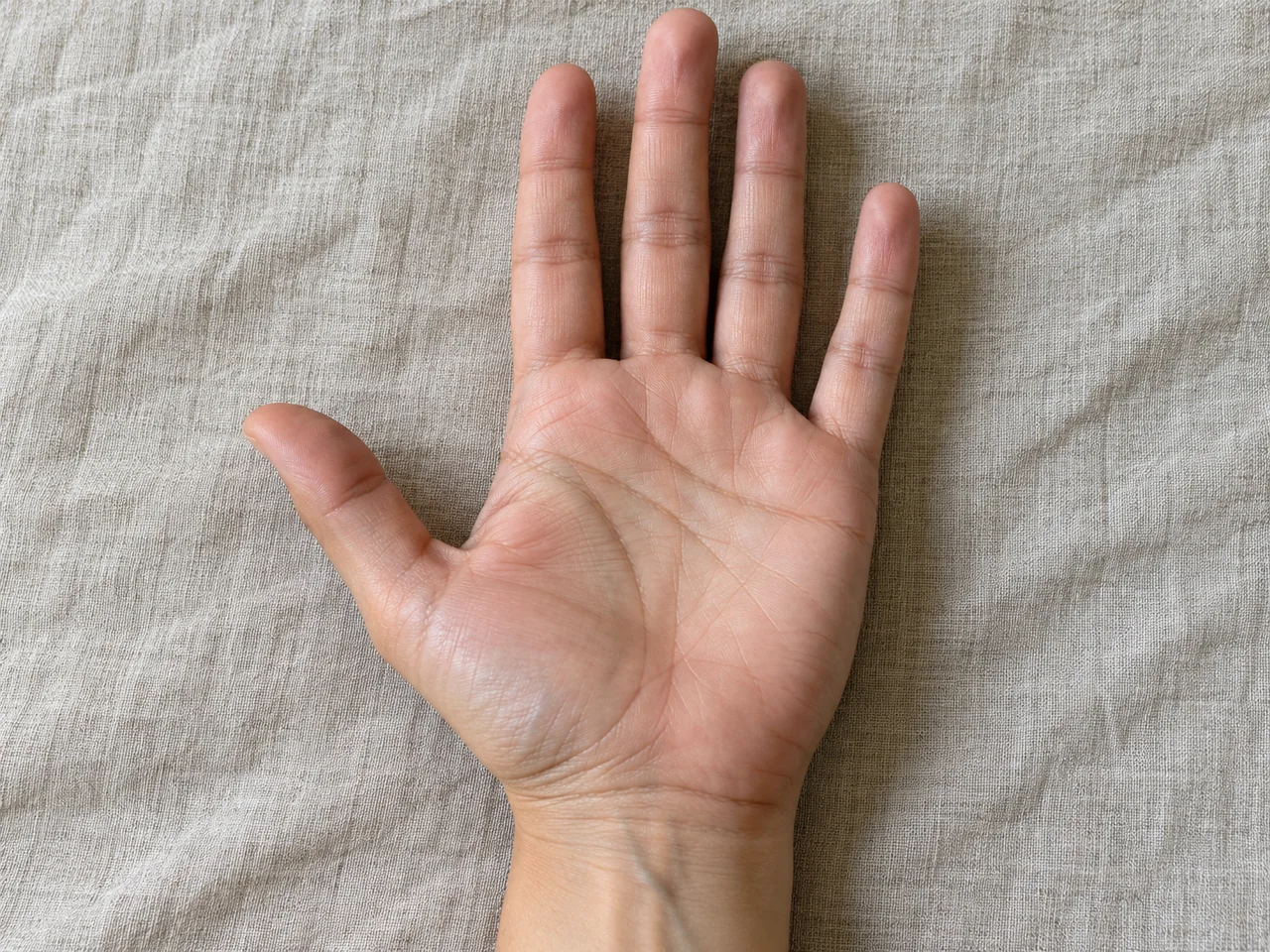
In palmistry the wealth line — also called the money line or the fortune line — is a short vertical crease below the little finger, running down toward the pad at its base. It is not one of the three creases every hand needs in order to close, and it is missing on many hands. Because it is both minor and frequently absent, the tradition itself reads it after hand shape, the three major creases and the mounts, and treats what it says as conditional on all of those.
The honest framing is short. The wealth line does not predict how much money a person will have, and it promises neither wealth nor poverty. At most it is a prompt to think about earning style, spending and appetite for risk. A person's actual finances are set by education, occupation, spending, policy and the economy — none of which leaves a mark on the hand.
What the tradition reads into the money features
Wealth is not read from one line. Four other features are consulted, and each one is a description of the hand before it is anything else:
| Feature | Where it sits | Traditional reading | What the hand supports |
|---|---|---|---|
| Wealth line | Below the little finger, short and vertical | Earning style, attitude to money, several income streams | A crease that can be described. The tradition itself notes that plenty of people with money have no visible wealth line |
| Sun line (Apollo line) | Below the ring finger, vertical | Recognition and achievement in a field | A second minor vertical crease. Recognition is a social fact, not something a crease displays |
| Fate line | Vertical through the centre of the palm | Career direction and outside support | A crease that is absent or fragmented on many hands — an anatomical variable, not a career verdict |
| Mount of Mercury | Fleshy pad below the little finger | Commercial skill and communication | The pad's development follows build and use. The reading describes the hand, not a measurable skill |
| Mount of Venus | Fleshy pad below the thumb | Vitality and the drive to earn | Same: a prominent pad is anatomy and use, and it is not evidence of drive |
The crease is fixed before birth; how deep it looks is not
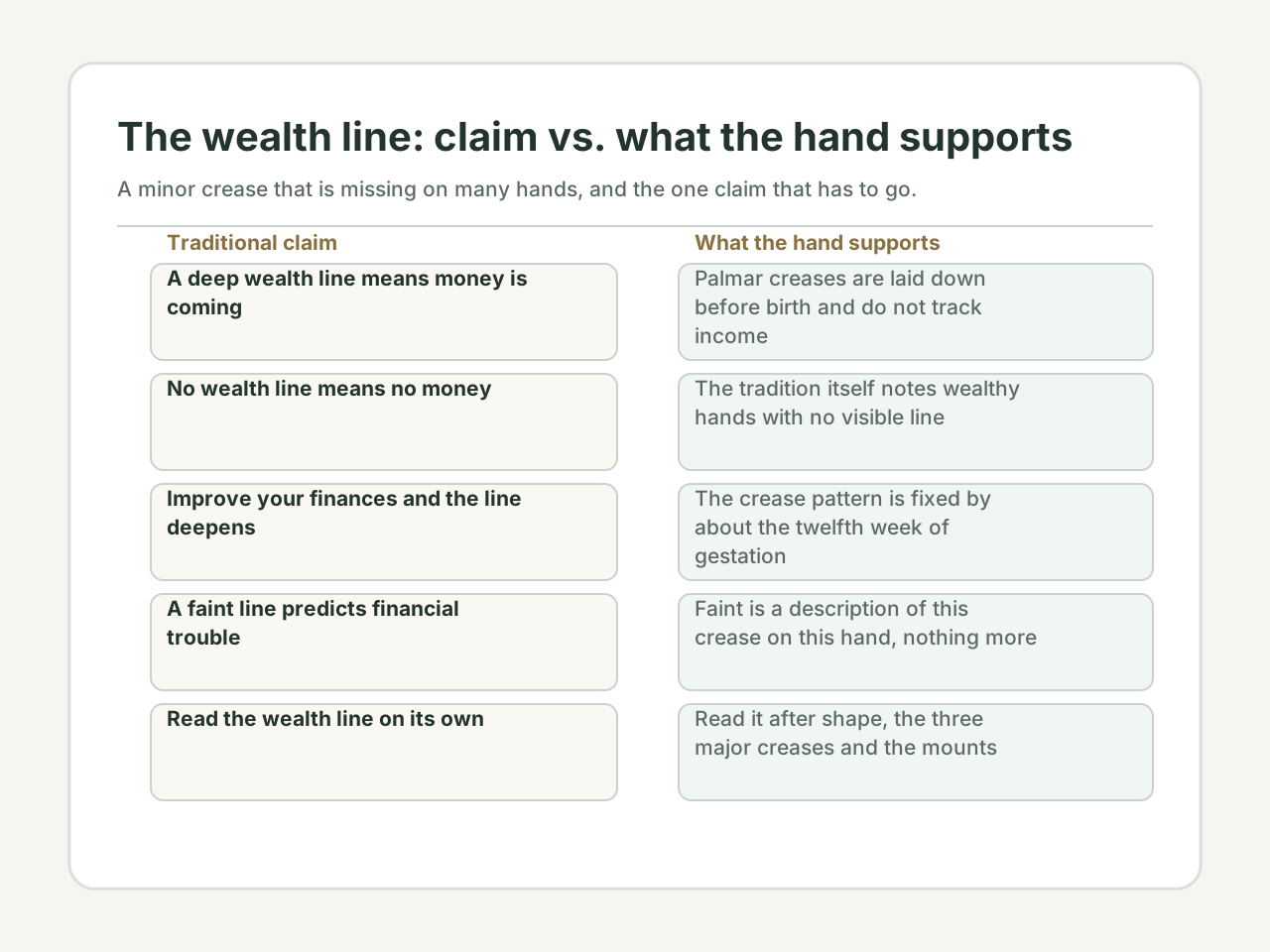
Palmar creases are laid down in the womb, most of them by the twelfth week of gestation, and the pattern does not change afterwards. That is the single most useful fact here, because it kills the claim that sells best: that the wealth line deepens as a person's finances improve.
What does change is everything around the crease, and four things move how deep the same crease looks. Hydration of the outer skin layer: a dry hand reads as more lined than a moist one, which is why hands look older after a day of housework than after a bath. Subcutaneous fat: a few kilos of weight change softens or sharpens every crease on the hand at once, in a direction that has nothing to do with income. Callus from manual work, which thickens the skin over pressure points and can make a crease crossing it look shallow. And light: a low side light rakes across a crease and deepens it, while a flat overhead light and a hand photographed palm-down lose most of it.
The consequence is easy to demonstrate and hard to argue with. Two photographs of the same hand taken a month apart will differ, and a person told that their wealth line has deepened will look at the second photograph and agree, because it has — in the photograph. For scale on how much the pattern itself varies, about one hand in thirty carries a single transverse crease instead of the usual three, for reasons that have nothing to do with fortune.
Three rules for reading anything money-related
These are the rules that keep a wealth reading inside what a hand can carry:
- Read the whole hand, not one line. A deep wealth line beside a strong fate line and the same line beside a weak one are two different observations, and tradition reads them differently. Say which reading is in play instead of delivering the more flattering one.
- Never say the line deepened because the finances improved. The crease pattern is fixed before birth and the skin around it is not; the argument is one sentence long, and a single photograph can disprove it.
- Treat the reading as a prompt for reflection, never as an input to a decision. If a faint line provokes the question 'do I have a consistent earning strategy?', the question is worth asking. It is worth asking because it is a good question, not because a line asked it.
A worked example: the reading that described a job
A man asks for a financial reading. He has a faint wealth line, a deep fate line, a well-developed pad below the little finger, and no visible sun line.
Read in the traditional order, that combination describes a stable career with a side interest in commerce — which is a description of a work history, not a forecast. The temptation is to add a verdict on top: he will not become rich, but he will not come to harm either. Nothing on the hand supports that sentence, and it is the sentence a client is most likely to remember.
Asked what he actually does, he describes fifteen years at the same employer, a steady salary, consistent saving and no appetite for speculative investment. The reading had not anticipated any of it. It had produced a description broad enough to fit a very common career, and the fit felt like confirmation.
The Barnum effect is the name for that feeling: a broad, favourable description reads as personally accurate. Whatever value the session had came from the questions it provoked, not from the line.
A ten-minute test for any wealth reading
Everything above amounts to one claim: the reading is a prompt, not a forecast. That is easy to say and easy to nod along with, so here is a procedure that turns it into something you can check. It works on any reading, from a palmist, an astrologer or a personality quiz.
Write the reading down first, sentence by sentence, before deciding whether it was accurate. Then mark each sentence B or S. B means broad: it would fit most adults of a similar age, background and situation. S means specific: it could be wrong, and you would be able to tell. A typical wealth reading comes out nearly all B — 'you have a cautious relationship with money' fits almost everyone, and 'you will not be wealthy but you will not come to harm' fits almost everyone and cannot be checked at all.
Then the transfer test, which is the part people skip. Hand the same list to someone else of similar age and background and count how many sentences they also endorse. Anything both of them endorse carried no information about either. What survives is an S sentence that the second person rejects — and once you have one of those, you are no longer reading a hand, you are testing a claim about a person, which is the only thing that can actually be tested.
The one-question version, for when there is no second person: ask what the reading would have looked like if this person's finances were the opposite of what they are. If the answer is the same sentence, the sentence says nothing. Most of them fail this question, and noticing that is worth more than the reading itself.
What a palm cannot tell you about money
A palm cannot tell anyone their income, their returns, or the timing of either. Those outcomes follow from education, occupation, spending, policy and the economy, and none of them is written on the hand. Palmistry for wealth is a cultural practice, not a planning tool, and the one thing it must never do is enter an investment decision.
Disclaimer: This content is for informational and cultural reference purposes only. It does not constitute professional medical, legal, financial, or psychological advice. Readers should exercise their own judgment and consult qualified professionals for specific concerns.
Sources and review basis
Traditional references explain historical vocabulary and context. Official practical sources support only the observable safety, comfort, or environmental points noted in the article; they do not validate metaphysical claims.
Practical source
MedlinePlus: Single palmar creaseUS National Library of Medicine · Accessed 2026-10-18
The source for the timing and frequency used across the palm-reading articles: palmar creases develop in the womb, most often by the twelfth week of gestation, and a single palmar crease appears in about one person in thirty. It describes anatomy and association only; it makes no claim that a crease predicts anything.
Practical source
APA Dictionary of Psychology: Barnum effectAmerican Psychological Association · Accessed 2026-07-14
A psychology reference for why broad, favourable personality descriptions can feel personally accurate. It does not evaluate BaZi calculations themselves.