The Ten Gods are relationship descriptors, not deities
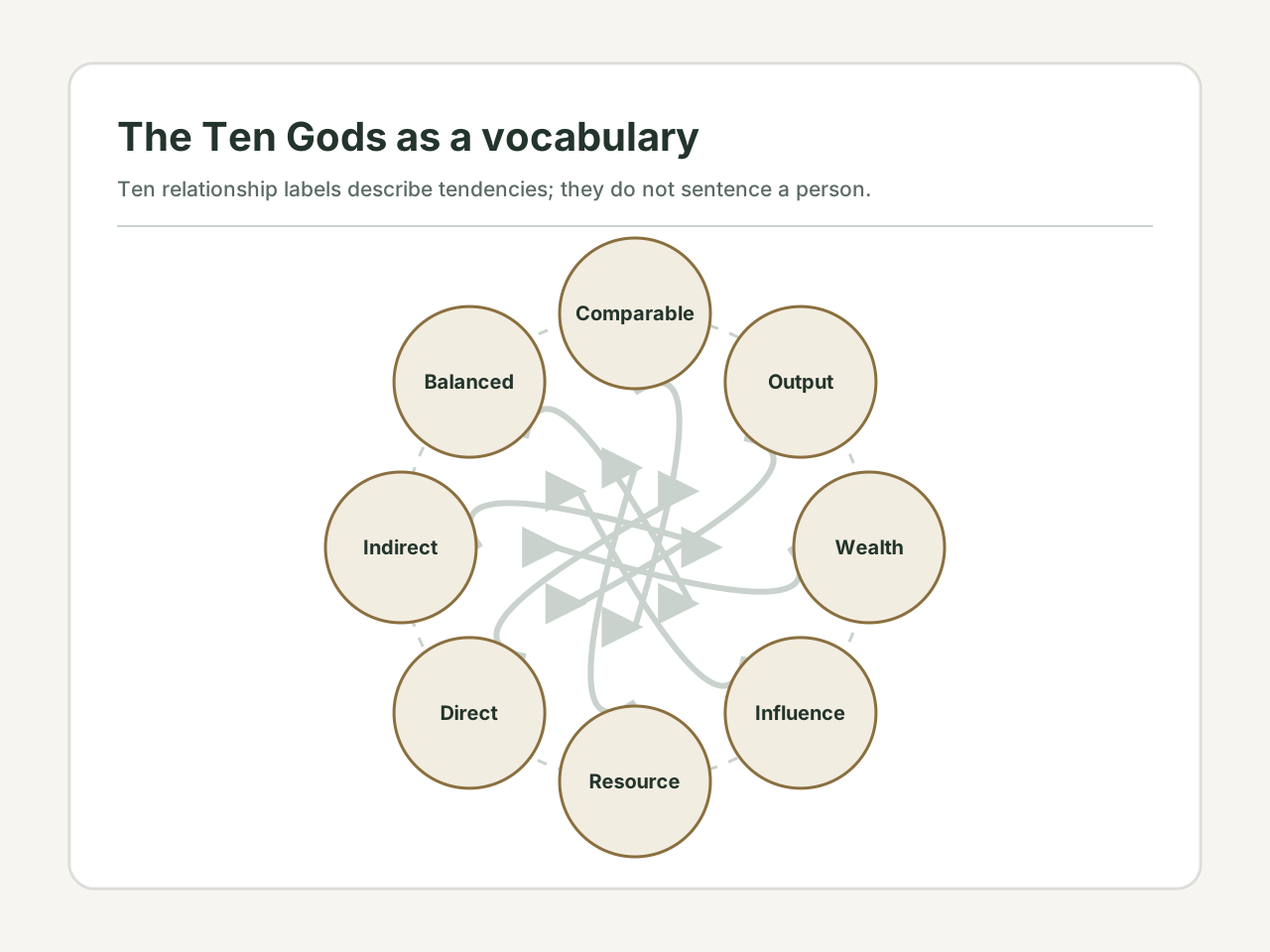
The Ten Gods (十神) are the core interpretive framework of BaZi. Despite the name, they are not gods or spirits. They are relationship descriptors: each stem in the chart is classified by its relationship to the Day Master (the stem of the day pillar). The relationships are based on the five-element interactions — generating, controlling, same-element — and the yin-yang polarity of the stems.
The honest view: the Ten Gods are a structured way of describing how different aspects of life — resources, output, power, wealth, peers — show up in a person's chart. They are categories of experience, not supernatural forces. A 'Direct Officer' (正官) does not mean you are destined for government work. It means your chart has a particular relationship pattern that tends toward structure, responsibility, and rule-following. The Ten Gods describe tendencies, not destiny.
The Ten Gods at a glance
Here is what each of the Ten Gods actually means, translated into plain language:
| Ten God | Relationship to Day Master | What it describes in plain terms |
|---|---|---|
| Direct Resource (正印) | Element that generates the Day Master, same yin-yang | Support, nurturing, knowledge, study. People or situations that help you grow. In excess: over-dependence, passivity |
| Indirect Resource (偏印) | Element that generates the Day Master, opposite yin-yang | Unconventional knowledge, intuition, spiritual insight. In excess: overthinking, detachment from reality |
| Friend (比肩) | Same element as Day Master, same yin-yang | Peers, siblings, competitors, self-reliance. In excess: stubbornness, difficulty cooperating |
| Rob Wealth (劫财) | Same element as Day Master, opposite yin-yang | Social connections, networking, sharing. In excess: over-dependence on others, boundary issues |
| Eating God (食神) | Element generated by Day Master, same yin-yang | Creativity, expression, enjoyment, talent. In excess: self-indulgence, lack of discipline |
| Hurting Officer (伤官) | Element generated by Day Master, opposite yin-yang | Innovation, rebellion, sharp intelligence, performance. In excess: conflict, recklessness, arrogance |
| Direct Wealth (正财) | Element controlled by Day Master, same yin-yang | Earned income, stable assets, practical management. In excess: materialism, rigidity about money |
| Indirect Wealth (偏财) | Element controlled by Day Master, opposite yin-yang | Variable income, investments, entrepreneurship, generosity. In excess: gambling, financial instability |
| Direct Officer (正官) | Element that controls Day Master, same yin-yang | Authority, discipline, responsibility, career structure. In excess: rigidity, fear of authority, overwork |
| Seven Killings (七杀) | Element that controls Day Master, opposite yin-yang | Competition, pressure, ambition, leadership under stress. In excess: aggression, anxiety, burnout |
The three things that matter more than which gods you have
The presence of a particular Ten God in a chart is less important than how it interacts with the rest of the chart. Here is what actually matters:
- Balance, not presence. A chart with a strong Hurting Officer is not a 'bad' chart. Hurting Officer energy is creative, innovative, and sharp — it needs productive channels, not suppression. The question is not 'do I have this god?' but 'is this god balanced by other elements in the chart?' A Hurting Officer controlled by a Direct Resource produces disciplined creativity. An uncontrolled Hurting Officer produces chaos.
- The Month Pillar carries the most weight. The Ten God that appears in the Month Pillar (the stem of the month of birth) is often the most influential in the chart. It describes the environment you were born into and the default mode of operating you developed early in life. If your Month Pillar has a Direct Officer, you may naturally gravitate toward structured environments regardless of what else is in the chart.
- The Luck Pillars change the picture. A Ten God that is absent in the natal chart may appear in a Luck Pillar and become dominant for a decade. A person with no Wealth stars in their natal chart may enter a Wealth Luck Pillar in their 30s and suddenly find financial opportunities opening up. The chart is not static; the Ten Gods are a moving picture.
A worked example: reading a chart with a strong Hurting Officer
A woman has a Yang Fire (丙) Day Master. Her month stem is Yang Earth (戊) — Hurting Officer. Her chart also has a lot of Wood (Resource) and some Metal (Wealth). She reads online that Hurting Officer is 'the most dangerous star' and that it means she will 'offend people and destroy her own luck'. She becomes anxious about her chart.
A more careful reading: her Hurting Officer (Earth) is produced by her strong Wood (Resource). This is a productive cycle: Resource → Day Master → Hurting Officer. She has a lot of internal knowledge and support (Wood/Resource) that she channels into creative output and expression (Earth/Hurting Officer). Her Hurting Officer is not uncontrolled — it is supported by a solid foundation.
In her career, she is a designer — creative work is literally her job. The Hurting Officer energy is being channelled productively. She is not 'offending people and destroying her luck'. She is using her sharp intelligence and creative drive to build a career. The Ten God label alone was misleading. The context — the whole chart and her actual life — told a different story.
The Ten Gods describe patterns; they do not sentence you
The Ten Gods are a sophisticated vocabulary for describing life patterns. They are useful for understanding tendencies in career, relationships, and personal style. But they are not deterministic labels. A chart with a strong Seven Killings is not a 'dangerous' chart — it is a chart that describes someone who operates well under pressure, provided the pressure is balanced by support. The Ten Gods are a map, not a sentence. Use them to understand the terrain, not to predict the destination.
Disclaimer: This content is for informational and cultural reference purposes only. It does not constitute professional medical, legal, financial, or psychological advice. Readers should exercise their own judgment and consult qualified professionals for specific concerns.
Sources and review basis
Traditional references explain historical vocabulary and context. Official practical sources support only the observable safety, comfort, or environmental points noted in the article; they do not validate metaphysical claims.
Traditional reference
Yuanhai Ziping (渊海子平)Wikisource digital text · Accessed 2026-07-14
A classical source for Four Pillars terminology, element relationships, and the Day Master framework.
Traditional reference
Sanming Tonghui (三命通会)Wikisource digital text · Accessed 2026-07-14
A historical compilation used to cross-check traditional BaZi concepts; it is not scientific validation.