Three dates get called the start of the year
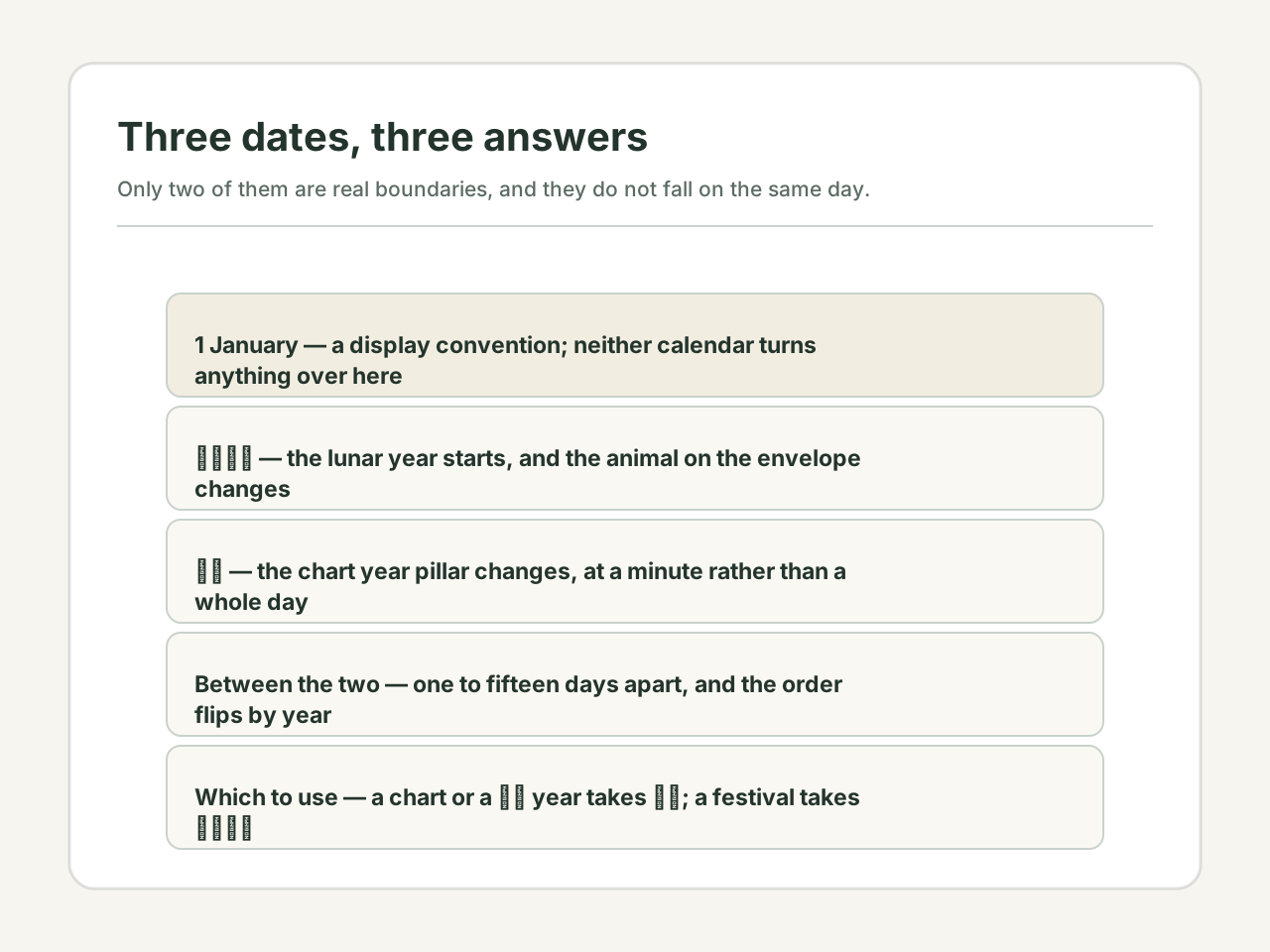
Ask which animal a birth year belongs to and you can get three different answers, because three different dates are used as the switch: 1 January, the first day of the lunar new year (正月初一), and 立春, the solar term that falls in the first week of February. They rarely agree, and in some years the two traditional ones sit two weeks apart.
1 January is the easy one to dismiss. No traditional calendar turns the stem-branch year over at midnight on 31 December; apps that do it are collapsing a lunisolar calendar into a solar display. Between the other two the choice is not a matter of taste — it depends on what the animal is for. A Four Pillars chart uses 立春. The animal on the red envelope, the restaurant placemat and the new-year greeting follows 正月初一.
What actually changes on each one
1 January changes nothing. The stem-branch year (干支年) is counted from a solar marker, not from the Gregorian year boundary, so no almanac renames anything on 1 January. The simplification exists because a display needs one number per calendar year, and the lunar year does not fit that shape.
正月初一 starts the lunar year, and that is the date the culture celebrates. In 2026 it falls on 17 February, opening 丙午, the Horse. The month is built from new moons and the year from twelve or thirteen of them, with a leap month inserted roughly every three years, so the date moves across a month-wide window: anywhere from 21 January to 20 February.
立春 turns the year pillar of a chart. It is the sun reaching 15° of ecliptic longitude, so it falls on 3, 4 or 5 February at a specific minute — 04:02 on 4 February 2026, China Standard Time. A birth at 03:00 that morning still belongs to 乙巳, the Snake; a birth at 05:00 belongs to 丙午, the Horse. Both are correct, and they are two hours apart.
The gap runs from one day to fifteen, and it swaps sides
Which boundary arrives first is not fixed, which is why the confusion is not a one-off. In 2026 the lunar new year comes thirteen days after 立春, so the chart and the placemat disagree for those thirteen days. In 2027 the order reverses: 立春 on 4 February, the new year on 6 February, a two-day gap. Across 2020 to 2035 the interval ranges from one day (2030) to fifteen (2034), in both directions.
| Year | 立春 (CST) | 正月初一 | Days apart | Which comes first |
|---|---|---|---|---|
| 2026 | 4 Feb, 04:02 | 17 Feb | 13 | 立春 |
| 2027 | 4 Feb, 09:46 | 6 Feb | 2 | 立春 |
| 2028 | 4 Feb, 15:31 | 26 Jan | 9 | 正月初一 |
| 2029 | 3 Feb, 21:20 | 13 Feb | 10 | 立春 |
| 2030 | 4 Feb, 03:08 | 3 Feb | 1 | 正月初一 |
| 2031 | 4 Feb, 08:58 | 23 Jan | 12 | 正月初一 |
| 2032 | 4 Feb, 14:48 | 11 Feb | 7 | 立春 |
Born 10 February 2026: Horse on a chart, Snake on a placemat
A birth at noon on 10 February 2026 in Beijing produces the four pillars 丙午 庚寅 乙卯 壬午. The year pillar is 丙午, the Horse. The lunar date of the same day is 乙巳年十二月廿三 — the twenty-third day of the twelfth month of the Snake year, because the new year has not arrived yet.
Neither answer is an error, and that is the point. A practitioner reading the chart reads the Horse. A relative checking the birthday against a placemat reads the Snake. If two websites have given you two animals, you were probably born inside one of these windows, and both sites were answering a slightly different question.
The reverse case exists too. On 5 February 2027, the day before that year's new year, the year pillar is already 丁未, the Goat, while the lunar date still reads 丙午年十二月廿九 — New Year's Eve of the Horse year.
Why two calendars disagree at all
The stem-branch year is solar. Twenty-four terms divide the sun's path into 15° segments, and the year pillar changes when the sun crosses 立春. That is an astronomical event with a time attached, so the boundary is a minute, not a day, and it is the same rule for every chart regardless of who is reading it.
The lunar calendar is lunisolar. Months begin at new moons, which are 29 or 30 days long, and twelve of them come to about 354 days — eleven short of a solar year. A leap month every two or three years absorbs the difference, and the result is that 正月初一 drifts against the seasons within a fixed window rather than staying put.
Both systems are internally consistent. They answer different questions: one divides the solar year for chart work and for date selection, the other tracks the moon for festivals and for the ritual calendar. The disagreement only appears when a single word — the animal — is used for both.
Checking your own date in four steps
The question can be settled in a few minutes if the birth record has a time on it. Without a time, a birth on a boundary day cannot be resolved at all, and the honest answer is to say so.
- Get the birth time to the minute and the place of birth. Both boundaries are instants; a date on its own will not decide the question.
- Convert the clock reading to China Standard Time, UTC+8. A birth outside China can land on a different date once converted, which moves both comparisons.
- Look up 立春 for that year and compare to the minute. Before the instant the year pillar is the previous one; after it, the new one.
- Look up 正月初一 as well. If the birth falls between the two dates, expect two answers and use whichever one matches the question being asked.
Which answer to give when someone asks
For a chart, a 太岁 year, or a date-selection calculation, use 立春. Those systems divide the year by solar longitude and the year pillar is one of the four, so getting the boundary wrong shifts the whole reading rather than one label.
For the animal people celebrate — the one on the envelope, in the greeting, in the shop display — use 正月初一. That is the date the culture marks, and it is the one a family will recognise.
If you were born in the gap and someone insists on a single answer, give the range instead: born between 立春 and the new year, so a Horse by the chart and a Snake by the lunar calendar. That is not hedging. It is what the two calendars actually say, and it is the only version of the answer that survives being checked.
Disclaimer: This content is for informational and cultural reference purposes only. It does not constitute professional medical, legal, financial, or psychological advice. Readers should exercise their own judgment and consult qualified professionals for specific concerns.
Sources and review basis
Traditional references explain historical vocabulary and context. Official practical sources support only the observable safety, comfort, or environmental points noted in the article; they do not validate metaphysical claims.
Traditional reference
Yuanhai Ziping (渊海子平)Wikisource digital text · Accessed 2026-07-14
A classical source for Four Pillars terminology, element relationships, and the Day Master framework.
Traditional reference
Seasonal Customs of Jing-Chu (荆楚歲時記)Wikisource digital text · Accessed 2026-10-14
A sixth-century record of regional seasonal customs. Cited for the earliest written description of the ninth-day outing and the use of 茱萸; it is a historical text, not evidence for any effect of the date.
Practical source
IANA Time Zone Database (tzdata)Internet Assigned Numbers Authority · Accessed 2026-10-16
The reference dataset for historical UTC offsets and daylight-saving transitions. Its Asia/Shanghai rules are the source for the 1986–1991 China summer-time dates used above.