Wedding date selection is about practical timing, not magical guarantees
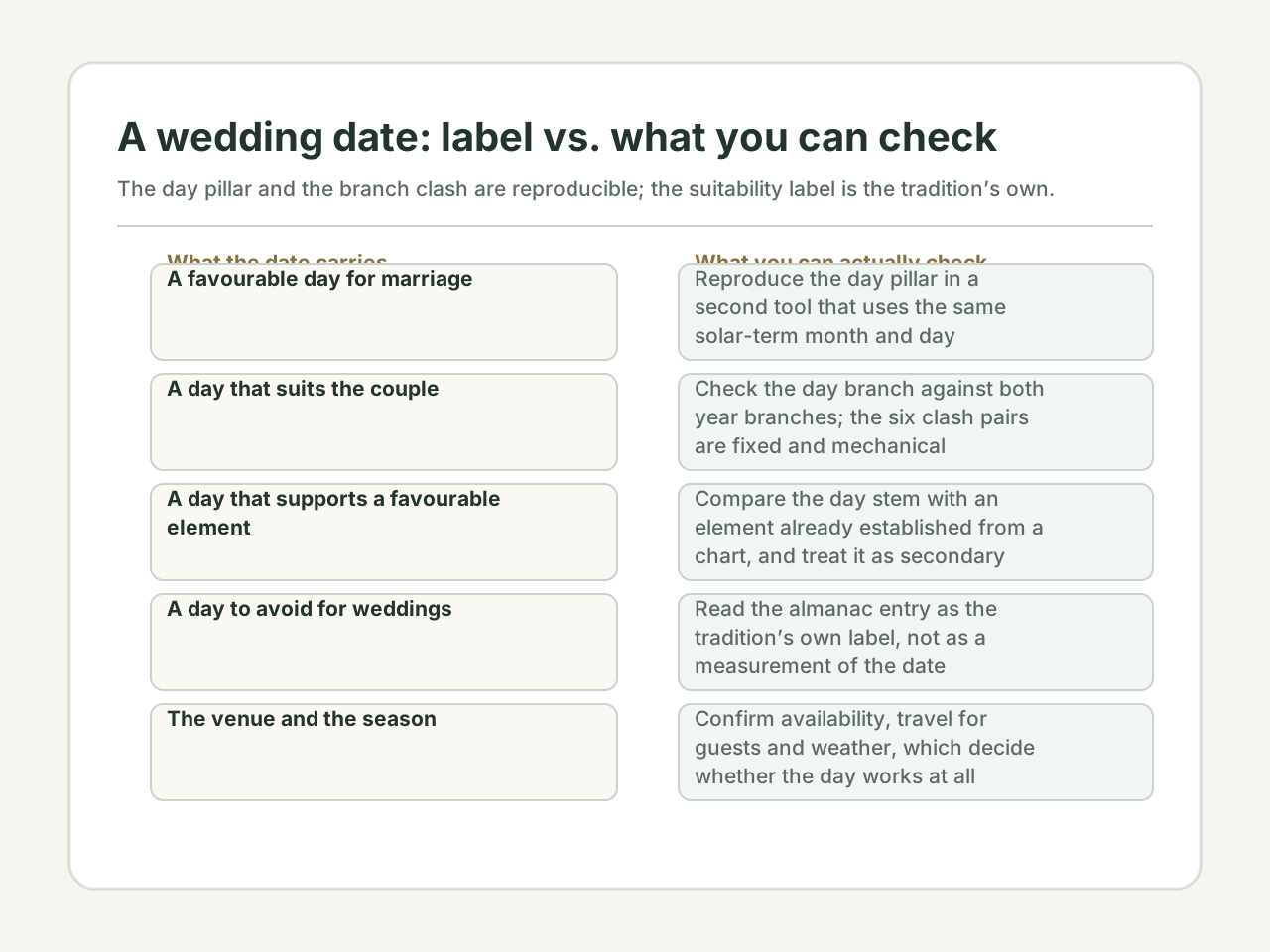
Traditional Chinese date selection for weddings involves checking the stem-branch of the proposed wedding date against the couple's BaZi charts. The goal is to find a date that is compatible with both people's charts — specifically, a date that does not clash with their year branches, that supports their favourable elements, and that falls on a day traditionally considered auspicious for marriage.
The honest view: wedding date selection is a traditional practice that helps couples choose a date they feel good about. It is not a guarantee of a happy marriage. A couple who marries on an 'auspicious' date but does not communicate, respect each other, or work on their relationship will not have a happy marriage. A couple who marries on an 'inauspicious' date but is committed to each other can have a wonderful marriage. The date is a symbol of intention, not a determinant of outcome.
What to check when selecting a wedding date
Here are the key factors in traditional wedding date selection:
| Factor | What to check | What it means in practice |
|---|---|---|
| Year branch clash | Does the day's earthly branch clash with the bride or groom's year branch? | A clash between the day branch and the year branch (e.g., 子 and 午) is traditionally avoided. This is the most important check. If the clash exists, the date is considered inauspicious. There are 6 clash pairs among the 12 branches, so about half of all days clash with any given year branch |
| Favourable elements | Does the day's stem-branch support the couple's favourable elements? | A day whose stem and branch are the couple's favourable elements is preferred. For example, if both people favour Water, a day with Water stems or branches is considered auspicious. This is a secondary consideration — the clash check is more important |
| Personal day master | Does the day clash with the bride or groom's day master? | The day's stem should not clash with either person's day master. This is a more detailed check that requires knowing the BaZi charts. A clash here is less significant than the year branch clash but still worth avoiding |
| Month and season | Is the month suitable for a wedding? Is the weather likely to be cooperative? | Practical considerations matter. Spring and autumn are popular wedding seasons because the weather is generally pleasant. A day in midsummer or midwinter may be less comfortable for guests. Traditional date selection should be balanced with practical planning |
The three rules for wedding date selection
Here is a practical approach to selecting a wedding date:
- Start with the venue. Before checking the calendar, secure a venue. The availability of venues and vendors is the most practical constraint on wedding dates. Once you have a shortlist of available dates, check them against the traditional criteria. Do not eliminate a date because of traditional concerns before checking practical availability.
- Check the year branch clash first. This is the most important traditional check. Eliminate any dates where the day branch clashes with the bride or groom's year branch. This is a simple mechanical check: list the clash pairs (子-午, 丑-未, 寅-申, 卯-酉, 辰-戌, 巳-亥) and check the day branch of each candidate date against the year branches of both people.
- Do not overthink it. If you have checked the year branch clash, the favourable elements, and the day master clash, and you have a date that passes all three, stop. There is no need to consult five different almanacs or get a second opinion. The date is fine. The most important factor in a successful marriage is not the date — it is the people.
A worked example: selecting a wedding date
A couple wants to marry in October 2026. The bride was born in 1998 (戊寅, Earth Tiger, Yin branch). The groom was born in 1996 (丙子, Fire Rat, Zi branch). They have two venue dates available: October 10 and October 17, 2026.
Step 1: Find the day branches. October 10, 2026 is a 丁巳 (Ding Si) day. The day branch is Si (巳). October 17, 2026 is a 甲子 (Jia Zi) day. The day branch is Zi (子).
Step 2: Check the clash. The clash pairs are 子-午, 丑-未, 寅-申, 卯-酉, 辰-戌, 巳-亥. The bride's year branch is Yin (寅). Yin clashes with Shen (申). Neither October 10 (Si) nor October 17 (Zi) clashes with Yin. The groom's year branch is Zi (子). Zi clashes with Wu (午). Neither date clashes with Zi. Both dates pass the year branch clash check.
Step 3: Check favourable elements. The bride favours Wood (her BaZi shows this). October 10 has a Ding (Fire) stem and Si (Fire) branch — not Wood. October 17 has a Jia (Wood) stem and Zi (Water) branch — Wood and Water, both favourable for the bride. October 17 is the better choice based on elements.
They choose October 17. The traditional checks support it, and the venue is available. The date is fine. They get married, and the real work of marriage begins — not because of the date, but because of the commitment they have made to each other.
An auspicious date is a symbol, not a guarantee
Wedding date selection is a traditional practice that helps couples choose a meaningful date. It is not a guarantee of marital success. The most important factors in a happy marriage are communication, respect, shared values, and commitment. The date is a symbol of intention, not a determinant of outcome. Choose a date that works for the couple, the family, and the venue. The traditional checks are a nice addition, not a requirement.
Disclaimer: This content is for informational and cultural reference purposes only. It does not constitute professional medical, legal, financial, or psychological advice. Readers should exercise their own judgment and consult qualified professionals for specific concerns.
Sources and review basis
Traditional references explain historical vocabulary and context. Official practical sources support only the observable safety, comfort, or environmental points noted in the article; they do not validate metaphysical claims.
Traditional reference
Yuxia Ji (玉匣記)Wikisource digital text · Accessed 2026-10-15
A household almanac whose 入宅 and 移徙 sections show how traditional date selection for moving house was organised. It documents a convention, not evidence that a date changes an outcome.
Practical source
APA Dictionary of Psychology: Barnum effectAmerican Psychological Association · Accessed 2026-07-14
A psychology reference for why broad, favourable personality descriptions can feel personally accurate. It does not evaluate BaZi calculations themselves.