Luck Pillars describe timing, not destiny
Luck Pillars (大运, Da Yun) are ten-year cycles in BaZi that describe how the external environment shifts around a person over time. They are calculated from the month pillar and the chart's yin-yang polarity, and they determine the starting age and direction of the cycles. Each Luck Pillar brings a new stem and branch combination that interacts with the natal chart, creating different energetic conditions for each decade of life.
The honest view: Luck Pillars are a timing tool. They tell you when certain types of energy — wealth, power, creativity, pressure — are more or less available. A Wealth Luck Pillar does not make you rich. It means the conditions for financial activity are more prominent, and you are more likely to notice and pursue financial opportunities. The opportunity still requires your action. An unfavourable Luck Pillar does not doom you to failure. It means you need to be more careful, more prepared, and more strategic.
How Luck Pillars work
Here is the mechanism of Luck Pillar calculation and interpretation:
| Aspect | How it is calculated | What it means |
|---|---|---|
| Starting age | Based on the distance from the birth date to the next (or previous) seasonal marker, converted to years at 3 days per year | The starting age tells you when the first Luck Pillar begins. Some people start at age 1, others at age 10. This is the age when the external environment first becomes 'readable' in the chart |
| Direction | Yang year + male, or Yin year + female: forward. Yang year + female, or Yin year + male: reverse | Forward direction means the Luck Pillars follow the order of the stems and branches. Reverse means they go backward. The direction determines which stem-branch combinations appear and in what order |
| Ten-year cycle | Each Luck Pillar lasts 10 years. The stem dominates the first 5 years; the branch dominates the second 5 years | The stem and branch of a Luck Pillar are not equal. The first half of the decade is coloured by the stem; the second half by the branch. A Luck Pillar with a favourable stem and unfavourable branch may start well and then get harder |
| Interaction with natal chart | The Luck Pillar combines, clashes, harms, or punishes with the natal chart's stems and branches | The interaction is the key. A Wealth Luck Pillar that clashes with the Day Master's branch (the spouse palace) may bring financial opportunity but relationship stress. The interaction tells you what trade-offs are likely |
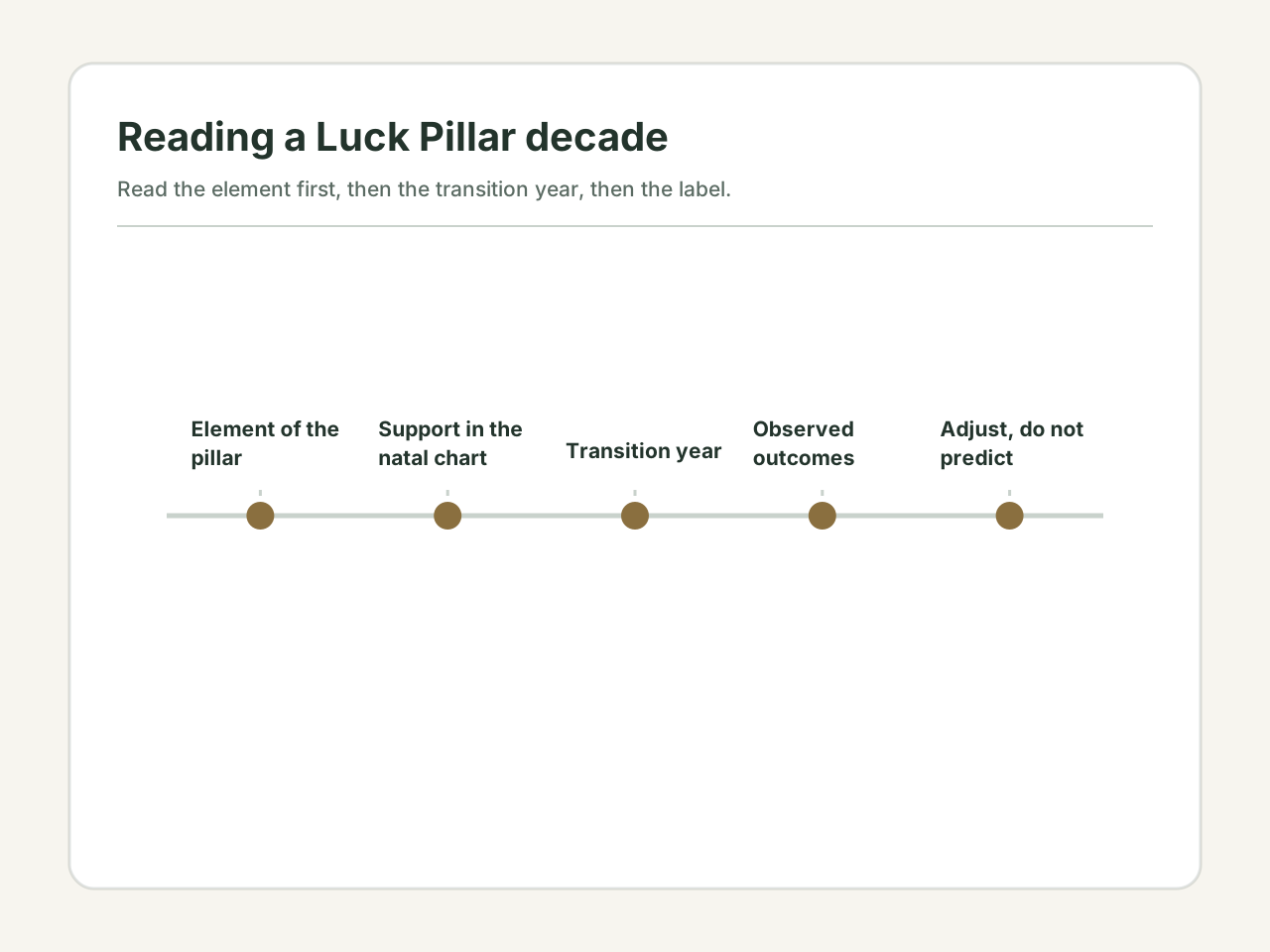
Reading a Luck Pillar: element first, label second
Here is how to use Luck Pillar analysis practically, without getting lost in the technical details:
- Look at the element, not just the label. A Luck Pillar labelled 'Seven Killings' sounds scary. But if the Seven Killings element is your favourable element, the decade may bring productive pressure — the kind that pushes you to perform at your best. A Luck Pillar labelled 'Direct Wealth' sounds great. But if the Wealth element is your unfavourable element, the decade may bring financial stress despite apparent opportunity. Look at the element, not the name.
- The transition year matters. The year when one Luck Pillar ends and another begins is often the most volatile. It is common for major life changes — career shifts, relocations, relationship changes — to occur in the transition year or the year immediately after. This is not a prediction; it is a pattern that many people report. If you are approaching a Luck Pillar transition, pay extra attention to your decisions.
- The Luck Pillar does not override the natal chart. A favourable Luck Pillar cannot turn a fundamentally imbalanced chart into a balanced one. An unfavourable Luck Pillar cannot destroy a well-structured chart. The natal chart is the foundation; the Luck Pillars are the weather. Good weather helps a strong foundation; bad weather tests it. But the foundation is what matters most.
A worked example: reading a decade of career change
A man enters a Luck Pillar at age 35. The pillar is Yang Metal (庚) over Yin Earth (丑). His Day Master is Yang Wood (甲). Metal controls Wood — this is a Seven Killings (Pressure) pillar. According to standard interpretation, a Seven Killings decade is challenging: pressure, competition, and stress dominate.
He does experience pressure: his company restructures, his role is eliminated, and he has to find a new job. But within six months, he lands a position at a better company with more responsibility and higher pay. The pressure of the Seven Killings decade forced him out of a stagnant role and into a better one. The element was 'unfavourable' in the traditional sense, but the outcome was positive.
The explanation: his chart has a strong Resource (Water) element. Water generates Wood — it supports the Day Master. The Seven Killings (Metal) pressure is being absorbed by the Resource (Water), which channels it into productive output. The pressure is real, but the chart has the structure to handle it. The Luck Pillar is not 'good' or 'bad' in isolation. It is a set of conditions that interact with the existing chart structure.
Keeping luck pillars (da yun) in BaZi in proportion
Luck Pillars are a timing tool, not a prediction machine. They describe the weather — the external conditions that are more or less prominent in each decade. But weather does not determine your actions. You can stay inside during a storm, and you can waste a sunny day. The Luck Pillar describes the conditions; your choices determine the outcome. Use Luck Pillar analysis to understand when to push forward and when to consolidate, when to take risks and when to be cautious. But do not let a ten-year label define your decade. You are the one living it.
Disclaimer: This content is for informational and cultural reference purposes only. It does not constitute professional medical, legal, financial, or psychological advice. Readers should exercise their own judgment and consult qualified professionals for specific concerns.
Sources and review basis
Traditional references explain historical vocabulary and context. Official practical sources support only the observable safety, comfort, or environmental points noted in the article; they do not validate metaphysical claims.
Traditional reference
Yuanhai Ziping (渊海子平)Wikisource digital text · Accessed 2026-07-14
A classical source for Four Pillars terminology, element relationships, and the Day Master framework.
Traditional reference
Sanming Tonghui (三命通会)Wikisource digital text · Accessed 2026-07-14
A historical compilation used to cross-check traditional BaZi concepts; it is not scientific validation.