Relationship analysis describes patterns, not destiny
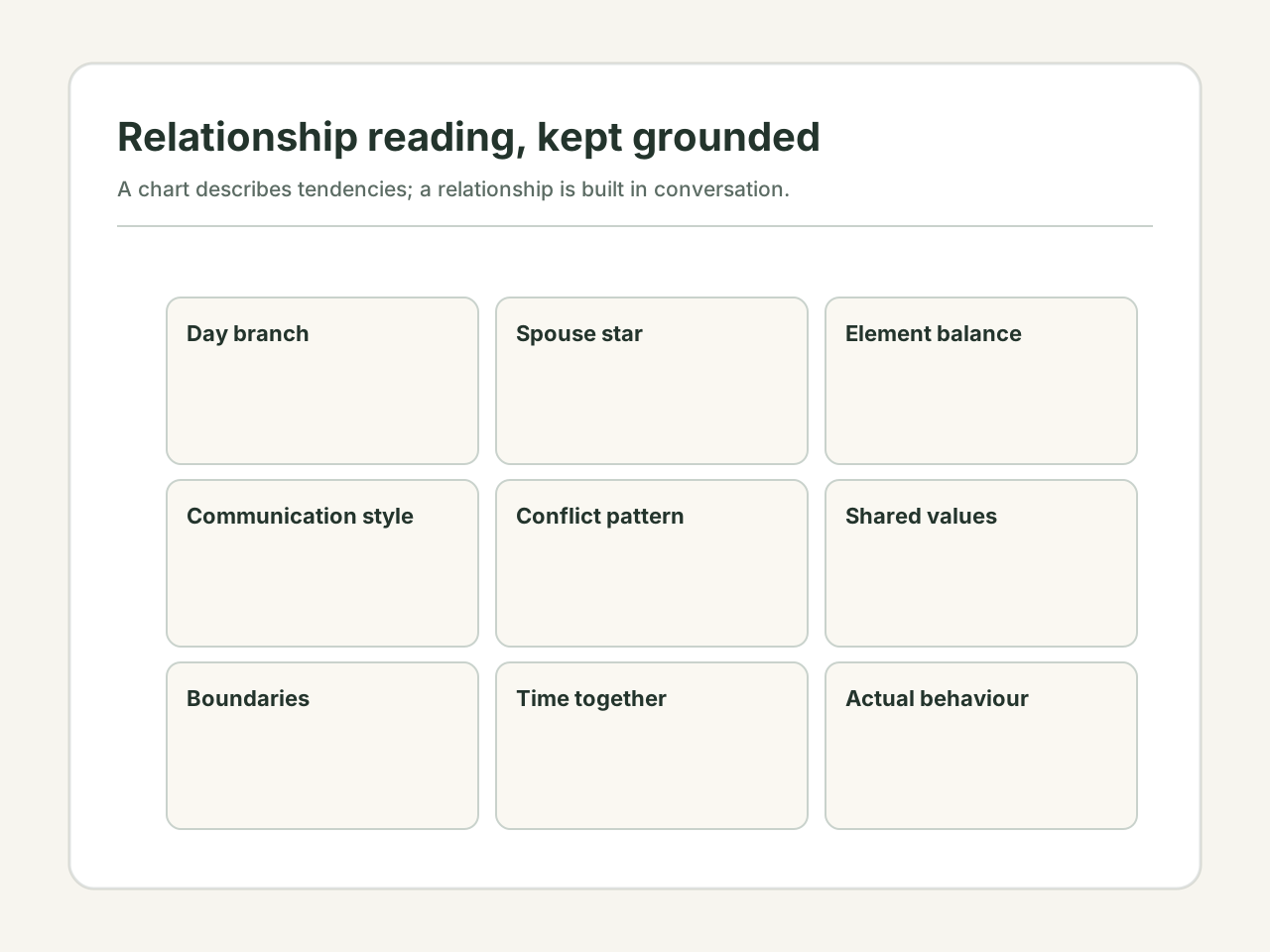
Relationships in BaZi are primarily read through the spouse palace (the Day Branch, 日支) and the spouse star (the element that represents the spouse). For a man, the spouse star is the Wealth element. For a woman, the spouse star is the Officer element. The interaction between the spouse palace, the spouse star, and the rest of the chart reveals relationship patterns.
The honest view: BaZi relationship analysis is a vocabulary for describing relationship tendencies, not a compatibility test or a marriage prediction. A chart with a 'difficult' spouse palace does not mean you are destined for relationship failure. It means you may need to work more consciously on relationship skills. A chart with a 'harmonious' spouse palace does not guarantee a perfect marriage. It means the chart structure is favourable for partnership — but partnership still requires effort.
What the spouse indicators actually mean
Here is how to interpret the relationship indicators in a BaZi chart:
| Indicator | What to check | What it means in practice |
|---|---|---|
| Spouse palace (日支) | What element is the Day Branch? Is it the same as, generated by, controlled by, or controlling the Day Master? | A Day Branch that is the same element as the Day Master suggests a partner who is a peer — equal, supportive, but possibly competitive. A Day Branch that generates the Day Master suggests a nurturing partner. A Day Branch controlled by the Day Master suggests the chart owner has more influence in the relationship |
| Spouse star | Where is the spouse star? Is it strong, weak, present, or absent? Does it have roots? | A strong spouse star with roots suggests a capable partner and a natural orientation toward partnership. A weak or absent spouse star does not mean no relationship — it means the chart has other priorities, and partnership may come later or require more conscious effort |
| Clashes and combinations | Does the Day Branch clash with other branches? Does it combine with annual or Luck Pillar branches? | A clashed spouse palace signals periods of relationship instability. A combined spouse palace signals relationship opportunities or changes. Both are temporary — they describe phases, not permanent conditions |
| Luck Pillar influence | Does the Luck Pillar bring the spouse star? Does it clash or combine with the spouse palace? | A Luck Pillar that brings the spouse star is a period when relationship themes are prominent. A Luck Pillar that clashes the spouse palace is a period of relationship adjustment — not necessarily breakup, but change |
The three relationship patterns BaZi describes
BaZi relationship analysis is about how you relate to partnership, not about who you will marry. Here are three common patterns:
- The partnership-oriented: strong spouse star + stable spouse palace. This person is naturally oriented toward partnership. They thrive in relationships and tend to attract capable partners. The risk is over-dependence — defining oneself through the relationship. The advice: maintain your own identity and career while enjoying partnership.
- The independent: weak or absent spouse star + stable or neutral spouse palace. This person's chart emphasises other life domains — career, creativity, personal growth. They may marry later, or not at all, and that is consistent with their chart structure. The advice: do not force partnership if it does not feel natural. There is no 'deadline' for marriage in BaZi.
- The dynamic: strong spouse star + frequently clashed spouse palace. This person is drawn to intense relationships that go through cycles of closeness and conflict. The chart suggests a pattern of relationship intensity that requires conscious management. The advice: the pattern is not a curse. Learn to recognise the cycle and communicate through it. The clash can be a source of growth, not destruction.
A worked example: reading a spouse palace clash
A woman's Day Branch is Yin Rooster (酉). Her spouse star is Direct Officer — Fire. She enters a Luck Pillar where the branch is Yin Rabbit (卯). The Rabbit and the Rooster clash — this is a direct clash of the spouse palace.
She reads online that 'a spouse palace clash means divorce' and becomes terrified. She starts looking for signs of trouble in her marriage, interpreting every disagreement as evidence that the prediction is coming true. Her anxiety begins to create actual problems in her marriage.
A more useful reading: the clash between Rabbit and Rooster describes a period of relationship adjustment. She and her husband disagree about a major decision — whether to relocate for her job. The clash is real: the decision creates tension. But the clash is not a verdict. It is a signal that this decade requires more communication, more negotiation, and more willingness to compromise. The clash describes the conditions; their choices determine the outcome.
They work through the decision. She takes the job, they move, and the first year is difficult. But they communicate, they adjust, and by the second year, the marriage is actually stronger. The clash was a challenge, not a death sentence. The relationship survived because they worked on it.
Where the tradition ends for BaZi relationship analysis
BaZi relationship analysis is a tool for understanding relationship patterns, not a compatibility calculator or a divorce predictor. It describes the terrain — the tendencies, the phases, the challenges. But terrain does not determine the journey. A couple with a 'perfect' compatibility chart can still fail through neglect. A couple with a 'challenging' compatibility chart can thrive through effort and communication. Use BaZi relationship analysis to understand yourself and your patterns. Do not use it to judge your partner or predict your marriage's future. Relationships are lived, not calculated.
Disclaimer: This content is for informational and cultural reference purposes only. It does not constitute professional medical, legal, financial, or psychological advice. Readers should exercise their own judgment and consult qualified professionals for specific concerns.
Sources and review basis
Traditional references explain historical vocabulary and context. Official practical sources support only the observable safety, comfort, or environmental points noted in the article; they do not validate metaphysical claims.
Traditional reference
Yuanhai Ziping (渊海子平)Wikisource digital text · Accessed 2026-07-14
A classical source for Four Pillars terminology, element relationships, and the Day Master framework.
Traditional reference
Sanming Tonghui (三命通会)Wikisource digital text · Accessed 2026-07-14
A historical compilation used to cross-check traditional BaZi concepts; it is not scientific validation.
Practical source
APA Dictionary of Psychology: Barnum effectAmerican Psychological Association · Accessed 2026-07-14
A psychology reference for why broad, favourable personality descriptions can feel personally accurate. It does not evaluate BaZi calculations themselves.