BaZi

Four Pillars BaZi Calculator

Create a reproducible Four Pillars calculation record with stems, branches, hidden stems, Ten Gods, Na Yin, branch-relation lookups, raw element counts, and explicit calendar limitations. Runs entirely in the browser.

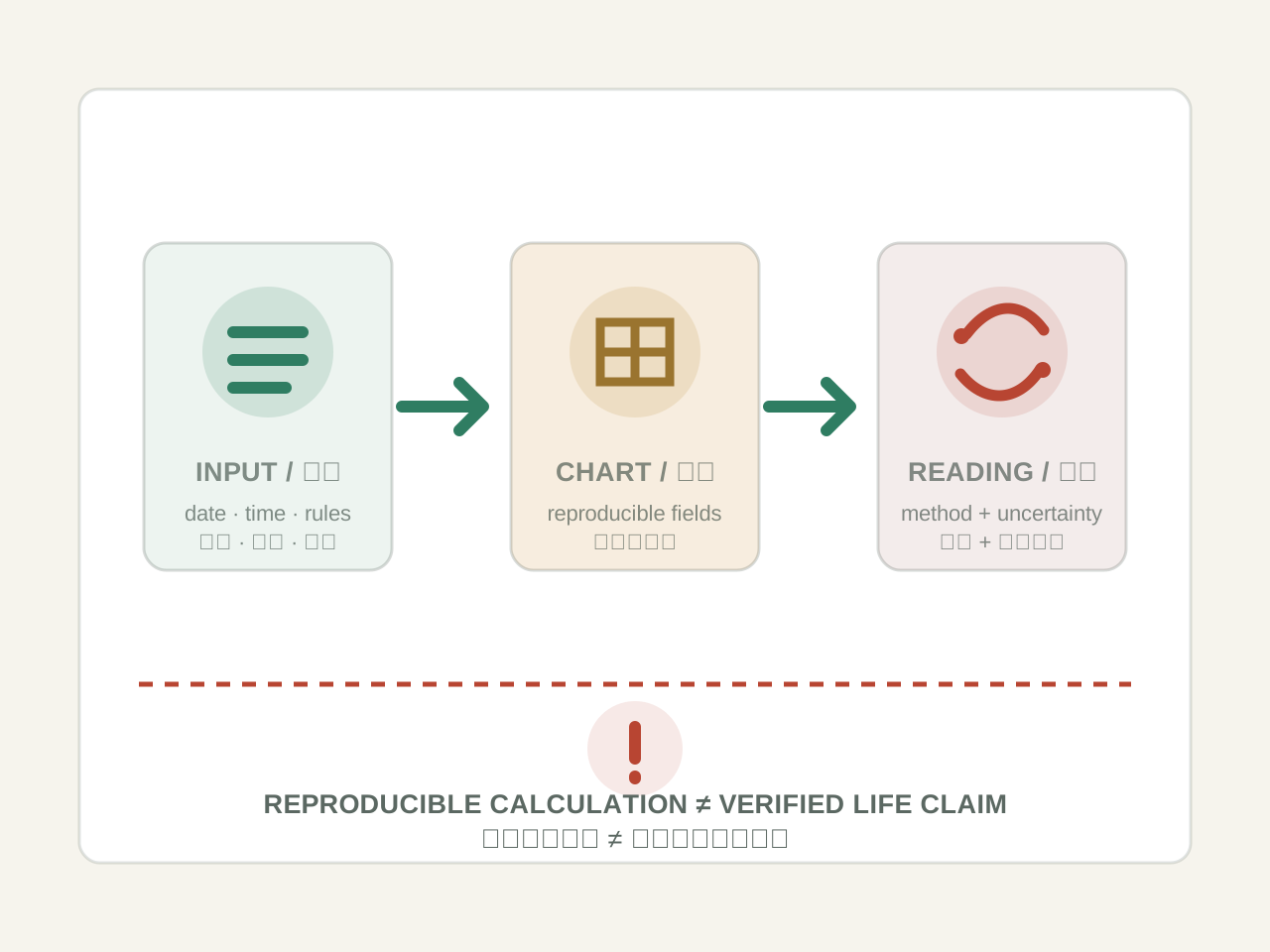
From input to output

See what the tool uses and what it returns

Check the required information and report structure before entering personal data. Missing details reduce precision instead of being silently invented.

Input example

  1. 1

    Birth date

    Calculates the year, month, and day pillars and lunar conversion.

  2. 2

    Birth time (local clock)

    Calculates the day-boundary case and hour pillar from local clock time.

Output structure

  1. 1

    Input and assumptions

    Shows Gregorian input, local clock time, solar-term month boundary, 23:00 day boundary, and unapplied time corrections.

  2. 2

    Pillar detail

    Displays pillars, stem and branch elements, Yin/Yang, hidden stems, Ten Gods, and Na Yin.

  3. 3

    Relation lookup

    Records matched Liu He, Liu Chong, Liu Hai, Liu Po, San He, San Hui, and Zi Xing table conditions.

What you need before you start

Review the exact fields, example values, validation rule, and effect of missing data before starting. Never accept an invented default for a required birth field.

Birth date

required

date required

Calculates the year, month, and day pillars and lunar conversion.

Example: 1990-06-15

Validation: Must be a valid Gregorian date no later than the current moment.

If missing: No pillar can be calculated.

Birth time (local clock)

required

time required

Calculates the day-boundary case and hour pillar from local clock time.

Example: 12:00

Validation: Must be precise to the minute; boundary cases need comparison.

If missing: A reviewable day and hour record cannot be produced.
How it works

This live tool calculates the result directly from the information shown on the page. You can use it right away without payment, and the form is not sent to an AI model.

Reproducible worked example

Worked example: a reproducible technical chart record

This fictional input uses an exact local clock time. The result applies the library solar-term month boundary and 23:00 day boundary, but no time-zone, daylight-saving, longitude, or true-solar-time correction.

Complete example input

Gregorian birth date
1990-06-15
Local clock time
12:30
Exact-minute input, mapped to 午时.

Corresponding output

Year · month · day · hour
庚午 · 壬午 · 辛亥 · 甲午
Lunar conversion
1990, month 5, day 23 · 午时
Day Master record
辛 · Yin Metal
A structural label, not a personality or ability finding.
Eight-character surface counts
Wood 1 · Fire 3 · Earth 0 · Metal 2 · Water 2
These counts exclude hidden-stem weights, season, roots, combinations, and school-specific strength rules.

How to verify it

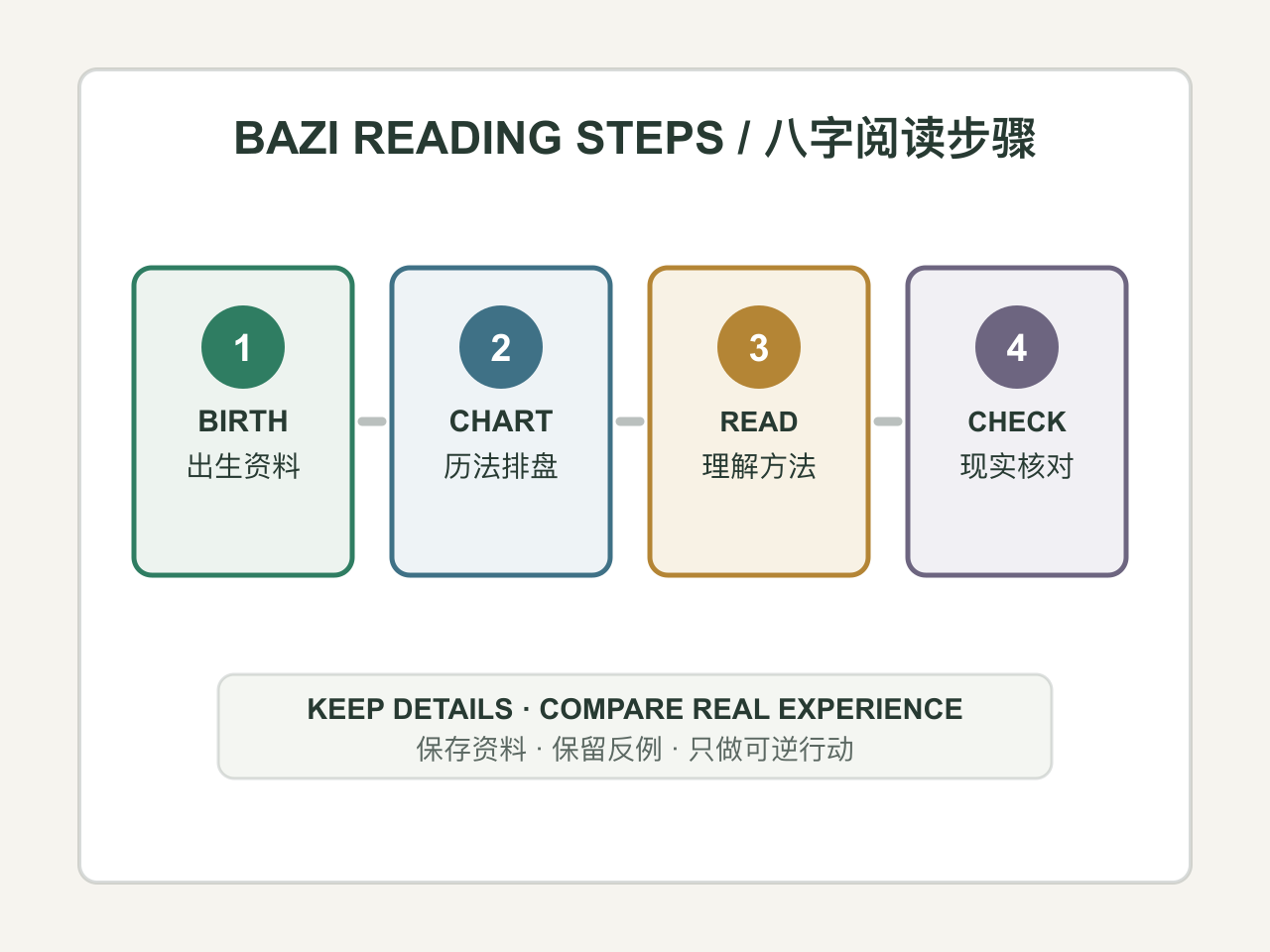
Save the input and stated boundary policy, then compare every pillar character and raw count. If the real birth record may cross 23:00, an hour boundary, or a solar term, calculate both candidate inputs and mark every changed field.

What this example cannot prove

This record does not establish strength, favourable elements, personality, health, income, career, relationship quality, or future events.

Tool specification

Professional details

Convert a Gregorian birth date and local clock time into a reproducible Four Pillars structure and keep the calendar assumptions and boundary limits with the result.

Technical Four Pillars calculation recordMedium sensitivityReview after correcting birth data or calculation policy

Use cases

Recommended

Learn the chart structure

Inspect the four pillars, stems, branches, hidden stems, and five-element distribution.

Recommended

Compare boundary policies

Record the 23:00 day change, solar-term month boundary, and time assumptions, then compare which pillars change across a boundary.

Not recommended

Infer personality or future outcomes

A chart structure cannot prove personality, ability, health, wealth, career, relationships, or future events.

Method basis

tyme4ts calendar conversion

Uses solar-term boundaries and the library’s default 23:00 day-change policy.

Four-pillar structure

Records the four stems and four branches for year, month, day, and hour.

Ten God and hidden-stem lookup

Displays traditional labels from stem relationships without deriving a real-world outcome.

Surface element counts

Counts eight visible characters only and does not treat quantity as strength, favourability, or a remedy.

Report structure

Input and assumptions

Shows Gregorian input, local clock time, solar-term month boundary, 23:00 day boundary, and unapplied time corrections.

Pillar detail

Displays pillars, stem and branch elements, Yin/Yang, hidden stems, Ten Gods, and Na Yin.

Relation lookup

Records matched Liu He, Liu Chong, Liu Hai, Liu Po, San He, San Hui, and Zi Xing table conditions.

Raw counts and limits

Shows surface element counts and explains why they cannot establish strength, personality, or outcomes.

Actions and boundaries

Save the calculation policy

Keep date, time, place, time zone, daylight-saving status, and software policy with the pillars.

Compare boundary results

Recalculate both sides of a possible boundary and mark every field that changes.

Separate real-world evidence

Keep traditional labels apart from contradictory evidence and qualified domain advice.

Time zone and true solar time

The tool does not collect birthplace or time zone and does not correct historical daylight saving, longitude, or true solar time.

Boundary uncertainty

Times near 23:00, an hour boundary, or a solar term require candidate-chart comparison.

No outcome inference

Day Master, Ten Gods, branch relations, and raw element counts are not used to infer personality, health, income, career, marriage, or future events.

This is a technical chart record

Four Pillars calculation converts a Gregorian birth date and local clock time into year, month, day, and hour stem-branch pairs. This page displays the input, conversion, and declared rules so the same input can be recalculated.

A reproducible chart proves only which traditional fields the software produced. It does not prove that a Day Master, Ten God, branch relation, or element count measures personality, ability, health, wealth, career, relationships, or future events.

Fields included in the output

Intermediate fields remain visible so a user can locate a date, time, or policy difference instead of accepting an unexplained summary.

  • Gregorian input, lunar conversion, year-branch zodiac label, and assigned double-hour branch.
  • The four pillars with each visible stem and branch element, yin-yang class, and Na Yin lookup.
  • Surface Ten Gods relative to the Day Stem, hidden stems, and hidden-stem Ten Gods.
  • Matched Six Harmony, Six Clash, Six Harm, Six Break, Three Harmony, Three Meeting, and self-punishment lookup conditions.
  • Visible counts for the four stems and four branches, without converting count into strength or a remedy.

Calendar and clock policy

Input is a Gregorian date and local clock time to the minute. Year and month pillars use tyme4ts solar-term boundaries; the library's default changes the day pillar at 23:00, and the hour pillar follows twelve double-hour ranges.

The page does not collect birthplace or time zone, so it cannot correct historical daylight saving, longitude, or true solar time. Near 23:00, an odd-hour branch boundary, or a solar term, preserve candidate charts on both sides and mark every changing field.

How to read the visible element count

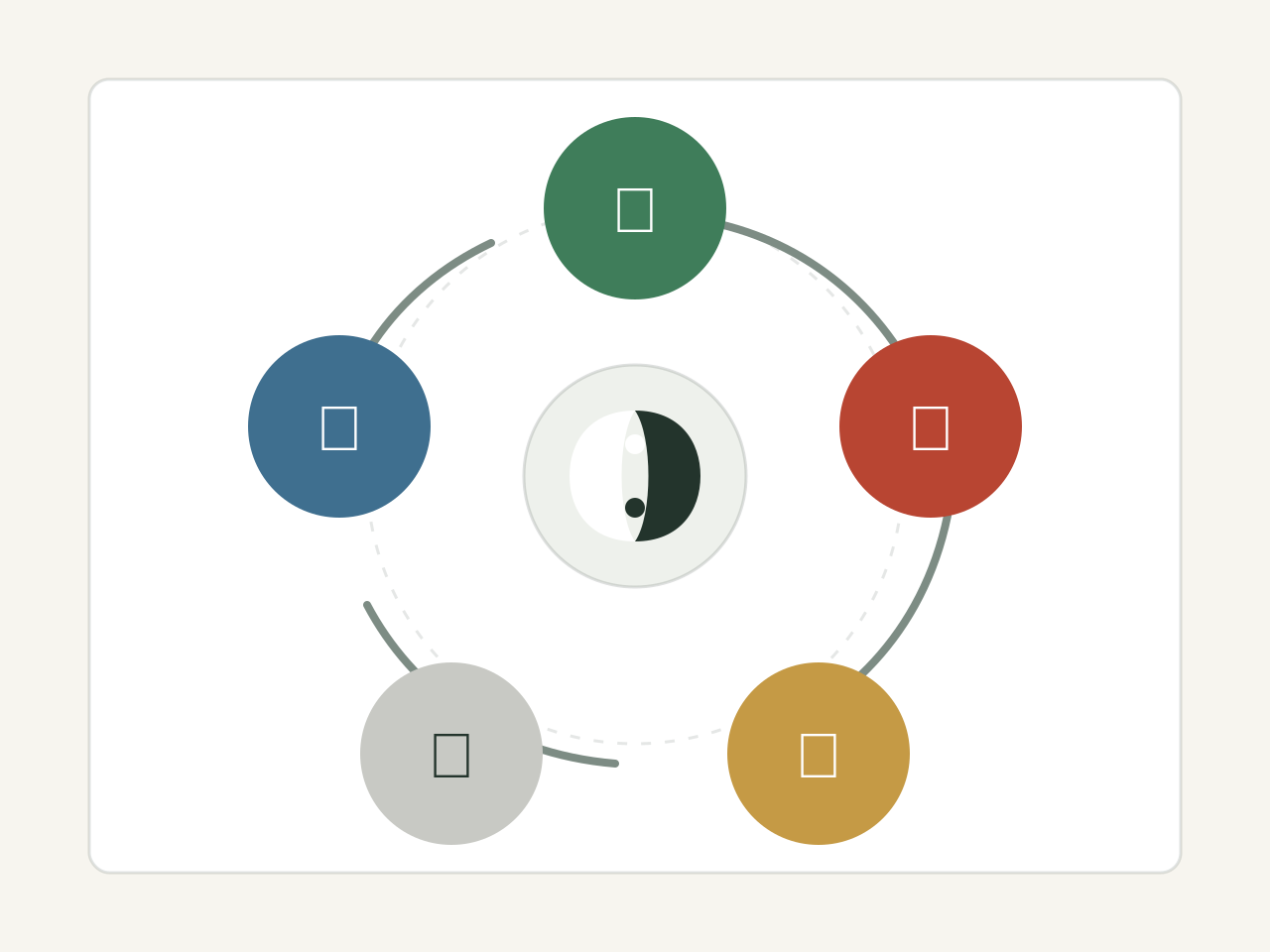
The page maps only the eight visible stem and branch characters to Wood, Fire, Earth, Metal, and Water. It does not add hidden-stem weights, season, roots, combinations, transformation, climate adjustment, or any school's strength method. The largest count is not automatically strongest, and zero does not prove a real-life deficiency.

Do not use the count to prescribe a colour, direction, occupation, food, accessory, or household object, and do not infer health, personality, income, or partner suitability. A report that adds strength, useful-element, or remedy claims must disclose the additional method and disagreement.

Verification and stop conditions

Keep the Gregorian date, local clock time, birthplace, historical time zone, daylight-saving status, software version, and day-boundary rule with the result. When data is uncertain, compare only fields that remain stable across the plausible range; never choose the chart that sounds more flattering.

Stop using the chart whenever a medical, investment, employment, legal, relationship, or safety decision depends on one field. Use facts, records, consent, and qualified advice from the relevant domain instead. Reproducibility is calculation consistency, not validation of a traditional interpretation.

What is the difference between this and the BaZi marriage tool?

This page records one chart's calendar conversion and structural fields. The marriage tool compares two charts with disclosed site-specific heuristic indexes. Neither page proves a relationship outcome, and the reviewed site does not send birth data to an external AI or require a paid report.

Why does my chart look different from another website?

This page uses Gregorian input, tyme4ts solar-term month boundaries, and a 23:00 day change. It does not correct time zone, historical daylight saving, longitude, or true solar time. Another tool can differ when it uses another day-change school or applies location corrections, especially near a solar-term or double-hour boundary.

Does the largest or zero element count identify strength or a favourable element?

No. The count covers only the four visible stems and four visible branches. It omits hidden-stem weighting, season, roots, combinations, transformations, and school rules. The page therefore does not label strength, calculate a favourable element, or recommend colours, directions, industries, food, or objects.

Which calendar assumptions must a Four Pillars tool disclose?

It should state whether the entered date is Gregorian or lunar, the time zone, daylight-saving treatment, solar-term month boundary, day-change convention, and true-solar-time policy. It should preserve the converted date, four pillars, hidden stems, and any uncertainty around the hour. If a birth time or location is missing, the report must reduce time-dependent detail instead of filling a confident default. These assumptions are part of the result and should remain visible whenever the chart is saved or shared.

Keep reading

Related articles

Try next

Related tools