Bed placement: direction matters, but comfort matters more
In Eight Mansions feng shui, bed placement has two components: the direction your head points while sleeping, and the position of the bed within the room. The direction is determined by your Ming Gua number: you want your head to point toward one of your four auspicious directions. The position within the room is determined by practical rules that apply regardless of your Gua number: the bed should have a solid headboard, a view of the door from the bed, and should not be directly in line with the door.
The tension in Eight Mansions bed placement is between directional theory and practical comfort. A bed that points in the correct direction but is placed under a window, in a draft, or in a position that feels exposed will not give you good sleep. The correct direction with bad placement is worse than a neutral direction with good placement.
The three rules for bed direction
Your Ming Gua number determines which four directions are auspicious. Each direction is suited to a different priority. Here is how to choose:
| Priority | Best direction | Why | When to choose this |
|---|---|---|---|
| Health and recovery | Tian Yi (天医) | Supports physical healing and deep rest | You have health concerns, you feel tired often, or you want to prioritise sleep quality above all else |
| Relationships | Yan Nian (延年) | Supports harmony in personal relationships | You share the bed with a partner and want to support the relationship, or you want to strengthen family bonds |
| Success and vitality | Sheng Qi (生气) | The strongest positive direction, supports energy and motivation | You wake up feeling sluggish and want more morning energy, or you want to start the day with maximum drive |
| Calm and stability | Fu Wei (伏位) | The mildest direction, supports peace and grounding | You are sensitive to stimulation and want the calmest possible sleep environment, or you cannot use the other three directions due to room layout |
Beyond direction: the position rules that always apply
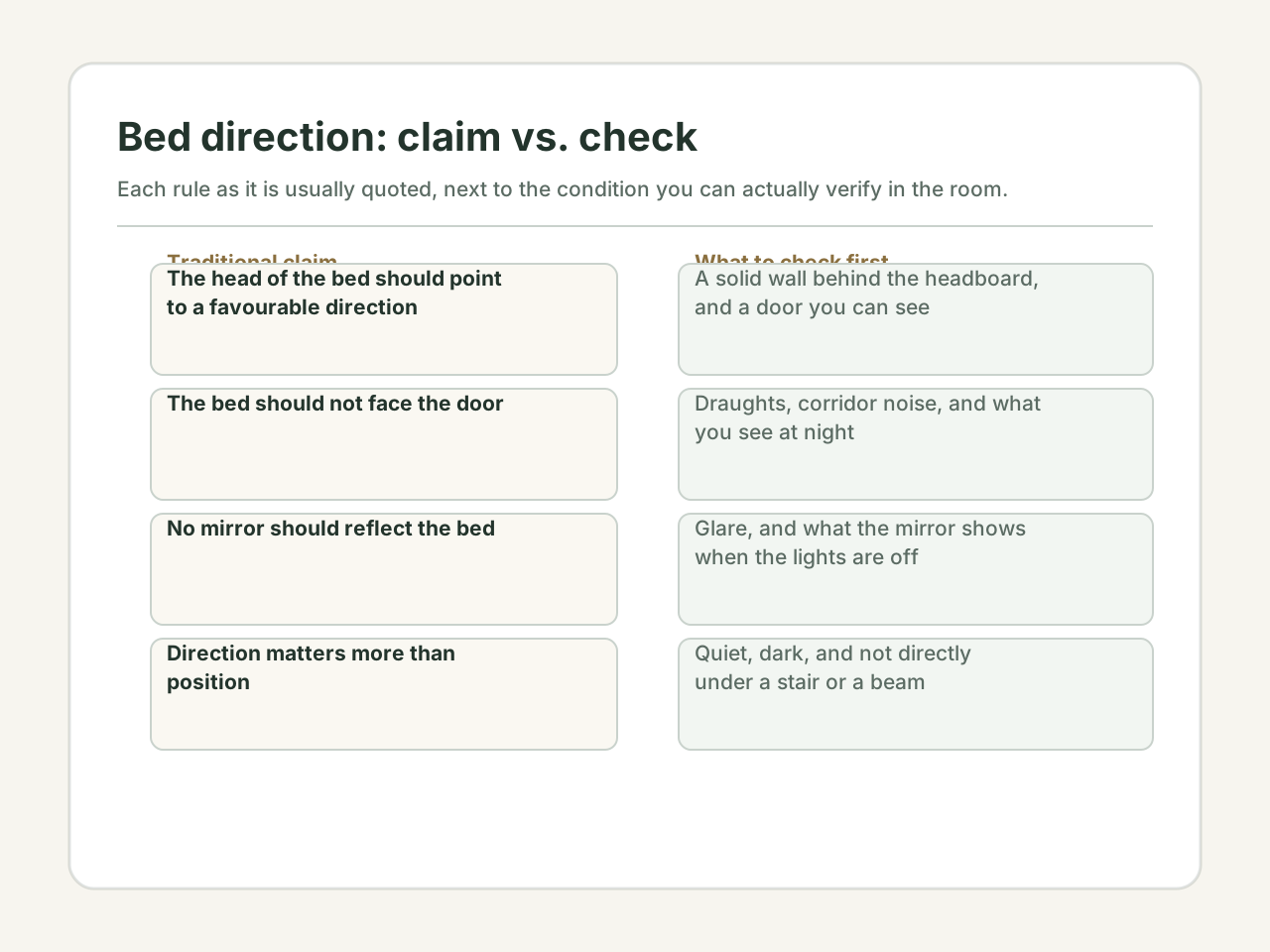
Direction is only one part of good bed placement. These position rules matter regardless of your Gua number and should be satisfied before you worry about direction:
- The bed needs a solid headboard against a solid wall. A bed without a headboard, or with a headboard against a window, feels unstable. The headboard provides a sense of protection and enclosure. This is more important than the direction your head points.
- You should be able to see the door from the bed, but the bed should not be directly in line with the door. The 'command position' — diagonally opposite the door, with a clear view of anyone entering — is the most secure position for a bed. If your room layout makes this impossible, a mirror positioned to reflect the door from the bed is a common workaround, but nothing beats the actual line of sight.
- Avoid placing the bed under a window. Windows are sources of light, noise, and temperature fluctuation. A bed under a window disrupts sleep quality regardless of direction. If you must place the bed under a window, use heavy blackout curtains and ensure the window is well-sealed.
- Keep the area under the bed clear. In Eight Mansions theory, energy (qi) should flow freely around the bed. A bed with storage boxes underneath blocks this flow. If you need under-bed storage, use it for soft items (bedding, clothes) and keep it organised, not crammed full.
A worked example: a couple with different Gua numbers
A couple shares a bedroom. The husband has Gua 1 (Kan, East Group), the wife has Gua 8 (Gen, West Group). Their auspicious directions are different, which is common. The husband's Tian Yi (health) is East. The wife's Tian Yi is Southwest. They cannot both point their heads toward their own Tian Yi in the same bed.
The room layout: the door is on the North wall. The only solid wall without a window is the East wall. The South wall has a large window. The West wall has a closet.
The decision process: first, the position rules. The bed goes against the East wall (the only solid, windowless wall), which naturally points the head West. That is not the husband's Tian Yi (East) or the wife's Tian Yi (Southwest). But West is a neutral direction for both — not one of their four unfavourable directions. The couple checks: West is in the husband's unfavourable directions? No. West is in the wife's unfavourable directions? No. Good — it is neutral for both.
They prioritise the position rules over the direction rules. The result: solid headboard against a solid wall, clear view of the door from the bed, no window above the bed, and a neutral direction rather than either person's ideal. Both sleep well. The couple's compromise is not a failure of Eight Mansions — it is the correct application of Eight Mansions, which is a tool for optimisation within real constraints.
The real limit of bed placement by eight mansions feng shui
Eight Mansions bed placement is a practical system with simple rules. It gives you a reason to think about where you put your bed, which most people never do. But the rules are guidelines, not laws. If your bed must be under a window, make the window as quiet and dark as possible. If your bed must face an unfavourable direction, focus on making the rest of the room as comfortable as possible. Good sleep comes from a comfortable mattress, a dark room, a cool temperature, and a quiet environment. Directional feng shui can add a small increment of benefit on top of those fundamentals. It cannot replace them.
Disclaimer: This content is for informational and cultural reference purposes only. It does not constitute professional medical, legal, financial, or psychological advice. Readers should exercise their own judgment and consult qualified professionals for specific concerns.
Sources and review basis
Traditional references explain historical vocabulary and context. Official practical sources support only the observable safety, comfort, or environmental points noted in the article; they do not validate metaphysical claims.
Traditional reference
Huangdi Zhaijing (黄帝宅经)Wikisource digital text · Accessed 2026-07-14
Historical context for traditional residential orientation and spatial vocabulary. Modern recommendations are reviewed separately.
Practical source
US NIH/NHLBI: Healthy Sleep HabitsNational Heart, Lung, and Blood Institute, NIH · Accessed 2026-07-14
Health background for sleep routines and bedroom conditions; it does not endorse directional feng shui claims.