The Chinese calendar is a practical timekeeping system, not a mystical object
The Chinese calendar is a lunisolar system — it tracks both the moon's phases and the sun's position. This is different from the Gregorian calendar, which is purely solar. The Chinese calendar reconciles lunar months (about 29.5 days each) with the solar year (about 365.25 days) by adding an extra month — a leap month — approximately every three years. This is similar to how the Gregorian calendar adds a leap day every four years.
The calendar also incorporates the sexagenary cycle, a 60-year cycle made by combining the ten heavenly stems (天干) and twelve earthly branches (地支). Each year, month, day, and hour can be expressed as a stem-branch pair. This is the foundation of BaZi, date selection, and other Chinese metaphysical systems.
The honest view: the Chinese calendar is a sophisticated pre-modern timekeeping system. It is not magical. It is a calendar. The stem-branch designations are labels in a cycle, not fate-determining forces. The calendar is useful for understanding traditional timing systems, but it does not control your life.
How the calendar actually works
Here is a breakdown of the calendar's components:
| Component | What it is | How it works | Why it matters |
|---|---|---|---|
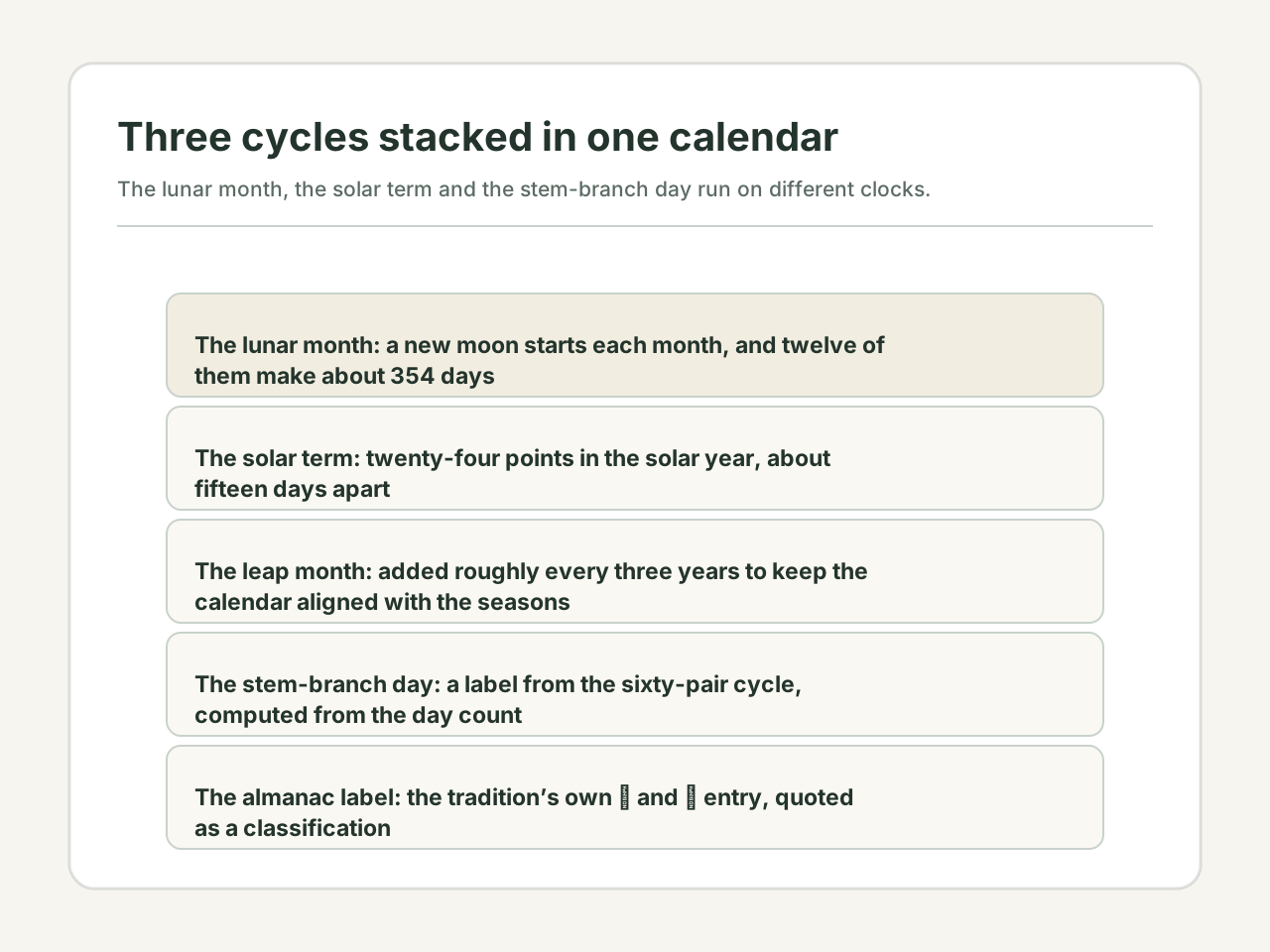
| Lunar months | Months based on the moon's cycle, approximately 29.5 days each | A new moon marks the start of each month. The year has 12 lunar months, totalling about 354 days | Chinese New Year falls on the second new moon after the winter solstice. This is why it moves between late January and mid-February |
| Solar terms (节气) | 24 points in the solar year, each about 15 days apart | The solar terms mark the sun's position. They are used to determine farming seasons, weather patterns, and the start of each month in the stem-branch system | The solar terms are purely solar and are more constant than lunar months. The month of the Rat (子) always begins at the winter solstice, regardless of the lunar calendar |
| Leap months (闰月) | An extra month added to align lunar and solar years | A leap month is added about every 3 years (7 times in 19 years). It is a duplicate of the preceding month | Without leap months, Chinese New Year would drift through the seasons over time. The leap month keeps the calendar aligned with the seasons |
| Sexagenary cycle (干支) | A 60-unit cycle of stem-branch pairs | Ten heavenly stems pair with twelve earthly branches. The cycle runs: 甲子, 乙丑, 丙寅... through 60 combinations, then repeats | The stem-branch system is used in BaZi, date selection, and feng shui. Each year has a stem-branch pair, and so does each month, day, and hour |
The stem-branch system in plain terms
The ten heavenly stems and twelve earthly branches are labels, not magical forces. Here is what they represent:
- The ten heavenly stems (天干): 甲 (Jia), 乙 (Yi), 丙 (Bing), 丁 (Ding), 戊 (Wu), 己 (Ji), 庚 (Geng), 辛 (Xin), 壬 (Ren), 癸 (Gui). Each stem is associated with one of the five elements and either yin or yang. The stems cycle through the five elements twice: Wood (甲 yang, 乙 yin), Fire (丙 yang, 丁 yin), Earth (戊 yang, 己 yin), Metal (庚 yang, 辛 yin), Water (壬 yang, 癸 yin).
- The twelve earthly branches (地支): 子 (Zi), 丑 (Chou), 寅 (Yin), 卯 (Mao), 辰 (Chen), 巳 (Si), 午 (Wu), 未 (Wei), 申 (Shen), 酉 (You), 戌 (Xu), 亥 (Hai). Each branch is associated with an animal of the Chinese zodiac, a direction, a season, and a two-hour period of the day. The branches are primarily used to mark time.
- The 60-year cycle combines stems and branches. Each year has a unique stem-branch pair. 2026 is 丙午 (Bing Wu — Fire Horse). The cycle is practical: it gives each year a distinct label that is useful for historical record-keeping and for the timing calculations in traditional Chinese systems.
A worked example: reading a date in the Chinese calendar
Suppose you want to find the Chinese calendar date for June 7, 2026. The year is 丙午 (Bing Wu, Fire Horse). The month is the fifth lunar month because it falls after the summer solstice solar term. The stem-branch for the month depends on the year's stem — a formula determines the month's stem. The day is the 12th of the fifth lunar month. The hour (if you were born at 10:00 AM) is the Si (巳) hour.
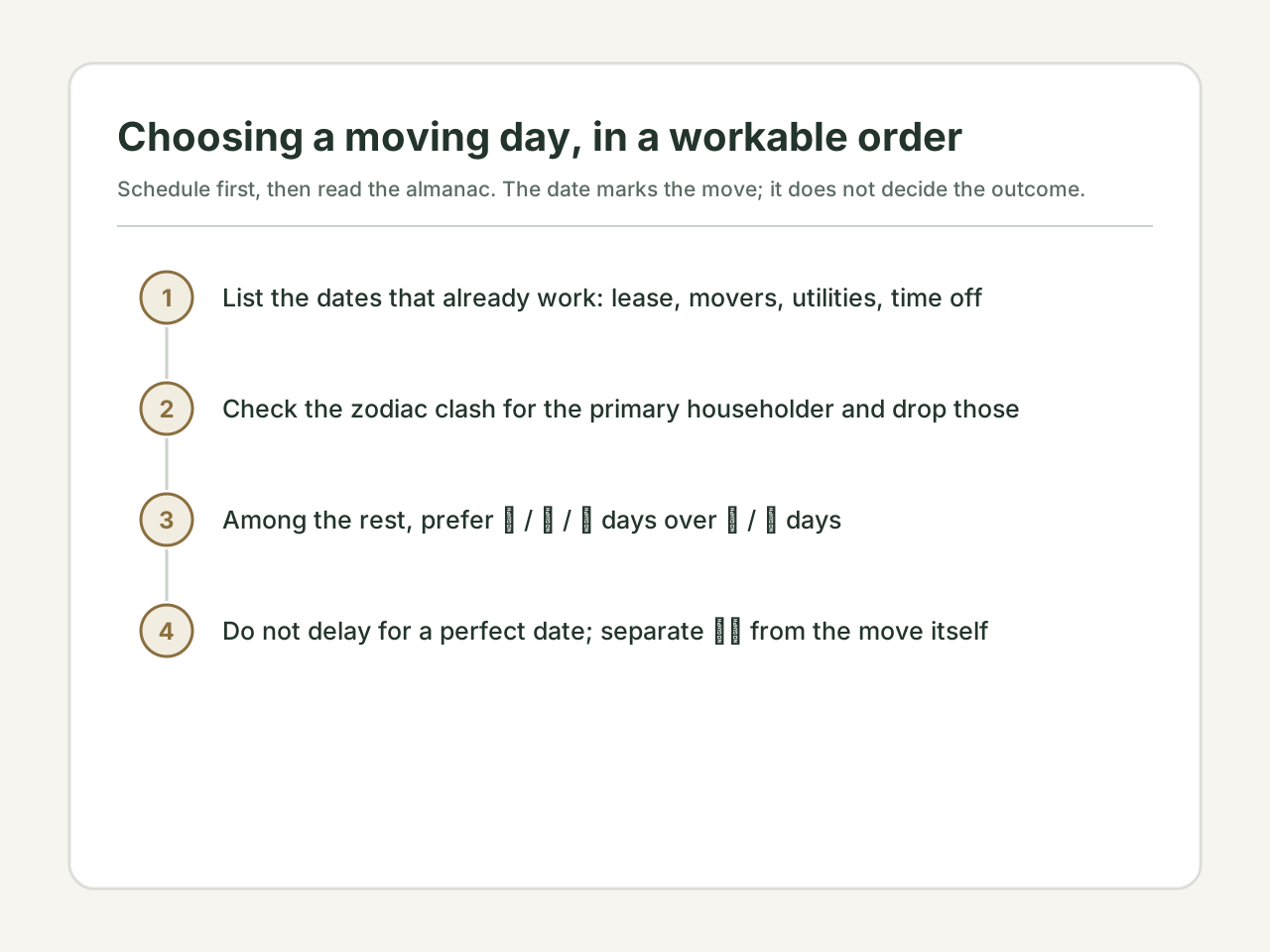
For date selection purposes, you would check whether the stem-branch of the day (the day's stem and branch) is compatible with the person's BaZi chart. A day that clashes with the person's year branch is generally avoided. A day that supports the person's favourable element is preferred. This is the practical application of the calendar in date selection.
The point: the calendar is a tool for organising time. The stem-branch designations are labels that allow you to check compatibility between a person's chart and a proposed date. The labels are not magical. They are a classification system, similar to how we use days of the week to plan activities.
The real limit of chinese calendar basics
The Chinese calendar is a sophisticated lunisolar timekeeping system that has been used for thousands of years. It is not a magical system that controls events. The stem-branch designations are labels in a cycle, not fate-determining symbols. The calendar is useful for understanding traditional timing systems and for date selection. But it is just a calendar — a way of organising time. Your life is not determined by the stem-branch pair of the year you were born.
Disclaimer: This content is for informational and cultural reference purposes only. It does not constitute professional medical, legal, financial, or psychological advice. Readers should exercise their own judgment and consult qualified professionals for specific concerns.
Sources and review basis
Traditional references explain historical vocabulary and context. Official practical sources support only the observable safety, comfort, or environmental points noted in the article; they do not validate metaphysical claims.
Traditional reference
Seasonal Customs of Jing-Chu (荆楚歲時記)Wikisource digital text · Accessed 2026-10-14
A sixth-century record of regional seasonal customs. Cited for the earliest written description of the ninth-day outing and the use of 茱萸; it is a historical text, not evidence for any effect of the date.
Practical source
IANA Time Zone Database (tzdata)Internet Assigned Numbers Authority · Accessed 2026-10-16
The reference dataset for historical UTC offsets and daylight-saving transitions. Its Asia/Shanghai rules are the source for the 1986–1991 China summer-time dates used in this article.