Day Master strength is about context, not just the stem
The Day Master (日主) is the stem of the day pillar — the element that represents 'you' in the BaZi chart. Assessing its strength is the first and most important step in chart analysis. A strong Day Master can handle output, wealth, and power. A weak Day Master needs support from resources and peers. Get the strength assessment wrong, and the entire reading is wrong.
The honest view: Day Master strength is not a measure of your personal strength or weakness as a human being. It is a technical term describing whether the Day Master element is well-supported in the chart. A 'weak' Day Master does not mean you are a weak person. It means the chart structure suggests you thrive with support rather than going it alone. A 'strong' Day Master does not mean you are invincible. It means you can handle more pressure and responsibility without the chart becoming unbalanced.
How to assess Day Master strength
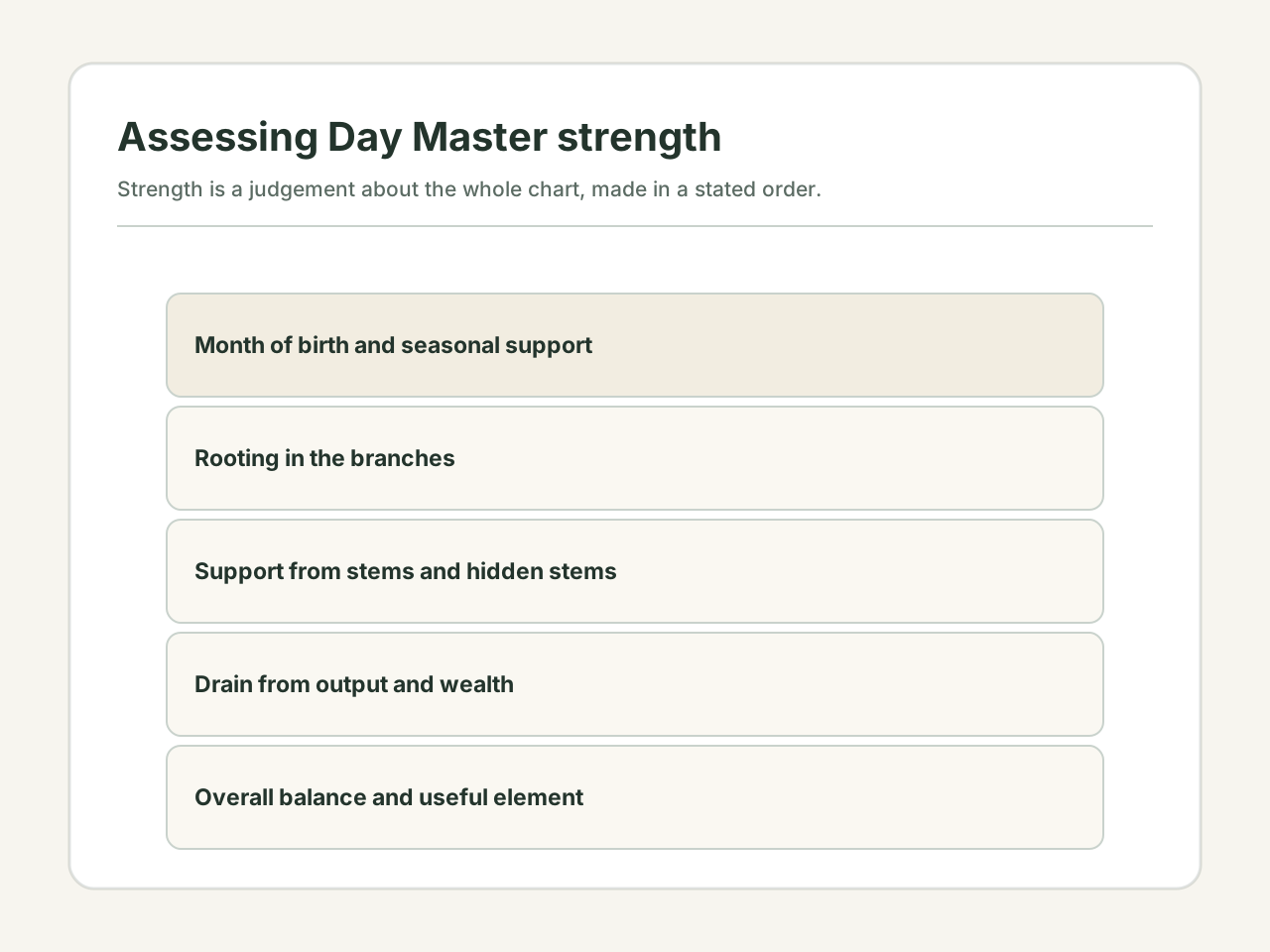
Here are the three factors that determine Day Master strength, in order of importance:
| Factor | What to check | How it affects strength |
|---|---|---|
| Season of birth (月令) | Which element dominates the month of birth? Is the Day Master in its prosperous season? | This is the most important factor. A Wood Day Master born in spring (Wood season) is strong. A Wood Day Master born in autumn (Metal season, which controls Wood) is weak. The month pillar carries about 40% of the strength assessment |
| Stem support (天干) | Are there other stems in the chart that are the same element as the Day Master or generate it? | Same-element stems (Friends/Rob Wealth) directly support the Day Master. Generating stems (Resources) indirectly support it. Having two or more supporting stems is significant; having none is a clear sign of weakness |
| Branch roots (地支藏干) | Do the branches contain hidden stems that support the Day Master? | Branches store hidden stems. A Day Master with roots in the branches — especially the month, day, and hour branches — has a foundation. A Day Master with no roots is like a tree with no roots in the soil: it is vulnerable |
The practical implications of strength
Once you have determined whether the Day Master is strong or weak, the entire reading strategy changes:
- Strong Day Master: can handle Wealth, Output, and Power elements. The favourable elements are those that the Day Master controls (Wealth), generates (Output), or is controlled by (Power). A strong Day Master benefits from challenge, responsibility, and productive output. The risk is excess: too much of any one element can still create imbalance.
- Weak Day Master: needs Resource and Peer elements. The favourable elements are those that generate the Day Master (Resource) or are the same element (Peer). A weak Day Master benefits from support, learning, collaboration, and rest. The risk is depletion: taking on too much without adequate support leads to burnout.
- Extreme cases: a Day Master that is extremely strong or extremely weak may follow a special pattern. An extremely strong Day Master with no controlling elements may be a 'Follow the Leader' chart. An extremely weak Day Master with no supporting elements may be a 'Follow the Element' chart. These special patterns require a different reading strategy.
A worked example: two people with the same Day Master, different strengths
Two women both have a Yang Water (壬) Day Master. The first was born in November (Water season, strong). She has another Water stem in her hour pillar and a Metal stem (Resource) in her year pillar. Her Day Master is strong. She thrives in a high-pressure career: she is a surgeon, and the constant demand and responsibility suit her chart structure. She can handle the Pressure (Seven Killings/正官) because her Day Master is strong enough to bear it.
The second woman was born in June (Fire season, which controls Water). She has no other Water stems in her chart and no Metal (Resource) to support her. Her Day Master is weak. She works in a quiet administrative role and prefers it. She tried a high-pressure management job once and burned out within a year. Her chart simply does not have the structural support to handle constant pressure.
The lesson: the Day Master stem alone tells you almost nothing. Two people with the same Day Master can have completely different chart structures and completely different life strategies. The strength assessment — based on season, stems, and roots — is what makes the chart readable.
What day master strength assessment in BaZi can and cannot do
Day Master strength is a technical concept in BaZi analysis, not a judgment of your character. A 'weak' chart is not a bad chart — it simply describes a structure that benefits from support, collaboration, and self-care. A 'strong' chart is not automatically good — it describes a structure that benefits from challenge, output, and responsibility. The strength assessment is a tool for understanding what environments and strategies are likely to work for you. It is not a fixed label, and it can shift across Luck Pillars. Most importantly, it is a description of tendencies, not a prediction of outcomes.
Disclaimer: This content is for informational and cultural reference purposes only. It does not constitute professional medical, legal, financial, or psychological advice. Readers should exercise their own judgment and consult qualified professionals for specific concerns.
Sources and review basis
Traditional references explain historical vocabulary and context. Official practical sources support only the observable safety, comfort, or environmental points noted in the article; they do not validate metaphysical claims.
Traditional reference
Yuanhai Ziping (渊海子平)Wikisource digital text · Accessed 2026-07-14
A classical source for Four Pillars terminology, element relationships, and the Day Master framework.
Traditional reference
Sanming Tonghui (三命通会)Wikisource digital text · Accessed 2026-07-14
A historical compilation used to cross-check traditional BaZi concepts; it is not scientific validation.