Favourable and unfavourable are about balance, not good and evil
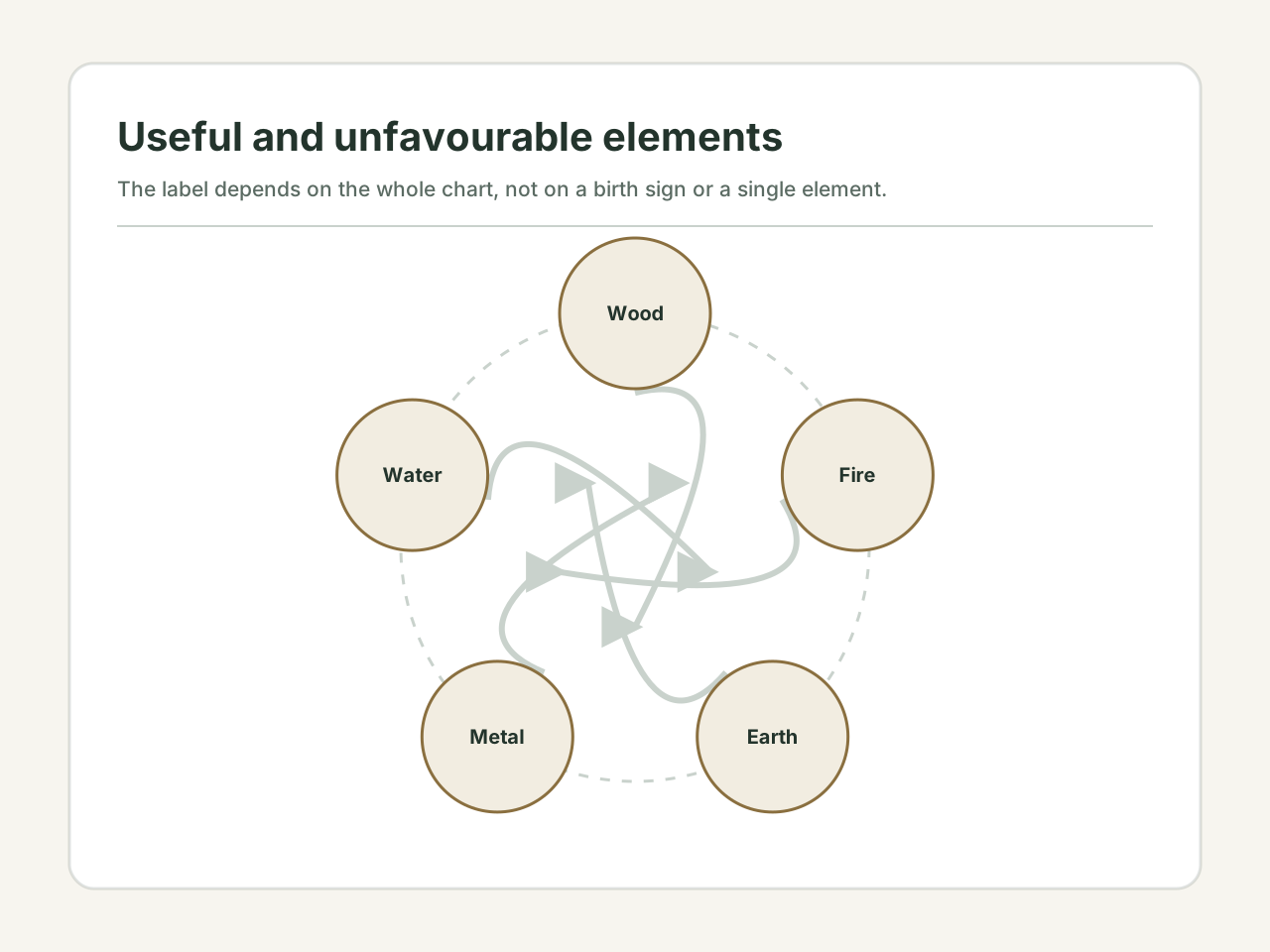
In BaZi, 'favourable' (喜神) and 'unfavourable' (忌神) elements are determined by what the chart needs to achieve balance. A favourable element is one that restores balance; an unfavourable element is one that worsens imbalance. The terms sound like moral judgments, but they are not. An element that is unfavourable in one chart may be the most favourable in another.
The honest view: the favourable/unfavourable framework is a tool for making practical decisions. If your chart is too cold (excess Water/Metal in winter), Fire is your favourable element — and spending time in warm environments, doing active things, and surrounding yourself with warm colours may genuinely help you feel better. This is not magic. It is pattern recognition dressed in traditional language.
How to determine favourable and unfavourable elements
Here is the step-by-step process for identifying which elements help and which harm a chart:
| Step | What to check | Example: a weak Wood Day Master in autumn |
|---|---|---|
| 1. Assess Day Master strength | Season, stems, roots. Is the Day Master strong or weak? | Wood Day Master born in autumn (Metal season). Weak — Wood is being controlled by the season |
| 2. Identify the dominant element | Which element is most abundant in the chart? | The chart has a lot of Metal (the controlling element) and Earth (which generates Metal). The dominant element is Metal |
| 3. Determine favourable elements | What would restore balance? For a weak Day Master: Resource and Peer. For a strong Day Master: Wealth, Output, Power | A weak Wood Day Master needs Water (Resource, to nourish the Wood) and Wood (Peer, to strengthen itself). Water and Wood are favourable |
| 4. Determine unfavourable elements | What would worsen the imbalance? Elements that strengthen the already-dominant element or further weaken the Day Master | Metal (which controls Wood) and Earth (which generates Metal, strengthening the controlling force) are unfavourable. Fire is also unfavourable — it generates Earth, which feeds Metal |
How to use favourable elements in daily life
Once you know your favourable elements, here is how to apply them practically:
- Career choices: each element is associated with certain industries. Water favours communication, media, transport, and consulting. Wood favours education, healthcare, publishing, and environmental work. Fire favours entertainment, technology, energy, and hospitality. Earth favours real estate, construction, agriculture, and administration. Metal favours finance, law, engineering, and manufacturing. These are suggestive tendencies, not rigid rules.
- Environment and colour: surround yourself with your favourable element's colours and materials. Water favours blue, black, and glass. Wood favours green and plants. Fire favours red and warm lighting. Earth favours yellow, brown, and ceramics. Metal favours white, grey, and metal objects. The effect is psychological — if these associations make you feel more comfortable, use them. If not, ignore them.
- Timing: each element is associated with a season. Water is winter, Wood is spring, Fire is summer, Metal is autumn, Earth is the transitions between seasons. If your favourable element is Fire, you may feel more energised in summer and should plan major initiatives for that period. This is about knowing your natural rhythms, not about astrological determinism.
A worked example: when the 'wrong' element is actually helpful
A man has a strong Fire Day Master born in summer. His chart is hot and dry — lots of Fire and Wood, very little Water. The standard analysis says Water is his favourable element (to cool the excess Fire) and Fire is unfavourable (it adds to the excess).
He enters a Luck Pillar dominated by Fire. According to the standard analysis, this should be a difficult decade — his unfavourable element is being amplified. But he reports that this decade has been his most successful: he started a business, built a team, and expanded into new markets.
The explanation: his chart is a 'Follow the Leader' pattern — the Fire is so strong that it cannot be controlled, and the chart follows the dominant element instead. In a Follow the Leader chart, the dominant element becomes favourable because resisting it is futile. The standard favourable/unfavourable analysis was wrong for his specific chart structure.
The lesson: favourable/unfavourable analysis is a starting point, not a final answer. Special chart patterns, Luck Pillar interactions, and the actual life experience of the person all need to be considered. The chart is a map, and the map needs to match the territory.
Where favorable and unfavorable elements in BaZi advice stops
The favourable/unfavourable element framework is a useful tool for making lifestyle decisions — what colours to wear, what environments to seek, what times of year to plan major moves. But it is a suggestive framework, not a deterministic one. An unfavourable element in your Luck Pillar does not mean the decade is doomed. A favourable element is not a promise of success. The elements describe tendencies, and tendencies can be worked with, compensated for, and sometimes overridden. Use the framework as a compass, not as a cage.
Disclaimer: This content is for informational and cultural reference purposes only. It does not constitute professional medical, legal, financial, or psychological advice. Readers should exercise their own judgment and consult qualified professionals for specific concerns.
Sources and review basis
Traditional references explain historical vocabulary and context. Official practical sources support only the observable safety, comfort, or environmental points noted in the article; they do not validate metaphysical claims.
Traditional reference
Yuanhai Ziping (渊海子平)Wikisource digital text · Accessed 2026-07-14
A classical source for Four Pillars terminology, element relationships, and the Day Master framework.
Traditional reference
Sanming Tonghui (三命通会)Wikisource digital text · Accessed 2026-07-14
A historical compilation used to cross-check traditional BaZi concepts; it is not scientific validation.