A Flying Star chart is a map, not a verdict
Xuan Kong Flying Star (玄空飞星) is the most mathematically sophisticated system in feng shui. It plots nine 'stars' — numbered 1 through 9, each with a specific energy quality — onto the eight compass sectors and the centre of a building. The chart changes based on the building's facing direction and the 20-year period it was built in. The result is a snapshot of how energy is distributed across the space at a given time.
But here is what the internet does not tell you: a Flying Star chart is a map, not a verdict. It tells you where energy is concentrated, where it is weak, and where combinations of stars create specific effects. It does not tell you that you will get rich in the Southeast or sick in the Northwest. The stars describe tendencies, and the actual outcome depends on how the space is used, who lives there, and what the physical environment looks like. A good star combination in a neglected storage room does nothing. A challenging combination in a room nobody uses is irrelevant.
The three pieces of information you need before you start
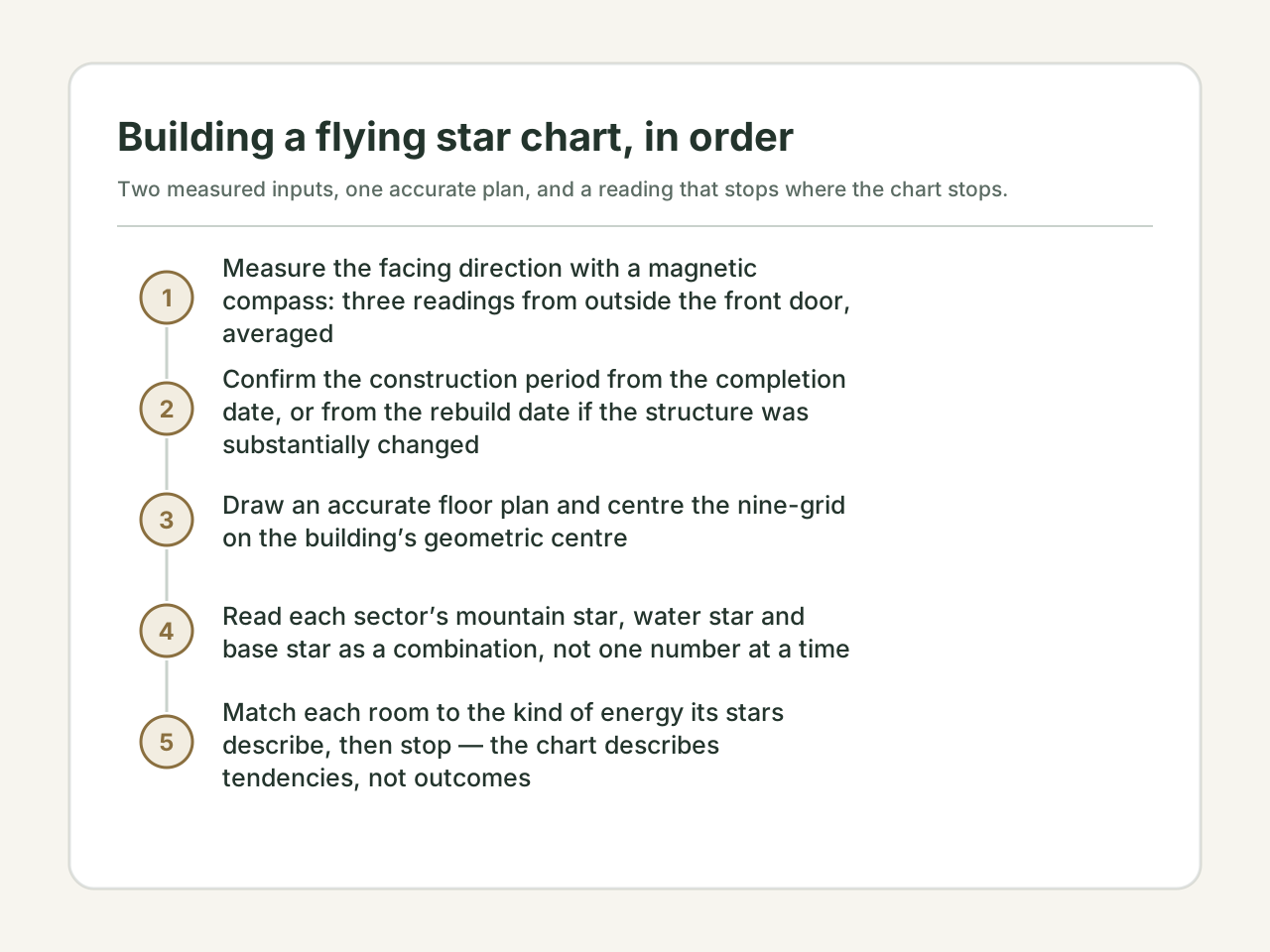
You cannot build a Flying Star chart without three precise inputs. Guessing any of them makes the chart meaningless:
| Input | What it is | How to get it | Why precision matters |
|---|---|---|---|
| Facing direction (坐向) | The compass direction the building faces, measured from the centre of the rear wall looking out the front | A proper compass (not a phone app), measured standing outside the front door, facing away from the building. Take three readings and average them. | A 5-degree error can put you in the wrong 15-degree sector, which changes all the star numbers in the chart |
| Construction period (运) | The 20-year period during which the building was completed. Period 9 started in 2024. | For buildings built 2004-2023: Period 8. 1984-2003: Period 7. 1964-1983: Period 6. If the building was substantially renovated (roof replaced, walls moved), use the renovation date. | The period determines the base star in the centre of the chart, which affects every sector |
| Floor plan | An accurate scale drawing of the building, showing walls, doors, and windows | Measure the building yourself or use an architect's plan. You need to be able to overlay the nine-grid template accurately. | The nine-grid must be centred on the building's geometric centre. A misaligned grid puts stars in the wrong rooms |
How to read a basic chart: the three numbers in each sector
Once you have plotted the chart, each of the nine sectors contains three numbers. These are the mountain star (山星, left), the water star (水星, right), and the base or period star (运星, centre). Here is what each represents:
- Mountain star (山星): governs people, health, and relationships. Think of this as the 'people energy' in the sector. A strong mountain star in a bedroom supports rest and recovery. A weak or negative mountain star in a bedroom suggests the room may not be ideal for sleeping.
- Water star (水星): governs wealth, opportunity, and activity. Think of this as the 'action energy'. A strong water star in a living room or office supports productive activity. The tradition says water stars are activated by movement and water features — the practical version is that a room with a good water star benefits from being used actively.
- Base star (运星): the underlying energy of the period. This is the foundation that the mountain and water stars sit on. It is less important than the combination of mountain and water stars, but a base star of 5 (the 'sickness' star) or 2 (the 'illness' star) in a frequently used room deserves attention.
A worked example: Period 8 home facing South (172.5°-187.5°)
This is one of the most common scenarios in cities built between 2004 and 2023. A south-facing Period 8 home produces a chart where the mountain star 8 (the most auspicious star of Period 8) lands in the centre, and the water star 8 lands in the South. The mountain star 8 in the centre means the home has strong 'people energy' at its core — good for family stability. The water star 8 in the South means the front sector has strong 'activity energy' — good for a living room or active entrance.
But the combination that catches people's attention is the Northwest sector, which in this chart gets mountain star 9 and water star 5. The water star 5 is the 'misfortune' star, and a water star 5 in the Northwest — the sector traditionally associated with the father or male head of the household — makes people panic. The honest reading: the combination 9-5 is tense. 9 is fire, 5 is earth. Fire produces earth in the five-element cycle, so the 5 is fed and strengthened. This is a sector where you should avoid spending too much time, especially if you can choose another room for the master bedroom.
The practical response, if the Northwest is your only option for a bedroom: do not panic. Add metal elements (white, grey, metallic finishes, a metal wind chime with six rods) because metal drains earth in the five-element cycle — it weakens the 5 star. Keep the room clutter-free and well-ventilated. And remember: the 5 star in the Northwest is one of nine sectors. If the rest of the chart is balanced, the effect is diluted.
When Flying Star is worth the effort, and when it is not
Flying Star analysis is the most detailed feng shui system, but it is also the most demanding. It requires accurate measurements, careful plotting, and nuanced interpretation. Here is an honest assessment of when it is worth the effort:
- Worth it: if you are buying a home and want to understand the energy blueprint before committing. A Flying Star audit can reveal sectors that are fundamentally challenging for the activities you plan to put there. It is a form of due diligence, like a structural survey.
- Worth it: if you have lived in a home for a while and certain rooms consistently feel 'off' or certain family members have persistent issues that seem connected to the rooms they occupy. The chart can give you a vocabulary for understanding why.
- Not worth it: if you are renting and cannot make structural changes, or if you are looking for a magic solution to a specific problem. Flying Star is a diagnostic tool, not a quick fix. It works best when you can act on what it tells you.
- Not worth it: if you are not willing to invest in an accurate compass reading and a precise floor plan. A chart built on approximations is worse than no chart at all — it gives you false confidence in wrong information.
Keeping flying star chart basics in proportion
Flying Star is the most intellectually satisfying system in feng shui. It is structured, mathematical, and internally consistent. But it is also a 9th-century framework applied to 21st-century buildings, and not everything translates cleanly. The stars describe tendencies in a space, not destinies. A home with a perfect Flying Star chart can still be miserable if it is badly designed, poorly maintained, or filled with unhappy people. A home with a challenging chart can still be a wonderful place to live if the people in it care for it and each other. Use the chart as a diagnostic tool and a conversation starter, not as a verdict on your life.
Disclaimer: This content is for informational and cultural reference purposes only. It does not constitute professional medical, legal, financial, or psychological advice. Readers should exercise their own judgment and consult qualified professionals for specific concerns.
Sources and review basis
Traditional references explain historical vocabulary and context. Official practical sources support only the observable safety, comfort, or environmental points noted in the article; they do not validate metaphysical claims.
Traditional reference
Huangdi Zhaijing (黄帝宅经)Wikisource digital text · Accessed 2026-07-14
Historical context for traditional residential orientation and spatial vocabulary. Modern recommendations are reviewed separately.
Practical source
APA Dictionary of Psychology: Barnum effectAmerican Psychological Association · Accessed 2026-07-14
A psychology reference for why broad, favourable personality descriptions can feel personally accurate. It does not evaluate BaZi calculations themselves.