The four directions: different types of 'good'
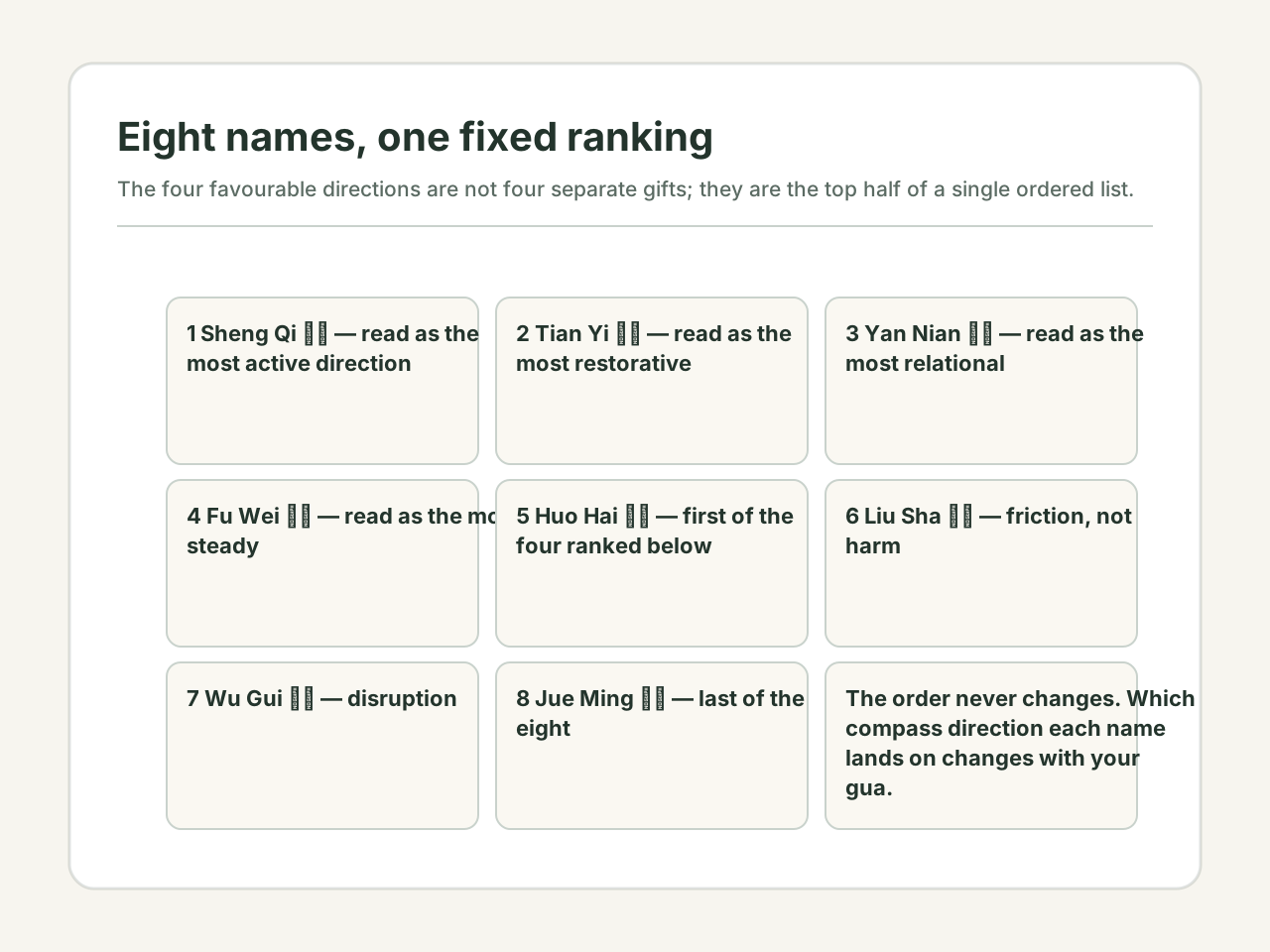
In Eight Mansions feng shui, your Ming Gua number gives you four favourable directions. They are not just 'good' in a generic sense — each one supports a different area of life. The four directions are Sheng Qi (生气, Success), Tian Yi (天医, Health), Yan Nian (延年, Relationships), and Fu Wei (伏位, Stability).
The practical question is not 'which direction is best?' but 'which direction is best for what I need right now?' A student preparing for exams might prioritise Sheng Qi for focused work. Someone recovering from illness might prioritise Tian Yi. A couple wanting to strengthen their relationship might prioritise Yan Nian. The directions are tools, and you choose the tool that matches your current task.
Sheng Qi (生气): the success direction
Sheng Qi translates to 'generating breath' or 'life force'. It is the strongest positive direction in Eight Mansions and is associated with vitality, career success, wealth, and overall prosperity. It is the direction of upward momentum.
- Best for: facing your desk while working, the direction your main door opens toward, the direction you face when eating, and the direction you face for important tasks that require focus and energy.
- How to use it: orient your desk so you face Sheng Qi while working. If your home office is in a sector where facing Sheng Qi means facing a wall, consider a different room configuration. The direction you face matters more than the room you are in.
- What to expect: a room or desk facing Sheng Qi tends to feel more energising. People report feeling more motivated and productive when working in this direction. The effect is subtle and cumulative — you will not notice it in a single day, but over weeks you may find yourself getting more done with less resistance.
Tian Yi (天医): the health direction
Tian Yi translates to 'heavenly doctor'. It is associated with physical health, recovery, and general wellbeing. It is the direction of healing and restoration.
- Best for: the direction your bed faces while sleeping, the direction you face when resting or meditating, and the direction used in a room where someone is recovering from illness or injury.
- How to use it: orient your bed so that the crown of your head points toward Tian Yi while you sleep. This is the most common recommendation in Eight Mansions for bed placement. If Tian Yi direction faces a window with street noise, you face a trade-off between directional theory and practical comfort. In that case, prioritise a quiet, dark sleeping environment over the direction.
- What to expect: sleeping with your head toward Tian Yi is said to support deeper rest and faster recovery. Again, the effect is subtle. If you have chronic sleep issues, a good mattress and consistent sleep schedule will do more for you than any directional adjustment.
Yan Nian (延年): the relationship direction
Yan Nian translates to 'prolonged years'. It is associated with harmonious relationships, marriage, family unity, and longevity. It is the direction of connection and stability in personal bonds.
- Best for: the direction the bed faces for couples, the direction you face when having important conversations with family, and the direction of the main seating area in the living room.
- How to use it: for couples, orient the bed so both partners face Yan Nian while sleeping. This is the direction recommended for relationship harmony. For single people, Yan Nian is said to support the quality of existing relationships (family, friends) rather than attracting new romantic partners.
- What to expect: Yan Nian is the gentlest of the four auspicious directions. Its effect is more about maintaining what already exists than creating something new. People who use Yan Nian for their bed or living room often describe the space as feeling 'warm' and 'settled' rather than exciting.
Fu Wei (伏位): the stability direction
Fu Wei translates to 'prostrate position' or 'hidden location'. It is the mildest of the four auspicious directions and is associated with calm, stability, and inner peace. It is the direction of grounding and centring.
- Best for: the direction you face when meditating, reading, or doing quiet, reflective work. It is also suitable for the direction of a child's bed or study area, as it supports calmness and focus.
- How to use it: Fu Wei is not as strong as the other three directions, but it is the most forgiving. If you cannot use Sheng Qi, Tian Yi, or Yan Nian for a particular activity, Fu Wei is a safe fallback. It will not produce dramatic results, but it will not create problems either.
- What to expect: facing Fu Wei tends to make a space feel calm and uneventful. It is a good direction for activities that benefit from stillness. Do not expect career breakthroughs or romantic sparks from Fu Wei — that is not its role.
A worked example: choosing which direction to prioritise
A woman in her 30s lives alone in a small apartment. Her Ming Gua is 4 (Xun, East Group). Her four auspicious directions are: Sheng Qi — North, Tian Yi — South, Yan Nian — East, Fu Wei — Southeast.
She has one bedroom with a window on the South wall. If she places her bed with the headboard against the South wall, she faces North (Sheng Qi, success). If she places it against the North wall, she faces South (Tian Yi, health). She cannot face East (Yan Nian) or Southeast (Fu Wei) without placing the bed in an awkward position in the room.
She works from home at a desk in the living room. Her desk can face any direction. She is currently single and values her career. Her decision: she orients her bed to face South (Tian Yi, health) because she has been dealing with fatigue and wants to prioritise restorative sleep. She orients her desk to face North (Sheng Qi, success) because she wants to maximise her work productivity.
She does not use Yan Nian (East) or Fu Wei (Southeast) for any specific purpose. She does not need relationship energy right now, and Fu Wei is too mild to prioritise over the other two. The result: she feels more rested in the morning and more focused during work. The layout is not perfect — she would prefer to face Sheng Qi for both sleep and work — but she made a conscious trade-off based on her current needs, which is the right way to use the four auspicious directions.
Where the tradition ends for four auspicious directions in eight mansions
The four auspicious directions are a useful framework for thinking about how you orient your body in space. They give you a reason to be intentional about where you place your bed, desk, and seating. But the directions are one variable among many. A room that is dark, noisy, or cluttered will not feel good no matter which direction you face. A bed that faces your health direction but is uncomfortable will not give you good sleep. Use the four directions as a tiebreaker when you have multiple good layout options, not as a rigid rule that overrides comfort, light, noise, and the practical constraints of your home.
Disclaimer: This content is for informational and cultural reference purposes only. It does not constitute professional medical, legal, financial, or psychological advice. Readers should exercise their own judgment and consult qualified professionals for specific concerns.
Sources and review basis
Traditional references explain historical vocabulary and context. Official practical sources support only the observable safety, comfort, or environmental points noted in the article; they do not validate metaphysical claims.
Traditional reference
Huangdi Zhaijing (黄帝宅经)Wikisource digital text · Accessed 2026-07-14
Historical context for traditional residential orientation and spatial vocabulary. Modern recommendations are reviewed separately.
Practical source
APA Dictionary of Psychology: Barnum effectAmerican Psychological Association · Accessed 2026-07-14
A psychology reference for why broad, favourable personality descriptions can feel personally accurate. It does not evaluate BaZi calculations themselves.