Ming Gua is a compass, not a personality test
Ming Gua (命卦) is the personal trigram number calculated from your birth year and gender. It is the foundation of Eight Mansions (八宅) feng shui: the system tells you, based on your Gua number, which compass directions are favourable for sleeping, working, and facing, and which are best avoided. The system is simple, mechanical, and has been in use for centuries.
But Ming Gua has a narrow purpose. It is a directional tool — it tells you which way to face, not who you are. It is not a personality test, a compatibility score, or a prediction of your fate. If your Gua number says you should face East to sleep, that is a spatial suggestion, not a cosmic decree. The goal is to help you orient your body in a way that, according to the Eight Mansions theory, supports your energy. Nothing more.
How to calculate your Ming Gua
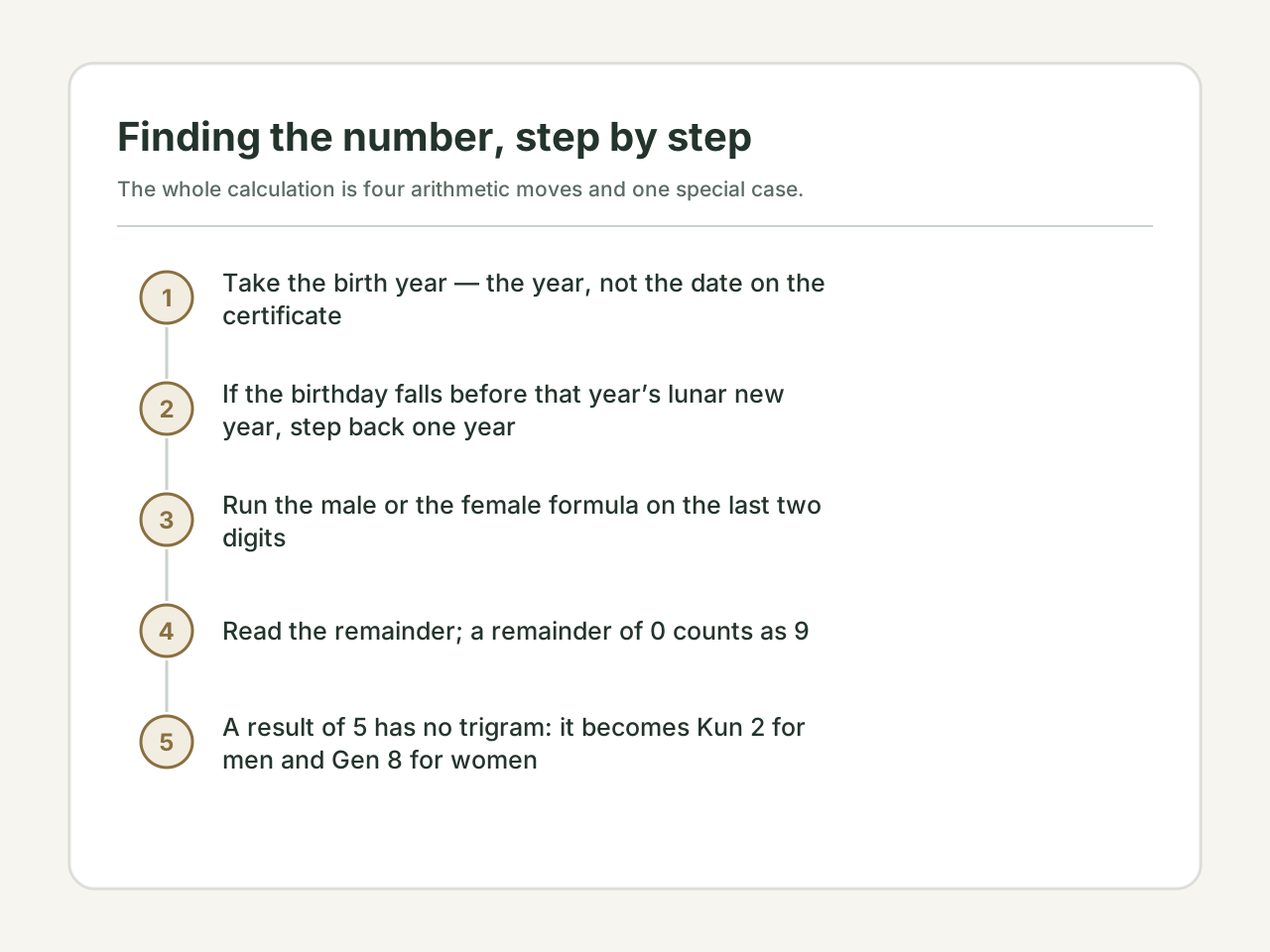
The calculation uses your birth year in the Chinese lunar calendar. The formula differs for males and females. Here is the step-by-step process:
- If you were born between 1 January and Chinese New Year of your birth year, use the previous year. For example, someone born on 15 January 1985 (before Chinese New Year of 1985) should use 1984 as their birth year.
- The result of 5 is handled differently for males and females because 5 has no trigram association in the Ba Gua. Males with 5 default to 2 (Kun 坤, Southwest), females with 5 default to 8 (Gen 艮, Northeast).
| Step | Male | Female | Example: Male born 1985 | Example: Female born 1990 |
|---|---|---|---|---|
| 1. Sum the digits of your birth year | 1+9+8+5 = 23 | 1+9+9+0 = 19 | 23 | 19 |
| 2. Reduce to a single digit | 2+3 = 5 | 1+9 = 10, 1+0 = 1 | 5 | 1 |
| 3. Apply the formula | Subtract from 11: 11-5 = 6 | Add 4: 1+4 = 5 | 6 | 5 |
| 4. Handle 5 (if result is 5) | Male: 5 becomes 2 (Kun) | Female: 5 becomes 8 (Gen) | 6 | 5 → 8 |
| Final Gua number | 6 (Qian 乾) | 8 (Gen 艮) | 6 (Qian) | 8 (Gen) |
What your number means: East Group vs West Group
The nine Gua numbers are divided into two groups: East Group (East, Southeast, South, North) and West Group (West, Northwest, Southwest, Northeast). Your Gua number determines which group you belong to and which four directions are favourable:
| Gua | Trigram | Element | Group | Favourable directions (best first) | Unfavourable directions |
|---|---|---|---|---|---|
| 1 | Kan 坎 (Water) | Water | East | Southeast, East, South, North | West, Northeast, Northwest, Southwest |
| 2 | Kun 坤 (Earth) | Earth | West | Northeast, West, Northwest, Southwest | North, Southeast, South, East |
| 3 | Zhen 震 (Thunder) | Wood | East | South, North, Southeast, East | Southwest, Northwest, Northeast, West |
| 4 | Xun 巽 (Wind) | Wood | East | North, South, East, Southeast | Northeast, Southwest, West, Northwest |
| 6 | Qian 乾 (Heaven) | Metal | West | West, Northeast, Southwest, Northwest | Southeast, East, North, South |
| 7 | Dui 兑 (Lake) | Metal | West | Northwest, Southwest, Northeast, West | East, South, Southeast, North |
| 8 | Gen 艮 (Mountain) | Earth | West | Southwest, Northwest, West, Northeast | Southeast, North, East, South |
| 9 | Li 離 (Fire) | Fire | East | East, Southeast, North, South | Northwest, West, Southwest, Northeast |
A worked example: same house, different Gua numbers
A couple shares a home. The husband, born in 1982, has a Gua of 1 (Kan, East Group). The wife, born in 1985, has a Gua of 8 (Gen, West Group). They are in different groups, which means their favourable directions are different and sometimes opposite.
The husband's best direction is Southeast (Sheng Qi, 生气). The wife's best direction is Southwest (also Sheng Qi for her). Their bedroom happens to be in the Southwest sector of the house. This is excellent for the wife — her bed faces her best direction. But the husband's best direction is Southeast, which is the kitchen in this house.
The practical compromise: the husband cannot sleep in the kitchen. Instead, he adjusts his home office desk to face Southeast, his best direction, while he works. When he sleeps, he faces Southwest, which is his wife's best direction but is still a neutral direction for him (not one of his four unfavourable directions). The wife's desk faces Southwest, her best direction. Both are satisfied with the arrangement.
The lesson: two people with different Gua numbers in the same house will rarely have perfect directional alignment. The goal is to make the best of what is available. Prioritise the bed direction for the person who is more sensitive to sleep quality. Prioritise the desk direction for the person who works from home. A Gua number is a tool for optimisation, not a reason for conflict.
What ming gua calculation does and does not change
Ming Gua is a simple, mechanical system that has been used for centuries. It gives you a clear, deterministic answer: face this direction, avoid that direction. That clarity is appealing, but it is also its limitation. The system reduces a person to their birth year and gender, ignoring everything else about their body, preferences, and circumstances. Use Ming Gua as a starting point for orienting your furniture, but do not let it override your own experience. If your Gua says to face North but facing North gives you a stiff neck, turn the chair. Your body knows more about what feels right than a formula based on your birth year.
Disclaimer: This content is for informational and cultural reference purposes only. It does not constitute professional medical, legal, financial, or psychological advice. Readers should exercise their own judgment and consult qualified professionals for specific concerns.
Sources and review basis
Traditional references explain historical vocabulary and context. Official practical sources support only the observable safety, comfort, or environmental points noted in the article; they do not validate metaphysical claims.
Traditional reference
Huangdi Zhaijing (黄帝宅经)Wikisource digital text · Accessed 2026-07-14
Historical context for traditional residential orientation and spatial vocabulary. Modern recommendations are reviewed separately.
Practical source
APA Dictionary of Psychology: Barnum effectAmerican Psychological Association · Accessed 2026-07-14
A psychology reference for why broad, favourable personality descriptions can feel personally accurate. It does not evaluate BaZi calculations themselves.