Mountain and water stars: the two halves of every sector
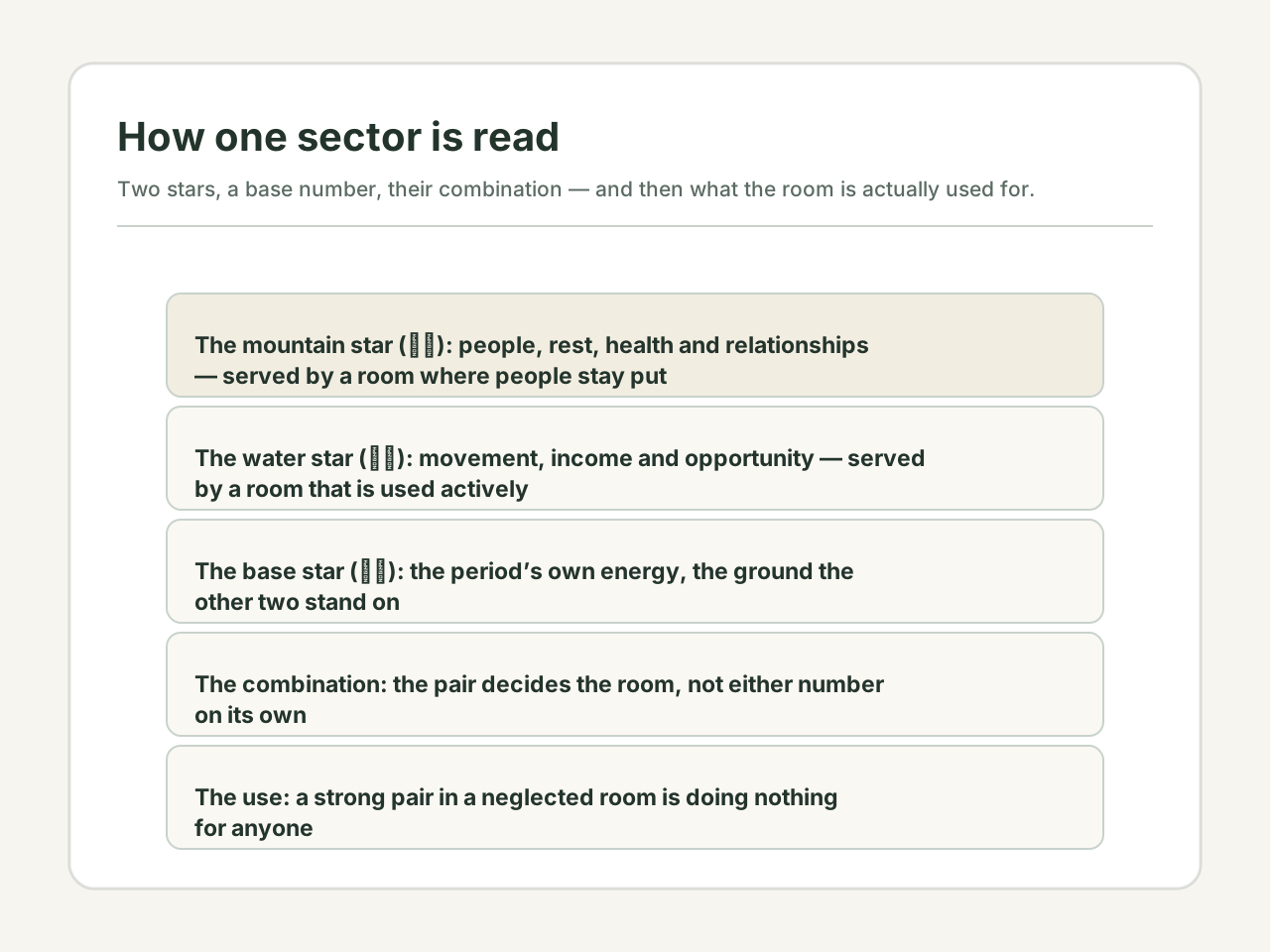
In a Flying Star chart, each sector has two key numbers: the mountain star (山星, left position) and the water star (水星, right position). Together they define the quality of energy in that sector, and their interaction is the heart of Xuan Kong analysis. The mountain star governs people — health, relationships, stability, and the quality of rest. The water star governs activity — wealth, career, opportunity, and the flow of resources.
The traditional image is a mountain behind a house and water in front of it. The mountain provides shelter, stability, and support. The water provides movement, circulation, and opportunity. A house with a solid mountain at its back and open water before it is the ideal. The mountain star and water star in each sector encode this same principle: every room needs the right balance of stillness (mountain) and activity (water) for its function.
What makes a good combination
A sector's quality depends on the mountain star and water star working together, not on either number in isolation. Here are the four basic patterns and what they mean:
| Pattern | Mountain star | Water star | What it means | Best use |
|---|---|---|---|---|
| Both favourable | High and timely (8, 9, 1) | High and timely (8, 9, 1) | The strongest combination — both people and activity energy are supported | Master bedroom, living room, home office, dining area |
| Mountain favourable, water weak | High and timely | Low or untimely (2, 3, 5, 7) | Good for people and rest, but the sector lacks activity energy | Bedroom, study, quiet reading corner |
| Water favourable, mountain weak | Low or untimely | High and timely | Good for activity and opportunity, but not ideal for prolonged rest | Entrance, hallway, staircase, active workspace |
| Both unfavourable | Low or untimely | Low or untimely | The most challenging combination — neither people nor activity energy is supported | Storage, bathroom, laundry, or any low-occupancy use |
The practical rule: match the room to the stars
The Flying Star chart does not tell you to move walls. It tells you which rooms are naturally suited to which activities. The practical rule is simple:
- A strong mountain star needs a room where people rest and recharge. The ideal is a bedroom with a solid headboard against a solid wall, quiet, and free of electronic clutter. The mountain star is supported by stillness, heaviness, and enclosure — exactly what a good bedroom provides.
- A strong water star needs a room where activity happens. The ideal is a living room, entrance, or home office — a space that is used actively, with movement, light, and people passing through. The water star is supported by activity, exactly what a busy living room provides.
- A sector with both stars favourable is the best room in the house. Use it for the activity that matters most to you — the master bedroom if you prioritise rest, the home office if you prioritise work, the living room if you prioritise family time.
- A sector with both stars unfavourable is not a disaster. Use it for storage, a bathroom, a laundry, or a guest room that is rarely occupied. The key is to avoid spending long periods of time in a sector with weak stars — the effect is cumulative, not immediate.
A worked example: the home with a reversed mountain-water pattern
A couple lives in a Period 8 home facing West. Their Flying Star chart shows an unusual pattern: the mountain star is strong in the front sectors (West, Northwest, North) and weak in the rear sectors (East, Southeast, South). The water star is the reverse — strong in the rear, weak in the front. This is called a 'reversed mountain-water' (上山下水) configuration, and it is traditionally considered one of the most problematic patterns.
The practical problem: the front of the house, where the entrance and living room are, has strong mountain energy but weak water energy. The front of the house is where activity should be, but the chart says the front is better suited to stillness. The rear of the house, where the bedrooms are, has strong water energy but weak mountain energy. The rear is where rest should be, but the chart says the rear is better suited to activity.
The couple's solution, developed with a feng shui consultant: they cannot move the rooms, but they can adjust how they use the spaces. The living room at the front gets a water feature — a small tabletop fountain — to activate the water energy that the chart says is weak there. The master bedroom at the rear gets heavy curtains, a solid wooden headboard, and a thick rug to create the sense of mountain stability that the chart says is weak there. They also keep the bedroom free of electronics, which add unwanted water (activity) energy.
The result: the home feels more balanced. The living room feels more alive. The bedroom feels more restful. The chart did not change, but the couple's response to it made the space work better. The reversed mountain-water pattern is a real challenge, but it is not a curse. It is a layout that requires more conscious effort to balance, and the effort is what makes the difference.
Mountain and water stars in xuan kong: what to expect, and what not to
Mountain and water stars are the analytical core of Xuan Kong feng shui. Understanding them gives you a vocabulary for why certain rooms feel the way they do — why one bedroom is deeply restful and another is restless, why one living room feels alive and another feels flat. But the stars describe tendencies, not certainties. A room with both stars favourable that is neglected, dirty, and filled with broken furniture will not feel good. A room with challenging stars that is loved, clean, and well-used can still be a pleasant space. The stars are one input into the complex equation of what makes a room feel right. Use them as a guide, not as a verdict.
Disclaimer: This content is for informational and cultural reference purposes only. It does not constitute professional medical, legal, financial, or psychological advice. Readers should exercise their own judgment and consult qualified professionals for specific concerns.
Sources and review basis
Traditional references explain historical vocabulary and context. Official practical sources support only the observable safety, comfort, or environmental points noted in the article; they do not validate metaphysical claims.
Traditional reference
Huangdi Zhaijing (黄帝宅经)Wikisource digital text · Accessed 2026-07-14
Historical context for traditional residential orientation and spatial vocabulary. Modern recommendations are reviewed separately.
Practical source
APA Dictionary of Psychology: Barnum effectAmerican Psychological Association · Accessed 2026-07-14
A psychology reference for why broad, favourable personality descriptions can feel personally accurate. It does not evaluate BaZi calculations themselves.