Room selection: a framework for when you have a choice
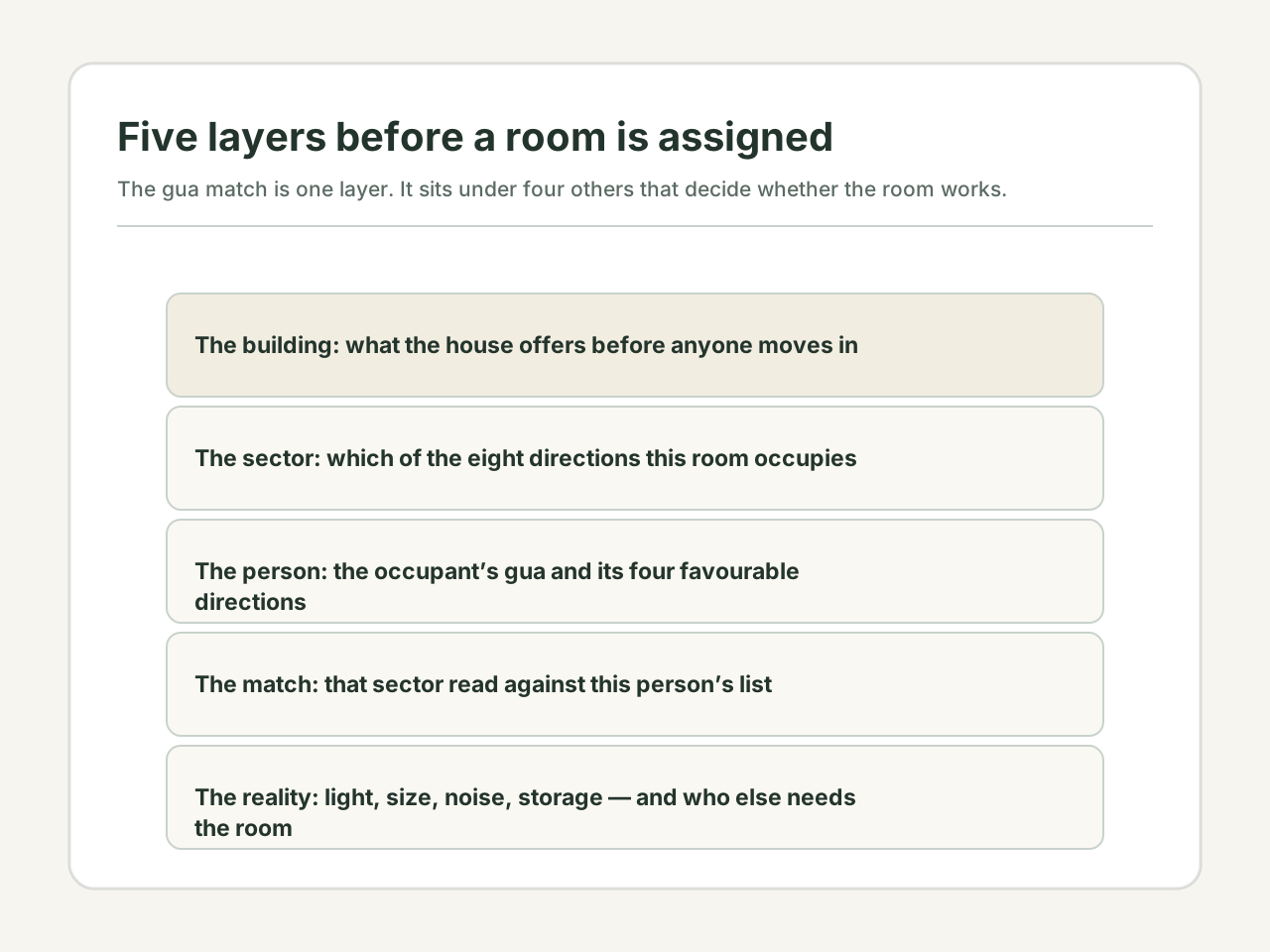
In Eight Mansions feng shui, the ideal room for a person is one located in a sector that matches their auspicious directions. If your Ming Gua is 1 (Kan, East Group), your best sectors are Southeast, East, South, and North. A bedroom in the Southeast sector of the house, for example, would be in your Sheng Qi (Success) direction — the best possible placement.
But most people do not choose their home based on Eight Mansions. The room selection question usually arises in two situations: you are moving to a new home and have a choice of rooms, or you are rearranging rooms within your current home. In both cases, Eight Mansions gives you a framework for making a decision. In all other cases — when you are already living in a room you cannot change — the framework shifts to optimisation within the room rather than room selection.
How to match a person to a room sector
The house is divided into nine sectors based on compass direction. Each sector has a direction, and each person has four auspicious directions. The goal is to place a person in a sector whose direction is one of their auspicious directions, with the strongest match being the best:
| Sector direction | Its role in Eight Mansions | Best for someone whose Ming Gua has this direction as... | Effect on the person |
|---|---|---|---|
| Sheng Qi (生气) sector | Success and vitality | Sheng Qi direction | Strongest positive effect — supports energy, motivation, and general wellbeing |
| Tian Yi (天医) sector | Health and recovery | Tian Yi direction | Strong positive effect — supports physical health and restful sleep |
| Yan Nian (延年) sector | Relationships and harmony | Yan Nian direction | Moderate positive effect — supports relationship harmony and family unity |
| Fu Wei (伏位) sector | Stability and calm | Fu Wei direction | Mild positive effect — supports calm and stability, good for sensitive people |
| Neutral sector | Neither auspicious nor inauspicious | Neither auspicious nor inauspicious | No strong effect either way — the room is usable but does not provide directional support |
| Inauspicious sector | Challenging | One of the four inauspicious directions | Potentially draining — best avoided for bedrooms, but manageable with good bed orientation inside the room |
What to do when you cannot choose the room
Most people live in homes where room selection is not a choice — the bedrooms are already assigned. In these cases, you work with the room you have by optimising the inside:
- Orient the bed toward your best available auspicious direction within the room. Even if the room itself is in an inauspicious sector, the direction you face while sleeping is the more important factor. The bed direction is said to have a stronger effect than the room sector.
- Orient the desk toward your Sheng Qi direction if you work in the room. The direction you face while working is the second most important factor after the bed direction.
- Use the room's door direction as a secondary indicator. The direction the room's door faces (the direction you face when entering the room) is less important than the bed direction, but it is worth noting. If the door faces an inauspicious direction, keep the door closed when you are inside the room.
- Do not let an unfavourable room sector create anxiety. The effect of a room sector is subtle and cumulative. It is one input among many. A well-maintained, comfortable room in an inauspicious sector is better than a neglected room in an auspicious sector.
A worked example: a family of four in a three-bedroom house
A family of four — parents and two children — lives in a Period 8 house. The house has three bedrooms: one in the East sector, one in the Southeast sector, and one in the Northwest sector. The parents' Ming Gua numbers: father is Gua 6 (Qian, West Group), mother is Gua 4 (Xun, East Group). The children: son is Gua 1 (Kan, East Group), daughter is Gua 8 (Gen, West Group).
The East sector is the Sheng Qi direction for the mother (Gua 4) and an auspicious direction for the son (Gua 1). The Southeast sector is the Sheng Qi direction for the son and an auspicious direction for the mother. The Northwest sector is the Sheng Qi for the father (Gua 6) and an auspicious direction for the daughter (Gua 8).
The family's decision: they have three bedrooms and four people. The parents share the master bedroom. They choose the Northwest bedroom (Sheng Qi for the father, and the daughter's West Group direction is compatible with the Northwest). The son gets the Southeast bedroom (his Sheng Qi, the strongest match). The daughter, who does not have a bedroom of her own, shares with the parents — but they orient her bed within the master bedroom to face her Tian Yi direction (Southwest).
The family's assignment is not perfect — the daughter does not have her own room in her best sector — but it is the best use of the available rooms. The father and son both get their strongest sectors. The mother gets a compatible sector (Northwest is neutral for her, not one of her inauspicious directions). The daughter gets a bed orientation that compensates for not having her own room. This is real Eight Mansions: optimisation within constraints, not ideal placement.
Use personal Gua when you are moving, not as a daily rule
Room selection by personal Gua is a useful framework when you have a choice of rooms. It gives you a systematic way to think about who should sleep where. But for most people, room selection is a once-every-few-years decision at best. The more practical skill is learning to optimise the room you are already in, regardless of its sector. The bed direction, the bed position, the quality of light, the level of noise, and the comfort of the mattress all matter more than which sector of the house the room is in. Use Eight Mansions room selection when you are moving or rearranging. The rest of the time, focus on making the room you have as comfortable as possible.
Disclaimer: This content is for informational and cultural reference purposes only. It does not constitute professional medical, legal, financial, or psychological advice. Readers should exercise their own judgment and consult qualified professionals for specific concerns.
Sources and review basis
Traditional references explain historical vocabulary and context. Official practical sources support only the observable safety, comfort, or environmental points noted in the article; they do not validate metaphysical claims.
Traditional reference
Huangdi Zhaijing (黄帝宅经)Wikisource digital text · Accessed 2026-07-14
Historical context for traditional residential orientation and spatial vocabulary. Modern recommendations are reviewed separately.
Practical source
CCOHS: Lighting ErgonomicsCanadian Centre for Occupational Health and Safety · Accessed 2026-10-14
Summarises lighting levels, glare, and contrast guidance for indoor work, reading, and circulation areas.