The twelve palaces map life domains onto the face
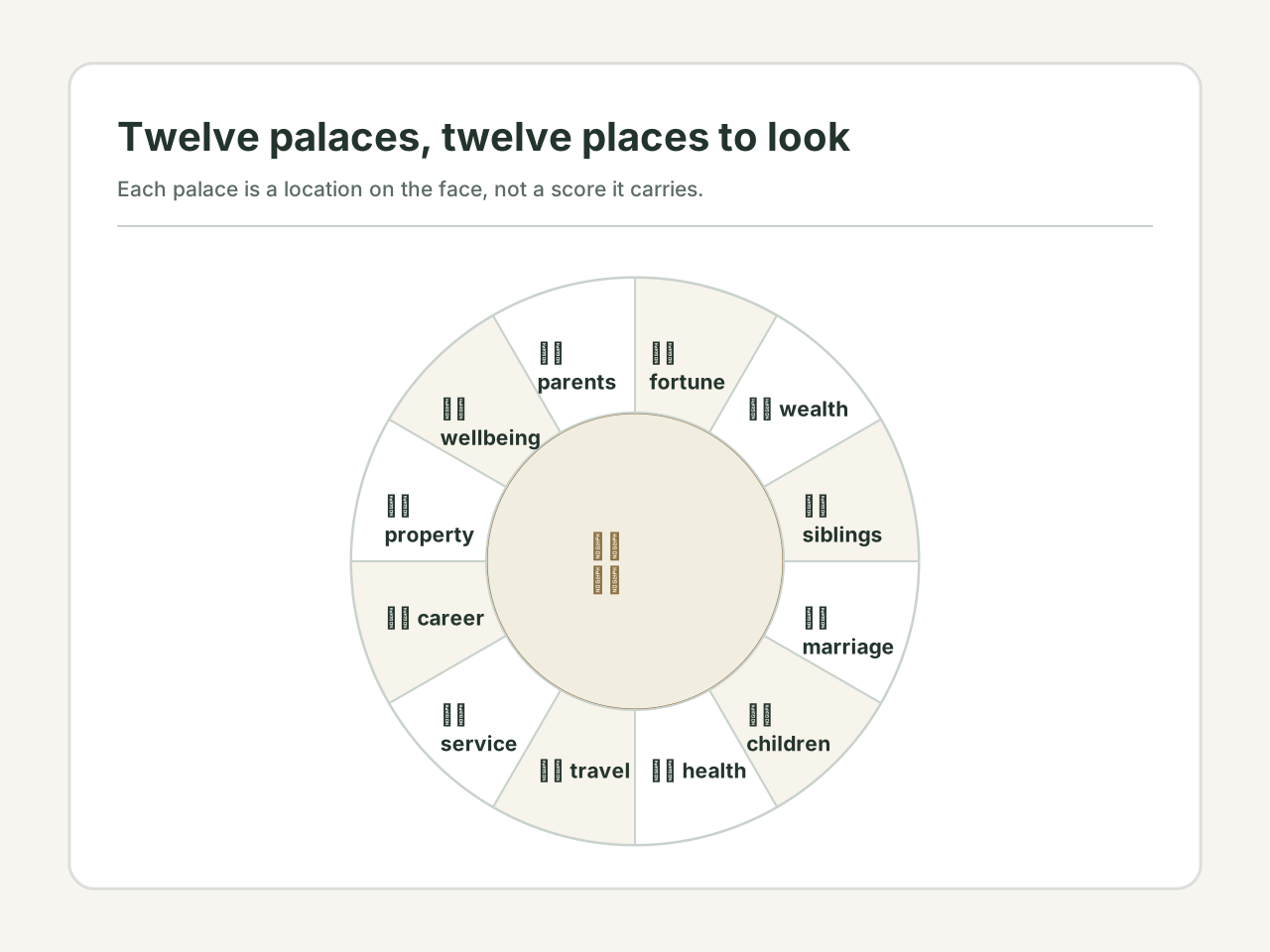
The twelve palaces (Shi Er Gong, 十二宫) are a detailed system within Chinese face reading that maps specific life domains to specific areas of the face. Each palace corresponds to an aspect of life — career, wealth, relationships, health, travel, and more. The system is similar to the twelve houses in Zi Wei Dou Shu astrology, and the two systems are often used together.
The honest view: the twelve palaces are a detailed framework for analysing different life areas through facial features. They are not a prediction system. A person with a 'good' Career Palace is not guaranteed career success. A person with a 'poor' Relationship Palace is not doomed to bad relationships. The palaces describe tendencies and potentials. They are useful for identifying which areas of life may come naturally and which may require more effort.
The twelve palaces and their locations
Here is a breakdown of the twelve palaces:
| Palace | Location on face | Life domain | What it indicates | Signs of quality |
|---|---|---|---|---|
| Life (命宫) | Between the eyebrows (Yin Tang area) | Overall life quality, fortune, general wellbeing | This is the most important palace. It represents your overall life direction and quality | Smooth, open, and unlined. No furrow between brows. Bright and clear skin. Suggests general good fortune and a smooth life path |
| Wealth (财帛宫) | The nose | Financial situation, earning ability, relationship with money | The nose is the wealth indicator. Its size, shape, and position indicate financial tendencies | Straight, well-proportioned nose with a rounded tip. Good bridge height. Suggests steady financial ability and good money management |
| Siblings (兄弟宫) | The eyebrows | Relationship with siblings, peers, colleagues | The eyebrows indicate relationships with equals — siblings, friends, and colleagues | Thick, well-shaped, and even eyebrows. Suggests good relationships with siblings and peers, supportive social network |
| Marriage (夫妻宫) | The outer corners of the eyes (tail area) | Marriage, romantic relationships, partnership | This area indicates the quality and stability of romantic partnerships | Smooth, unlined, and slightly raised. Clear skin. Suggests harmonious relationships and stable marriage |
| Children (子女宫) | Below the eyes (the eye bags area) | Children, creativity, legacy, nurturing | This area relates to children, but also to creative output and what you leave behind | Full, slightly raised, and pinkish. Suggests good relationships with children and creative fulfilment |
| Health (疾厄宫) | The bridge of the nose (between the eyes) | Physical health, vitality, resilience | This area indicates overall health tendencies and physical resilience | Smooth, straight, and unmarked. No discolouration. Suggests good health and strong constitution |
| Travel (迁移宫) | The temples (sides of forehead) | Travel, relocation, adaptability, life changes | This area indicates your relationship with change, travel, and new environments | Full, slightly raised, and smooth. Suggests adaptability and positive experiences with travel and change |
| Servants (奴仆宫) | The area below the corners of the mouth | Relationships with subordinates, service providers, helpers | This area indicates how you relate to people who work for or with you | Full and firm. Suggests good relationships with subordinates and helpful people in your life |
| Career (官禄宫) | The centre of the forehead | Career, profession, public life, reputation | This area indicates your career path, public standing, and professional reputation | Broad, smooth, and well-proportioned. Suggests career achievement and good professional reputation |
| Property (田宅宫) | The upper eyelids | Property, home, real estate, living environment | This area indicates your relationship with property and your living environment | Full, firm, and well-defined. Suggests stable living situation and property ownership |
| Fortune (福德宫) | The area above the eyebrows (forehead sides) | Happiness, contentment, spiritual wellbeing | This area indicates your capacity for happiness and contentment | Full, smooth, and slightly raised. Suggests a generally content and positive disposition |
| Parents (父母宫) | The forehead corners (above the temples) | Relationship with parents, elders, authority figures | This area indicates your relationship with parents and authority figures | Full, smooth, and well-proportioned. Suggests good relationship with parents and positive early guidance |
Three rules for using the twelve palaces
Here is how to use the twelve palaces framework practically:
- Read the palaces as a system, not in isolation. The twelve palaces are interconnected. A strong Career Palace (forehead) with a weak Wealth Palace (nose) suggests a person who achieves professionally but may not accumulate wealth. A strong Marriage Palace (eye corners) with a weak Children Palace (eye bags) suggests a happy marriage but possible challenges with children. Always read the palaces in relationship to each other.
- Focus on the palaces that matter to you. Not all twelve palaces are equally relevant to everyone. If you are not planning to have children, the Children Palace is less important. If you are focused on career, the Career and Wealth Palaces matter more. The twelve palaces are a menu of life areas, not a checklist. Focus on the areas that are relevant to your life.
- The palaces describe tendencies, not guarantees. A person with a 'weak' Wealth Palace is not destined to be poor. They may need to be more intentional about financial management. A person with a 'strong' Marriage Palace is not guaranteed a perfect marriage. They may have a natural tendency toward harmonious relationships, but they still need to work at their marriage. The palaces describe potential, not predestination.
A worked example: reading the twelve palaces
A woman is curious about her face reading. She has a strong Career Palace (broad, smooth forehead), a modest Wealth Palace (small nose), and a strong Marriage Palace (smooth, unlined eye corners).
The traditional reading: she will have a successful career, modest finances, and a happy marriage. But the nuanced reading: her strong Career Palace with a modest Wealth Palace suggests she is career-driven but not money-driven. She achieves professionally but does not prioritise wealth accumulation. She may choose meaningful work over high-paying work. Her strong Marriage Palace suggests she has a natural ability for harmonious relationships. Combined with her career orientation, she likely has a supportive partner who complements her professional drive.
The point: the twelve palaces tell a story about a person's life pattern. The story is in the relationship between the palaces, not in any single palace. The reading should always be grounded in the person's actual life and priorities.
A realistic view of twelve palaces of the face
The twelve palaces are a detailed traditional framework for analysing life areas through facial features. They are not a scientific system. They cannot predict your life outcomes. They offer a way of thinking about different life domains, but they should not be used to make important decisions. The best use of the twelve palaces is as a tool for self-reflection — understanding which areas of life may come naturally and which may require more effort. The actual course of your life is determined by your choices, not by the shape of your face.
Disclaimer: This content is for informational and cultural reference purposes only. It does not constitute professional medical, legal, financial, or psychological advice. Readers should exercise their own judgment and consult qualified professionals for specific concerns.
Sources and review basis
Traditional references explain historical vocabulary and context. Official practical sources support only the observable safety, comfort, or environmental points noted in the article; they do not validate metaphysical claims.
Traditional reference
Huangdi Zhaijing (黄帝宅经)Wikisource digital text · Accessed 2026-07-14
Historical context for traditional residential orientation and spatial vocabulary. Modern recommendations are judged against real conditions.
Practical source
APA Dictionary of Psychology: Barnum effectAmerican Psychological Association · Accessed 2026-07-14
A psychology reference for why broad, favourable personality descriptions can feel personally accurate. It does not evaluate BaZi calculations themselves.